


 Česky (CZK)
 Slovensky (EUR)
 Deutsch (EUR)
 Austria
 Belgium
 Bulgaria
 Croatia
 Denmark
 Estonia
 Finland
 France
 Germany
 Greece
 Hungary
 Italy
Italy Latvia
 Lithuania
 Luxembourg
 Netherlands
 Poland
 Portugal
 Romania
 Slovenia
 Spain
Spain Sweden










Singaporean street food: how to understand it through hawker culture, iconic dishes, and flavor logic
Singaporean street food is not just "fast food from the street." It is an urban system of dining and cooking that grew out of the multicultural environment of a port city – and it is best understood through hawker centers, specialized stalls, and several iconic dishes. In the article, we will clarify what is typical for Singapore, why Chinese, Malay, Indian, and Peranakan influences meet here, and how to take a practical guide from it: what to taste first and how to tackle Singaporean flavors at home without unnecessary mistakes.
Why Singaporean street food is more than just "street food"
Singaporean cuisine is not a single "national cuisine" in the classic sense. It is an urban, port, and multicultural cuisine formed from the meeting of Chinese, Malay, Indian, Peranakan, Eurasian, and other influences. And street food (in the Singaporean context very often associated with hawker culture) is the place where this mix is most visible and most readable in practice.
For the reader, this is important for one simple reason: if you perceive Singaporean food only as a "set of borrowed recipes," you will miss what holds it together. Singaporean street food is mainly about daily availability of food outside the home, speed, specialization of individual stalls, and community dining (shared dining) – and only then about individual dishes.
🌶️ What hawker centers are and why they are the heart of Singaporean food
In many parts of Asia, regional style is inseparable from city life and street food – and for Singapore, this is doubly true. Hawker culture is not just "cheap snacks." It is a cultural system that:
- concentrates local specialties in one place,
- preserves and stabilizes urban versions of traditional dishes,
- supports specialization (one stall often makes a narrow type of dishes, but long-term and well),
- makes food a part of the everyday rhythm across social strata.
Practically, this means that "Singaporean street food" is often not described by one universal cooking style. It is more of a mosaic: noodle soups, rice dishes, coconut and chili bases, soy and fish seasonings, herbs and dips – and various cultural branches side by side that have long functioned and influenced each other in one city.
Multicultural map on a plate: why Singapore tastes "hybrid," but has its own identity
Singaporean cuisine is based on the historical meeting of several major streams: Chinese communities and their regional cuisines, Malay (and broader island) traditions, Indian (especially South Indian) influences, Peranakan cuisine on the border between Chinese and Malay worlds, and colonial as well as commercial environment.
An important detail: the result is not just "cuisines side by side." In the Singaporean environment, dishes that were born directly from the blending of these traditions also came into being. Therefore, it makes sense to read Singapore as a culinary laboratory – not as a random mix, but as an urban whole with its own stable identity.
Three iconic dishes by which you quickly understand Singaporean street food
There are more strong dishes in the Singaporean street food environment, but for basic orientation, it pays to stick to three icons that also nicely show how Singapore works culturally and flavor-wise.
Hainanese chicken rice: why it is not "just chicken with rice"
Chicken rice is among the most famous Singaporean dishes and is often spoken of as one of the "national" dishes. The key is that it is not just meat and a side dish. Important are techniques and textures: fragrant rice cooked in chicken broth and fat, the correct texture of the chicken, and chili dip as part of the whole.
The dish is mainly linked to the Hainanese tradition, but development in the local environment brought other influences (including Cantonese techniques and local details). In practice: if chicken rice seems "simple" to you, usually you are not reading where the work is hidden – precisely in the rice, juiciness, and accompanying elements.
Laksa: noodle soup as a shortcut to understanding Singaporean multiculturalism
Laksa is a great example of how several worlds meet in Singapore. In the Singaporean environment, it is primarily about a noodle soup dish with coconut milk, seafood or fish components, aromatic paste, and rice noodles. It is strongly connected to the Peranakan tradition and to a combination of Chinese and Malay influences.
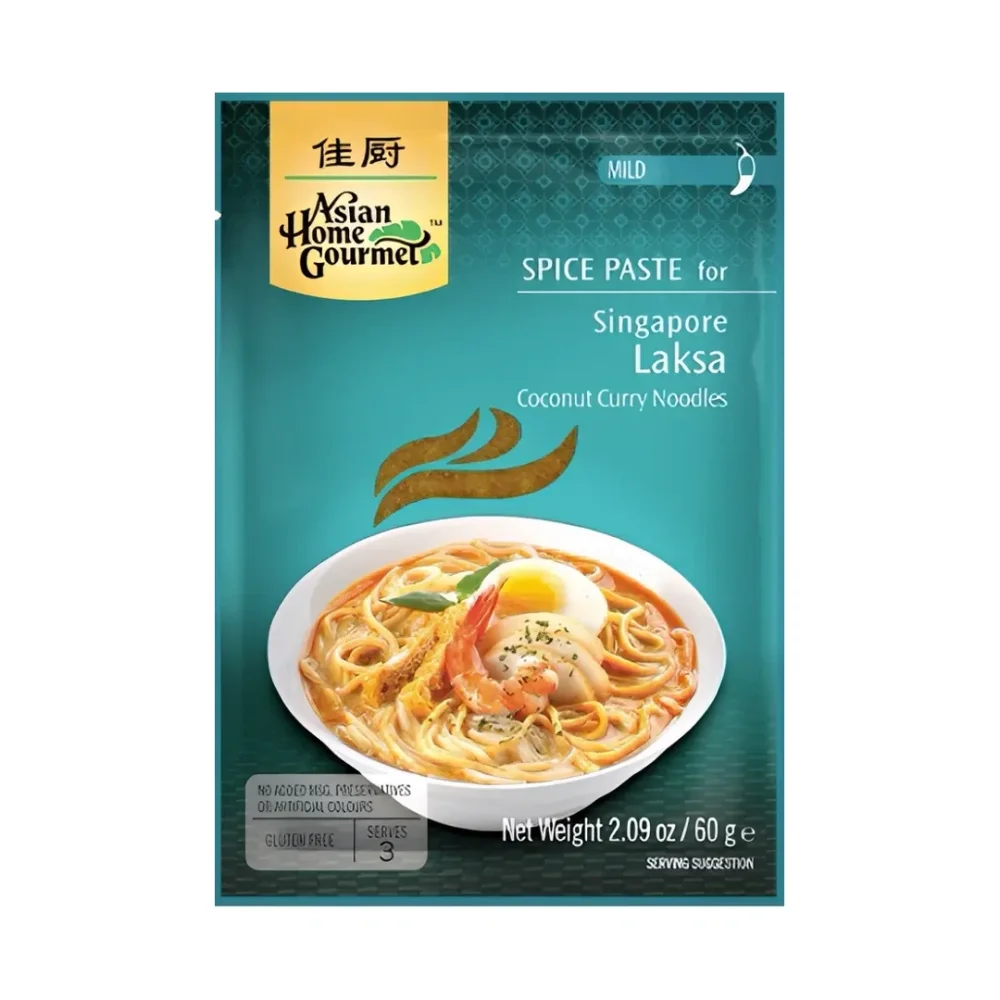
For starting at home, laksa is practical because part of the flavor relies on a well-built base. If you want a safe first step, you can use a ready paste that gives the dish direction and then focus only on properly "building" the soup. An example is AHG pasta for coconut curry noodle Laksa 60 g – for laksa-type dishes it typically makes sense to work with coconut milk (see below in the practical section).
Chilli crab: iconic seafood specialty (and why not to reduce it to "crab" only)
Chilli crab is an iconic Singaporean dish, often mentioned as the national seafood specialty. The important thing is that it is not defined only by the ingredient (crab) – the logic of the sauce and overall "style" of serving is also essential. If you want to take a lesson for orientation in street food: in Singapore, it is often not about one dominant ingredient, but about a precisely recognizable whole, which gives the dish its identity.
Island flavor axis: Singapore vs. Indonesia vs. the Philippines (why "street food" doesn’t mean the same everywhere)
Asia is not one cuisine – and this is especially true for street food, because urban style is often "concentrated" and distinctive. For Singaporean street food to make sense, it is useful to compare it within the island and port Southeast Asian space: Singapore, Indonesia, and the Philippines (and generally the Malaysian area). It is not about who is "better," but about how flavor logic differs.
Singapore: noodles, rice, coconut, herbs, chili, and soy and fish seasonings
Singapore is typical for a strong connection of multiple traditions, emphasis on accessibility and speed, and also that many dishes have a clear identity even though they were created hybr idly. In flavor, you often encounter rice and noodles, coconut milk, herbs, chili, and also soy and fish seasonings.
Indonesia: sambal as the everyday engine and distinctive pastes
Indonesian cuisine is very broad and regionally diverse, but for practical orientation, certain pillars repeat: rice as a base, frequent use of coconut and coconut milk, strong work with aromatic pastes, and especially sambal – a broad family of chili dips, sauces, and pastes that can be fresh, cooked, or fermented.
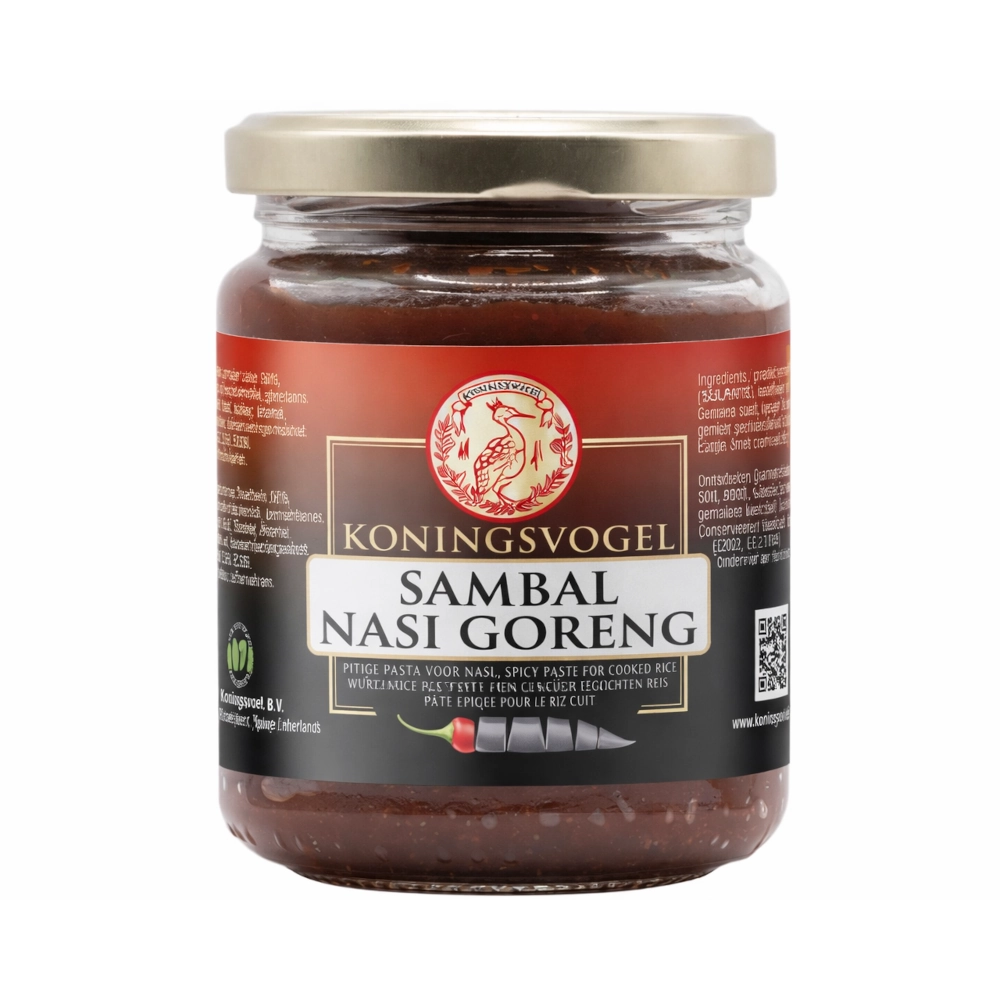
If you are used to spiciness being "just chili," Indonesian logic will surprise you: sambal can carry not only heat but also saltiness, umami, or acidity, and serves as a table seasoning as well as a base for dishes. For a quick home demonstration of this logic, for example, Koningsvogel chili paste Nasi Goreng 260 g is a good example of how Indonesian style often builds on a strong flavor base that then "carries" rice, eggs, meat, or vegetables.
Philippines: acidity, vinegar, and saltiness as the flavor axis
Filipino cuisine (like Indonesian) is not just one dish. Practically, however, you often recognize it by its emphasis on acidity and saltiness – and by common use of vinegar along with soy and fish seasonings. It is a different “pull” than in many Singaporean dishes: instead of coconut creaminess (laksa) or precise rice base (chicken rice), here the flavor axis built on acidity often takes the lead.
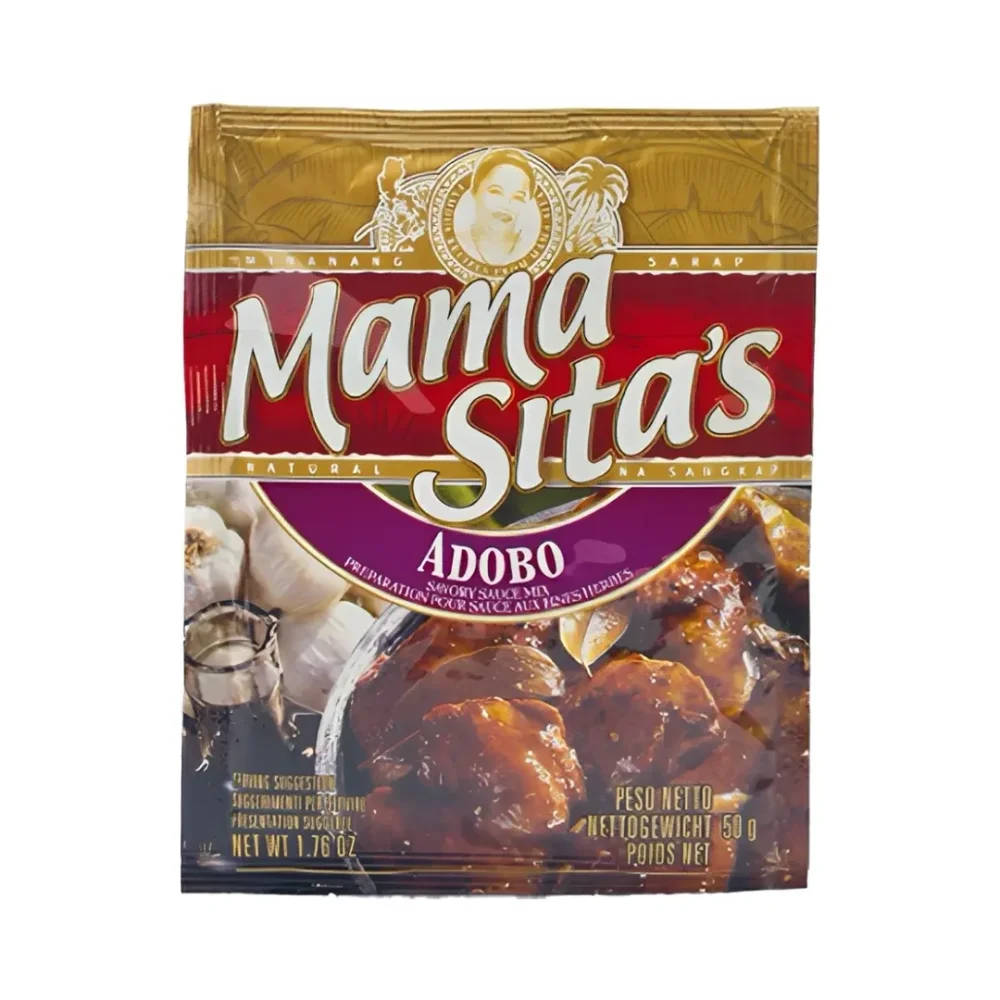
As an accessible entry for home cooking, an adobo mix can work well (adobo in the Filipino context is associated with cooking in a vinegar base and saltiness). If you want to understand this direction without complicated tuning from scratch, there is, for example, Mama Sita's Adobo sauce mix 50 g. Take it mainly as a flavor logic tasting of the Philippines: acidity is not a "complement" but one of the main pillars.
How to start at home: a simple onboarding to Singaporean street food (without cooking "blindly")
Singaporean street food is best learned at home as dish construction, not as a chase for one "mysterious spice." Below are steps that work as practical guidance – including what to watch out for and how to help yourself with ready-made bases if you are just starting.
1) Start with two directions: the coconut noodle world and the rice world
- The coconut noodle world (laksa): the goal is a creamy coconut soup with aromatic paste and noodles. In practice, it's good to watch that the coconut does not "flatten" the dish – the flavor should also have aromatic and chili components. To start, you can help yourself with laksa paste and solve the coconut component by choosing coconut milk.
- The rice world: for Singaporean chicken rice, it is important that the rice is cooked so that it is itself a bearer of flavor. Even if you do not immediately build the whole "authentic" chicken rice at home, take the principle: in the Singaporean context, rice is often not a neutral side dish but part of the recipe.
2) Take coconut milk as an ingredient with a function (not as a universal "softener")
In dishes like laksa, coconut milk is one of the pillars of texture and fullness. Practically, it pays to follow a simple rule: add it gradually and taste so that coconut does not overpower the aromatic paste and chili. If you want to explore different types of coconut milk, a good guide is the category Coconut Milk.
Tip for the first try: if laksa at home seems "too heavy," often reducing salt doesn't help but rather returning aromatic sharpness (more paste) or balancing with chili. Conversely, if it is "too spicy," do not just overpower it with coconut – rather try to reduce the paste next time and add coconut only to the degree where the flavor is still readable.
3) Learn to work with spiciness as a separate component (sambal and chili pastes)
In island Southeast Asia, spiciness is often dealt with as a separate table seasoning or as a separate base, not just "a pinch of chili in everything." If you want to test spiciness at home in a controlled way, it makes sense to have chili paste/sambal as an optional addition that each person adds according to their taste. As a guide to different styles of spicy pastes, the category Sambal and chili pastesserves.
4) Nasi lemak as a practical shortcut to "coconut rice" (and to the port space)
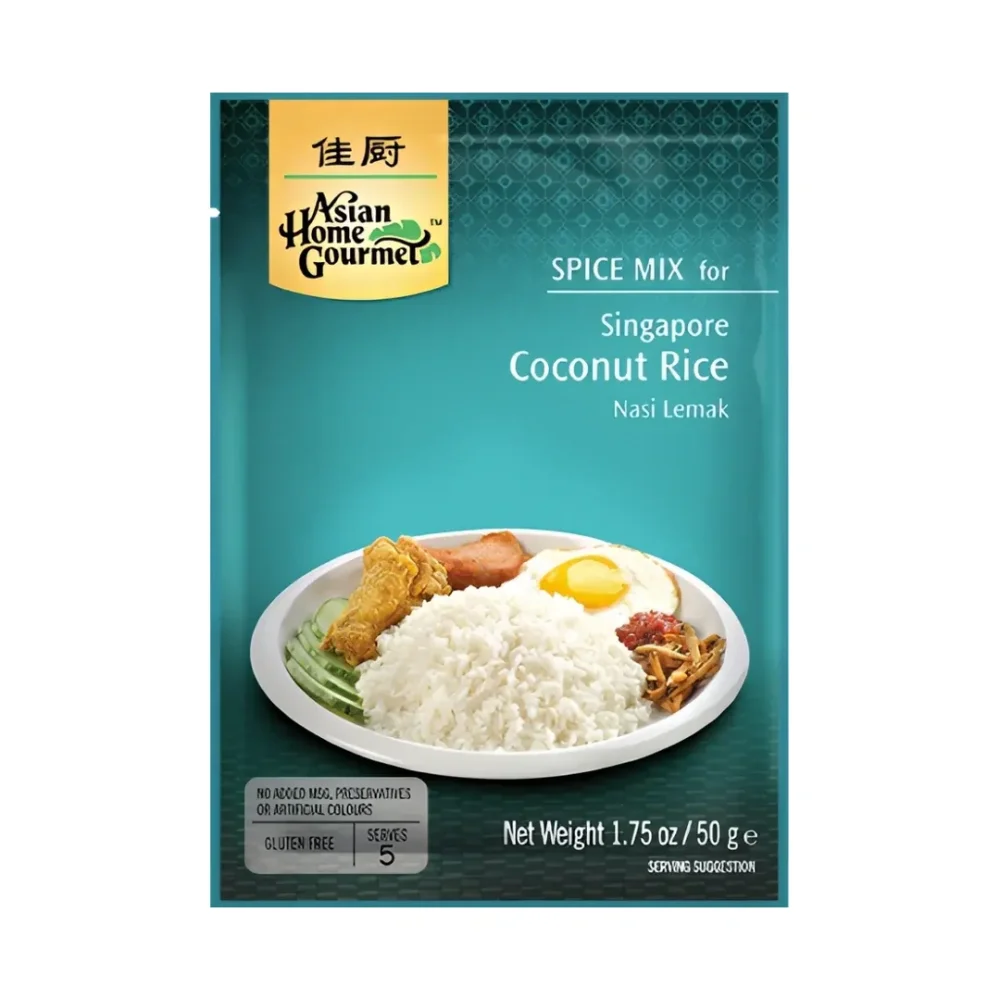
For the island and port Southeast Asian space, it is typical that coconut appears not only in soups but also in rice bases. If you want to quickly understand at home how rice can carry a coconut flavor, you can try a ready seasoning base for coconut rice – for example, AHG paste for coconut rice Nasi Lemak 50 g. Take it as "training" of the principle: rice is not an empty side dish but an active part of the flavor.
How not to mess it up: if rice tastes flat, typically the problem is that it lacks a clear flavor direction (aromatic) or contrast (for example, a spicy complement). If it is over-seasoned, do not add more seasonings "out of habit" – first taste what is already in the base, and only then adjust.
💡 Most common mistakes and what to watch out for
- "Singaporean cuisine is just a collection of borrowed dishes." No. It emerged from multiple influences but created its own stable urban identity. Instead of asking "where it is from," it often pays to ask "how it works as a whole in Singapore."
- "Hawker food is just cheap street food." No. Hawker culture is a system based on expertise, specialization, and community dining – and it is one of the reasons why Singaporean dishes are so clearly recognizable.
- "Chicken rice is just chicken with rice." No. In the Singaporean context, it is a set of techniques, textures, and accompanying components. If it tastes "boring," usually the main thing is missing: fragrant rice and proper work with dip/seasoning.
- "Laksa is one universal dish throughout Southeast Asia." No. There are various regional and local laksas, and the Singaporean version has its specific place (among other things, linked to the Peranakan environment and coconut logic).
- "Singapore is culinarily just Chinese." No. Malay, Indian, Peranakan, and other heritages are essential for Singaporean street food – and street food is the place where this is clearly visible.
What to take away from the article
- Singaporean street food makes the most sense as hawker culture: specialization, speed, and everyday food outside the home.
- Singapore is a multicultural urban cuisine – not a random mix, but a stable whole with its own identity.
- For quick orientation, remember three shortcuts: chicken rice (technique and texture), laksa (coconut noodles and Peranakan mixing) and chilli crab (an iconic dish defined by its whole style, not just the ingredient).
- Within island Southeast Asia, it pays to notice differences: Indonesia often stands on sambal and distinctive pastes, Philippines on an axis of acidity (vinegar) and saltiness, while Singapore often links rice/noodles, coconut, herbs, chili, and soy and fish seasonings.
- For a home start, the best approach works as "dish construction": coconut noodle direction (laksa) + rice direction (fragrant rice / coconut rice) + spiciness as an optional component.

Read next
If you want to explore this topic further, continue with these related blog guides and articles:
