


 Česky (CZK)
 Slovensky (EUR)
 Deutsch (EUR)
 Austria
 Belgium
 Bulgaria
 Croatia
 Denmark
 Estonia
 Finland
 France
 Germany
 Greece
 Hungary
 Italy
Italy Latvia
 Lithuania
 Luxembourg
 Netherlands
 Poland
 Portugal
 Romania
 Slovenia
 Spain
Spain Sweden










Typical Singaporean dishes: what to taste and how to understand them
Singaporean cuisine is not a "single national cuisine" in the traditional sense. It is an urban, port, and multicultural gastronomy that arose from the meeting of Chinese, Malay, Indian, Peranakan, and other influences – and is best understood through specific dishes and the environment where they are eaten every day. This guide features iconic Singaporean dishes, explanations of what makes them typical, and practical tips on how to approach them at home without unnecessary mistakes.
Singapore as a culinary crossroads: what "typical" means in practice
With Singapore, it is useful to adjust expectations: "typical" often does not mean isolated development food, but rather a locally settled specialty, which arose in the environment of the port, trade, migration, colonial ties, and daily contact of different communities.
That’s why Singaporean food often combines several things at once: emphasis on availability, speed, and specialization (one stall = one dish perfected to the detail), a strong role of rice and noodles, and also that the final flavor is often completed by sauce, broth, or table dip. The result is dishes with a clear identity – even though they are hybrid in the background.
Island Southeast Asia: where Singapore lies on the axis
For better orientation, it helps to think of Singapore in the broader "island and port" context of Southeast Asia. Here it becomes clear why Singapore so strongly relies on a mix of influences: in this axis, Indonesia (the world of sambal, sweet soy sauce kecap manis, coconut, and tempeh), the Philippines (the world of vinegar, sourness, adobo, and calamansi), and Malaysia with Singapore (the world of nasi lemak, laksa, sambal, and the Hawker mix of influences) are often mentioned. It’s not that these tastes are the same – quite the opposite: they help to understand why Singaporean "typical" often arises at the intersection.
Hawker centres: the place where Singaporean food makes sense
Without hawker culture Singaporean cuisine is only half described. Hawker centres are not just "food courts" – they function as social spaces where people from different communities meet and where food is truly lived every day.
In practice, this mainly means:
- professional preparation of affordable food (quickly, efficiently, but with high standards for consistency),
- strong specialization of individual stalls,
- shared dining across groups,
- multicultural offering in one space,
- natural connection of everyday life, tradition, and local identity.
It’s also important that hawker centres build on an older street-food tradition, but in the Singaporean context they have become a stable and publicly known "community canteen" – a place where local cuisine is shaped and maintained.
Three iconic dishes that define Singaporean street food
If you want to "taste Singapore" at the first try, there are three dishes that excellently explain how Singaporean cuisine works: working with rice, working with broth and paste, and an iconic dish defined by sauce as much as the main ingredient.
Hainanese chicken rice: why it’s not just chicken with rice
Hainanese chicken rice (often shortened to "chicken rice") is one of the most famous Singaporean dishes and is considered one of the "national" dishes. The key is that it’s not just a simple plate of chicken with a side dish.
What makes chicken rice chicken rice:
- fragrant rice cooked in chicken broth and fat (the rice is not a side dish but the core),
- correct chicken texture (not "lean and dry"),
- chilli dipthat finishes the entire flavor logic.
The dish is mainly linked to the Hainanese tradition, but the development in the local environment brought other influences (including Cantonese techniques and local details). The simple rule for home orientation is: when you want good "Singaporean chicken with rice" focus equally on the rice and dip as on the chicken.
Laksa: a multicultural bowl that only makes sense as a whole
Laksa is one of the best dishes to explain Singaporean multiculturalism. In the Singaporean context, it is primarily a soup noodle dishwhere the following work together:
- coconut milk (creaminess and fullness),
- seafood or fish components (type of umami),
- aromatic paste (character of the bowl),
- rice noodles (texture and “body” of the dish).
Laksa is strongly connected to the Peranakan tradition and the combination of Chinese and Malay influences. From a flavor perspective, it’s important to perceive it not as "curry soup" but as a balanced whole where broth/soup base and noodles support each other.
Chilli crab: a seafood icon defined by sauce
Chilli crab is an iconic Singaporean dish often called the national seafood specialty. The essential point is that it is not defined only by "crab as an ingredient" – the character of the dish is given above all by a distinctive sauce (and how the dish is eaten and seasoned with it).
For tasting orientation, it is useful to realize one thing: with chilli crab, the "typical" is precisely that the taste and experience are based on the relationship between the main ingredient and the sauce – similarly to many other Singaporean dishes where everything is based on the relationship between rice/noodles and a liquid or paste component.
Other important worlds of Singaporean food (useful detours)
Besides the most famous trio, it is good to know other categories that you often encounter in the Singaporean environment. Not all need to be detailed in one article, but as a "name map" they are important – they help read menus and understand how broad the hawker offer is.
- Char kway teow – a representative of quick wok-fried/rested noodle dishes.
- Bak kut teh
- Roti prata
- Fish head curry
- Carrot cake
- Popiah
- Yong tau foo
- Mee rebus
- Mee siam
- Oyster omelette
- Hokkien mee
- Kaya and kopitiam culture
- Peranakan curries and kueh
As a practical guide: when you want a quick pan, look for wok noodles (this typically includes the mentioned char kway teow). When you want a “bowl” that is based on a liquid base, look for noodle soups and broth bowls – and use laksa as a reference point.
How to assemble Singaporean flavors at home: rice, noodles, coconut, chilli
Singaporean cuisine is best learned at home not by trying "everything at once," but by selecting one rice pillar, one noodle bowl and one chilli elementthat you dose carefully. Practically, this often means: rice + broth/sauce + dip.
1) Start with a dish where the logic is clear
- Chicken rice: focus on making the rice aromatic and having "flavor on its own" (cooking in broth and fat is a principle that makes a fundamental difference). And don’t underestimate the chilli dip – without it, the result is usually flat.
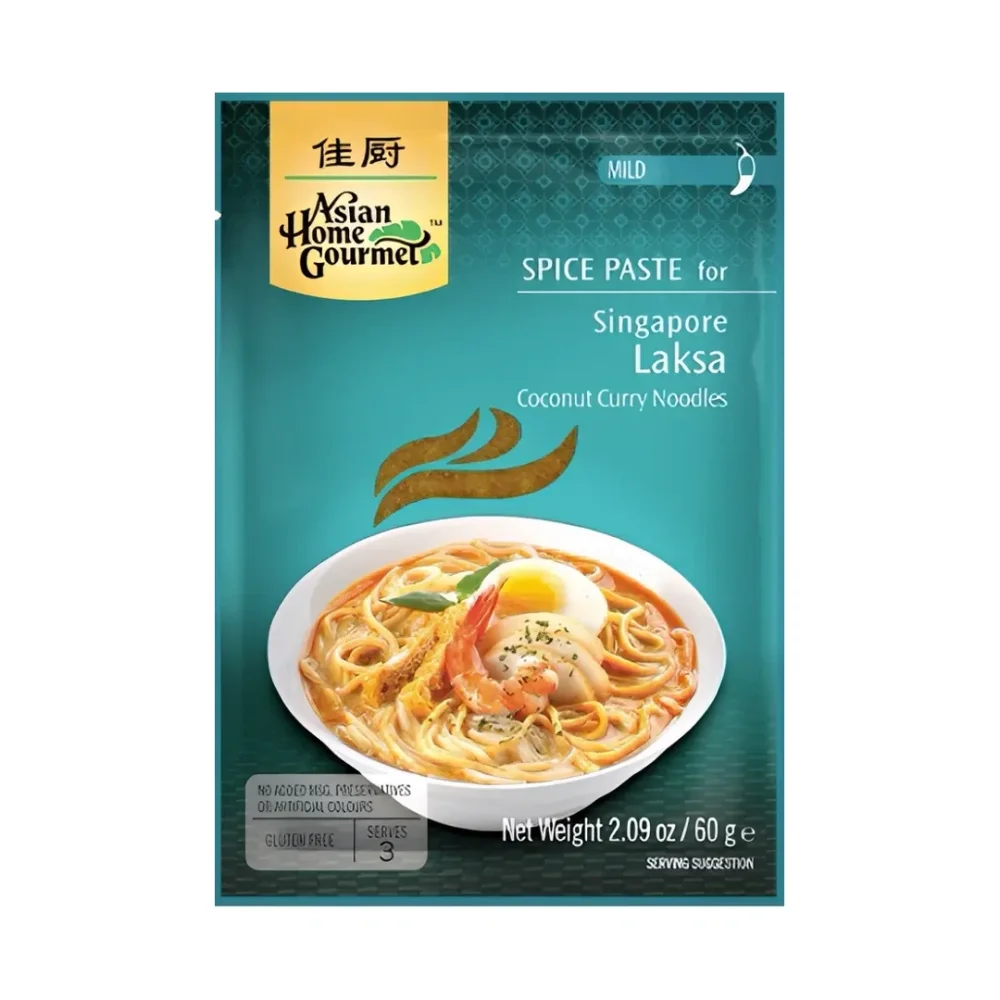
- Laksa: think of it as a noodle soup bowl, where broth carries the noodles and noodles hold the broth. For a home start, it is practical to have a quality base/paste for laksa at hand and adjust it with coconut milk.
A concrete example of a base might be AHG coconut curry noodle Laksa paste – home preparation is sped up mainly because it quickly gives the soup a "Singaporean" aromatic direction. Creaminess is typically supported by coconut milk.
2) For rice, watch the aroma and texture (it’s not just a side dish)
In Asian cuisines, rice often acts as a stable centerpiece: other components are composed to work well with it. This is very clearly seen in Singaporean dishes, especially chicken rice – rice is a flavor component, not a neutral filler.
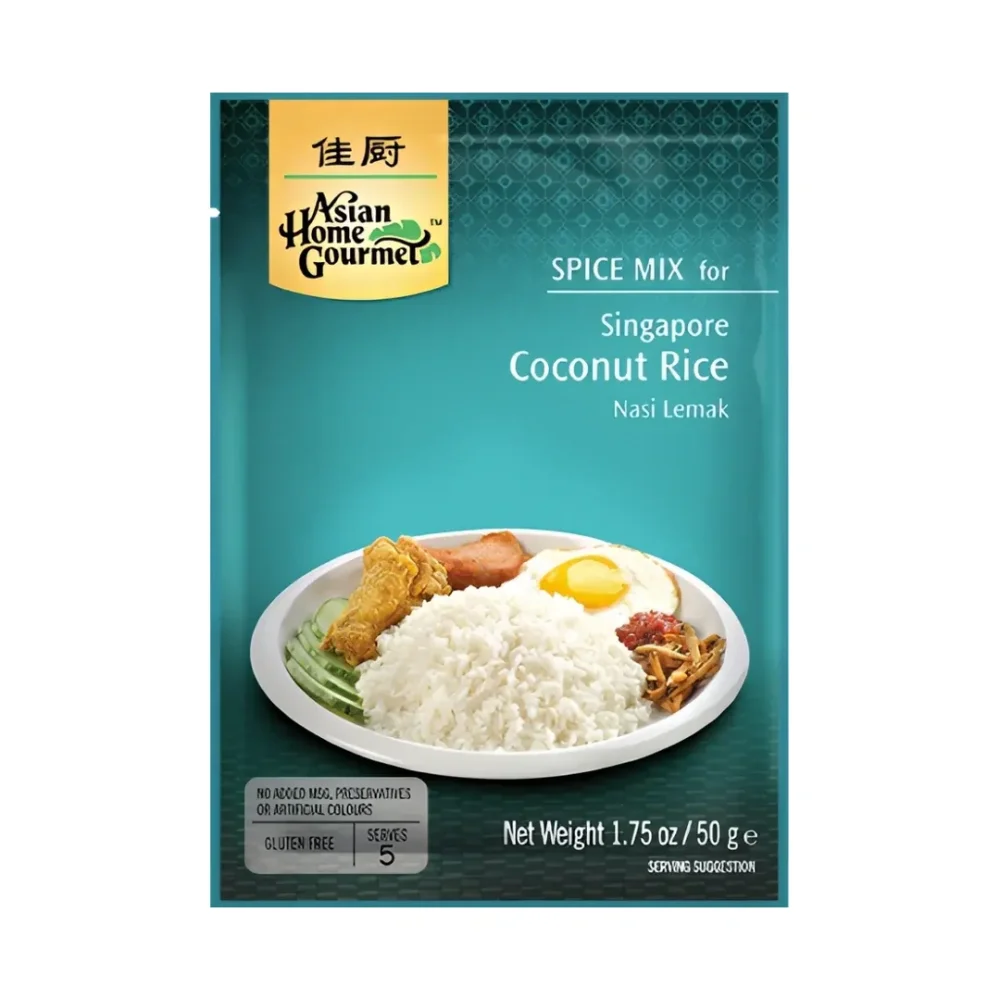
The Malay-Singaporean flavor circle also includes the world of coconut, seasoned, and regionally “fragrant” rice (typically included here is, for example, nasi lemak). If you want to understand this direction in practice, a ready-made seasoning paste that helps capture the basic flavor profile of coconut rice can be useful, such as AHG coconut rice Nasi Lemak paste.
3) Add chilli as a "controller," not as the main ingredient
Chilli in the Singaporean environment often works as the final adjustment – dip, table seasoning, a component that finishes the bowl. If you’re starting with spiciness, stick to a simple rule: add in small doses and always taste before adding more.
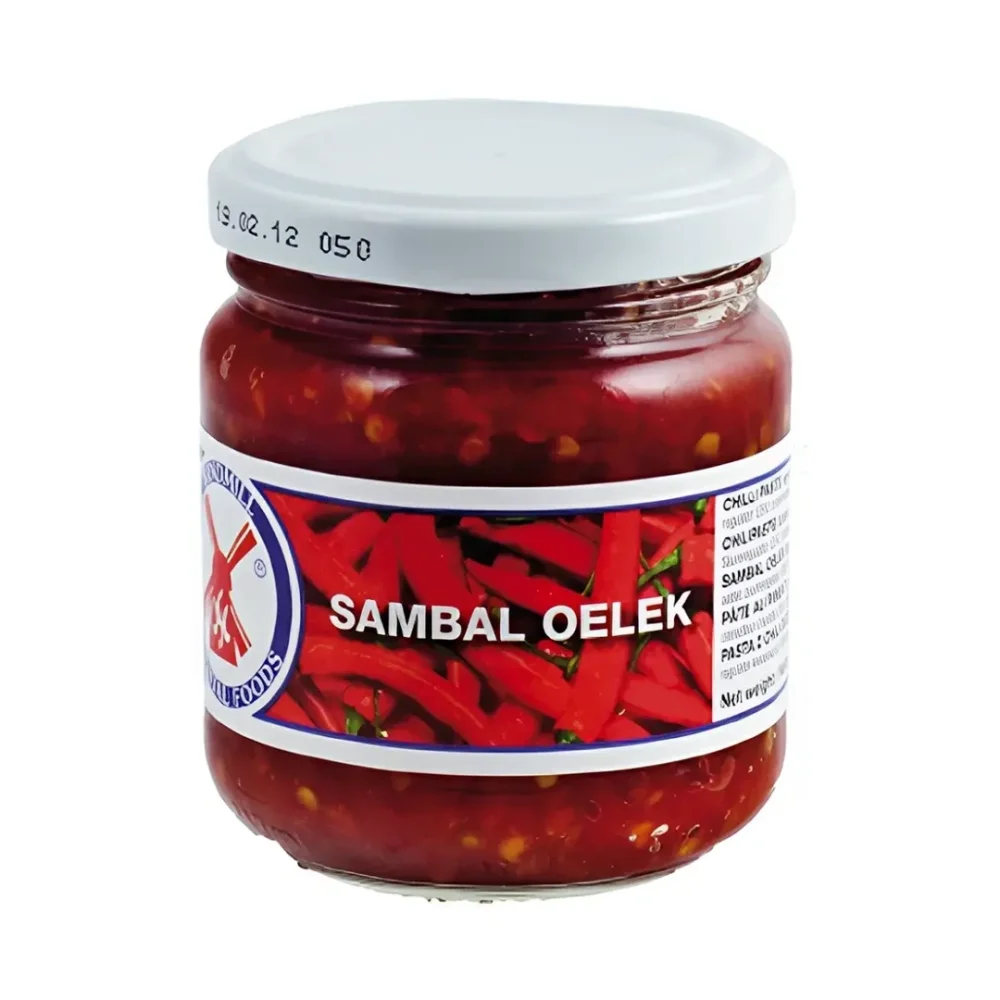
As a universal chilli base for dips, soups, and sauces you can use chilli paste like sambal. A practical guide is the category Sambal and chilli pastes. And if you want pure "chilli heat" without complicated seasoning, an example can be Windmill Chilli paste Sambal Oelek – start with a really small amount (like the tip of a teaspoon for one serving) and gradually adjust.
Common mistakes and misunderstandings (and how to avoid them)
“Chicken rice = chicken + rice, I can manage that any way”
The most common shortcut is to focus only on the chicken. But with Singapore chicken rice, the key is fragrant rice cooked in broth and fat and the final chilli dip. If you leave the rice neutral and skip the dip, you will be eating a different dish – both in flavor and "identity."
"Laksa is just curry soup"
Laksa is a type of noodle soup bowl where not only the spicy base plays a crucial role, but also the texture of the noodles and how they behave in the broth. If you overcook the noodles or choose a type that quickly loses structure in hot liquid, the typical experience of the bowl is lost.
"More sauce/broth = more flavor"
In noodle dishes, two things often decide: the type of noodles and how they are coated with liquid. In broth bowls, the broth should be technically well-executed and clean in flavor – the noodles must not disappear, but at the same time must carry the broth. In wok and "dry" dishes, too much sauce often destroys the texture, and too little sauce makes the dish unconnected.
"Singaporean food is simply spicy"
Singaporean cuisine is more about adjustability: table dips and seasonings (chilli, sauces) that one adds according to their preference play a big role. If you feel everything is "too much," the solution often isn't to omit chilli entirely but to learn to dose it in small steps.
What to take away from the article
- Singaporean cuisine is urban and multicultural – the environment and style of dining, as well as the specific recipe, are typical.
- Hawker centres are key: they rely on accessibility, specialization, and shared dining.
- Three iconic dishes that best explain the Singaporean style are Hainanese chicken rice, laksa and chilli crab.
- In practice, Singaporean dishes are held together by the relationship of rice/noodles and broth, sauce, or dip – and emphasis on texture.
- At home, it pays to start with one clear direction (e.g., laksa or chicken rice) and use chilli as a subtle adjustment, not as a main ingredient.

Read next
If you want to explore this topic further, continue with these related blog guides and articles:
