


 Česky (CZK)
 Slovensky (EUR)
 Deutsch (EUR)
 Austria
 Belgium
 Bulgaria
 Croatia
 Denmark
 Estonia
 Finland
 France
 Germany
 Greece
 Hungary
 Italy
Italy Latvia
 Lithuania
 Luxembourg
 Netherlands
 Poland
 Portugal
 Romania
 Slovenia
 Spain
Spain Sweden







Malaysian Cuisine: Flavours, dishes and key ingredients

This guide gathers articles focused on Malaysian cuisine, explaining its characteristic flavour profiles, common dishes, and the ingredients and cooking ideas that shape everyday Malaysian food. Use it to get clear context on what defines the cuisine and how different influences show up across meals and styles.
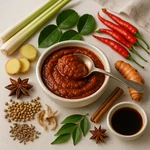
Influences in Malaysian cuisine: how the Malay base, Chinese wok, and Indian spices meet
Malaysian cuisine is hard to describe in one sentence because it is not "one" – it is a practical mix of several cuisines that historically met in one territory. These influences (Malay, Chinese, Indian, Peranakan, and Bornean) explain why coconut rice plates, broth noodle soups, and richly spiced dishes coexist – and why it makes sense to learn to read them as different culinary branches.
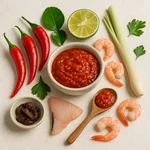
Typical Malaysian ingredients: how to recognize the "Malaysian" taste and how to recreate it at home
Malaysian cuisine is not a single uniform "national taste," but a practical mix of several traditions that meet and often blend in one territory and often even in one dish. This makes it all the more important to recognize the ingredients that keep reappearing in Malaysian cooking: rice and noodles, coconut, chili and sambal, aromatic herbs, tamarind and lime, and pronounced fermented marine components. In this article, we will arrange them according to their function, explain the differences, and add specific tips on how to start with them without unnecessary mistakes.
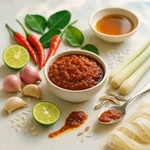
Typical Malaysian dishes: from nasi lemak to laksa (and how to understand them)
Malaysian cuisine is hard to fit into one "typical flavor" – and that is exactly its strength. It is a practical mix of Malay, Chinese, Indian, Peranakan, and local Bornean influences, best understood through specific dishes: coconut rice nasi lemak, satay skewers, various worlds of laksa, festive rendang, and simple chicken rice. The article provides orientation, differences, and tips on how to recreate Malaysian flavors at home without unnecessary mistakes.
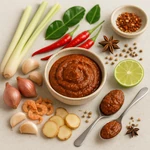
How to start with Malaysian cuisine: 5 logics to quickly get oriented at home
Malaysian cuisine is not one "typical taste," but a practical mix of several traditions meeting in one country – Malay, Chinese, Indian, Peranakan, and local Bornean. When you want to start with it at home, it doesn’t make sense to learn everything at once. In this guide, you will set simple orientation points (rice vs. noodles, coconut vs. broth, the role of sambal, accompanying sauces and dips) and pick a few first dishes to learn the Malaysian "system" fastest.
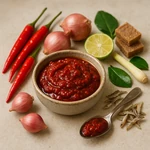
The taste of Malaysian cuisine: how to recognize it, why it is so diverse and how to build it at home
Malaysian cuisine cannot be reduced to one “typical” flavor. It is a living mix of Malay, Chinese, Indian, Peranakan and local Bornean influences – and you will often find them all on one plate. In this guide we will show you how to reliably recognize Malaysian taste, how it differs across dishes and regions, and how to practically construct its most important flavor pillars at home.
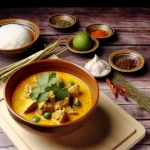
Nyonya (Nonya) Curry Recipe: Creamy Peranakan Curry with Coconut Milk
Nyonya curry is a bold, coconut-rich curry from Peranakan (Straits Chinese) kitchens, where Chinese techniques meet Malay spices. This approachable version delivers a deep, aromatic sauce with a gentle tang—perfect with steamed rice or flaky roti.
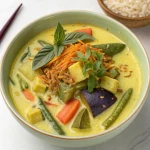
Sayur Lodeh: Indonesian Coconut Vegetable Curry (Easy, Flexible Recipe)
Sayur Lodeh is a comforting Indonesian-style vegetable curry made with coconut milk, aromatics, and a mix of everyday vegetables. It’s naturally plant-based, easy to adapt to what’s in your fridge, and tastes even better with steamed rice.
To compare neighbouring food cultures and spot shared influences, you may also want to read the guides to Singaporean Cuisine , Indonesian Cuisine , and Thai Cuisine .
