Česky (CZK)
 Slovensky (EUR)
 Deutsch (EUR)
 Austria
 Belgium
 Bulgaria
 Croatia
 Denmark
 Estonia
 Finland
 France
 Germany
 Greece
 Hungary
 Italy
Italy Latvia
 Lithuania
 Luxembourg
 Netherlands
 Poland
 Portugal
 Romania
 Slovenia
 Spain
Spain Sweden










Dumplings and Filled Bites: Guide and Recipe Ideas
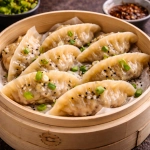
This guide focuses on dumplings and other filled bites found across Asian cuisines, explaining common styles, typical fillings, and how they are usually served in everyday meals and special-occasion spreads. You’ll find practical recipe-oriented context such as what makes different wrappers and shapes distinct, how cooking methods change texture, and which dipping sauces and side dishes are most often paired with them.
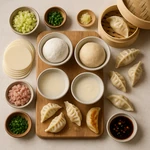
Fillings, doughs, and cooking methods of dumplings: how to understand Asian dumplings
Dumplings (Asian dumplings and pockets) are not "one dish," but a whole family of bites determined by a trio: filling, wrapper/dough, and cooking method. Once you put these three things together, the differences between jiaozi, gyoza, mandu, wontons, or shumai start to make sense – and especially why some dumplings are for soup, others for the pan, and others for steaming.
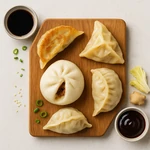
How gyoza, wonton, bao and mandu differ (and why it matters)
Gyoza, wonton, bao and mandu are often lumped together as “Asian dumplings.” But each of these names actually promises a slightly different experience: a different type of wrapper, a different texture, and often a different role in a meal (pan-fried, steamed, in soup, dim sum…). When you know what to expect, it’s much easier to choose the right style, the right preparation, and the appropriate seasoning.
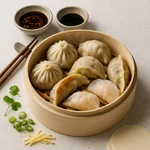
Dumplings and Asian dumplings: how to tell apart jiaozi, gyoza, mandu, and dim sum
Dumplings (dumplings, pockets, filled buns) are not a single specific dish but a huge family of foods across Asia. They share a simple principle: a dough or starch wrapper holds the filling – or forms a bite on its own without filling. In practice, however, they differ fundamentally: by the type of wrapper, shape, cooking method, and whether they are a quick pan dinner, part of a soup, or dim sum dining. This guide gives you a map to decide by situation, not just by foreign names.
For more dish-focused reading, continue with Soups and Broths for dumplings served in clear or rich stocks, Street Food Dishes for snack-style filled bites, or Curries and Sauces to understand the condiments and accompaniments that often appear alongside them.