


 Česky (CZK)
 Slovensky (EUR)
 Deutsch (EUR)
 Austria
 Belgium
 Bulgaria
 Croatia
 Denmark
 Estonia
 Finland
 France
 Germany
 Greece
 Hungary
 Italy
Italy Latvia
 Lithuania
 Luxembourg
 Netherlands
 Poland
 Portugal
 Romania
 Slovenia
 Spain
Spain Sweden










How to start with Singaporean cuisine: from hawker logic to your first meals at home
Singaporean cuisine is best understood as an urban, port “crossroads of flavors”: Chinese, Malay, Indian and other influences live side by side and create dishes with a clear identity. If you want to start at home, the goal is not to cook “all of Singapore,” but to pick a few typical hawker specialties, understand the role of rice and noodles, broth and coconut components, and learn to work with chilli dips (sambal) and table-seasonings.
Singaporean cuisine in brief: a crossroads, not a single “national” tradition
Singaporean cuisine is not one closed tradition that developed in isolation. It arose in a setting of port, trade, migration and daily contact between different communities. That is why it is characterized by:
- a strong interconnection of multiple cultural branches (Chinese, Malay, Indian, Peranakan and others),
- hawker culture (eating outside the home as a normal part of life),
- an emphasis on accessibility, speed and specialization – often one dish perfected in detail,
- noodles and rice as main carriers,
- coconut milk, chilli, herbs, soy and fish seasonings as a recurring toolkit,
- a big role for texture, broths, sauces and table dips.
An important shift to begin with: Singaporean cuisine is not “simplified Asia.” It is a specific local system where various heritages have turned into recognizable local flavors.
Hawker logic: why it pays to learn Singaporean cuisine by “specialties”
For a home start it is useful to adopt one key idea: hawker specialty is often one dish that rests on a few decisive details. If you want quick progress, focus not on breadth but on the quality of the base.
In practice this means:
- choose 1–2 dishes and repeat them (instead of cooking laksa once, “something with rice” a second time and noodles a third time without continuity),
- watch what makes a dish a dish: broth or fragrant rice, the right type of sauce and a finishing dip,
- treat “table-seasoning” as part of the recipe: the final taste is often adjusted with a chilli component, a soy element, lime or sambal.
Flavor map of Singapore: umami, chilli, coconut, broth and texture
Singaporean flavor is not uniform, but often consists of clear layers that are combined differently in various dishes:
- saltiness and umami (often via soy and fish seasonings),
- chilli heat – often in the form of sambal or a chilli dip,
- coconut softness in selected Malay and Peranakan dishes,
- light sweetness (in some combinations balancing chilli and saltiness),
- occasional acidity as contrast,
- broth depth,
- textural contrast (soft vs. crunchy, dry vs. “gravy”, noodles vs. topping).
For home cooking it’s practical to view Singaporean dishes as a layered composition: main carrier (rice/noodles) + sauce or broth + side/topping + dip + contrast (crispness/acidity). When something doesn’t “taste like Singapore,” it is often not a missing exotic ingredient but one of these layers.
Three main cultural branches worth orienting yourself by
To make flavors make sense, it’s useful not to lump everything together. Even a basic distinction helps when choosing recipes and shopping:
Chinese line: rice and noodles, sauces, work with broth
In the Singaporean context the Chinese line often manifests in dishes built on precise work with rice or noodles and on the “body” of a sauce or broth. For a beginner it’s a good path if you want to train technical cleanliness (properly cooked rice, sauce logic, order of steps).
👃 Malay (and Peranakan) line: coconut, aromatics, sambal as key
Here you’ll typically encounter a coconut component more often, strong aromatics and the fact that sambal or chilli dip is not just an “extra spicy sauce,” but part of a dish’s character. For a home start it’s practical to have good coconut milk on hand (more on that in the practical section).
Indian line: spiced base and richer flavor
Indian influence is one of the important layers of Singapore’s mix. In home practice it’s good to start so you don’t end up with a “random fusion”: first learn one specific dish in its logic, then allow yourself to combine.
The island and port axis around Singapore: how to quickly set expectations straight
For orientation it’s useful to perceive Singapore in the broader island and Southeast Asian port context. Not to cook everything at once, but so you don’t expect a flavor logic of another country from Singaporean food:
- Indonesia often centers around sambal, sweet-salty combinations (e.g. kecap manis), coconut and specific soy/fermented elements. If you expect an “Indonesian” sweetness in a Singaporean dish, you may be off.
- Philippines can be surprisingly “vinegary” and acidic for many people (typically adobo-style, working with acidity). It’s a different direction than Singaporean broth depth or the coconut creaminess of some dishes.
- Malaysia and Singapore share some iconic dishes and flavors (e.g. nasi lemak, laksa, sambal) and both worlds are strongly connected by street-food and port logic.
The result: when something at home doesn’t work out, often the question that helps is “Am I still cooking Singaporean logic, or has it drifted into another island cuisine?”
Practical home start: 6 dishes that teach Singaporean cuisine best
A beginner should not start by attempting “all of Singapore.” Better to pick several typical dishes through which you’ll understand the key principles: fragrant rice, broth/sauce, noodles, coconut component and chilli dip.
👃 1) Chicken rice (chicken with aromatic rice)
A great start because it teaches you that rice matters more than it seems. It’s not just about the chicken, but about making the rice aromatic and have “body.” At home watch rice consistency and avoid flat flavor – a clearer salty/umami layer and something on top (a dip) often helps.
2) Laksa (creamy coconut curry noodles)
Laksa is a good first “big” project because it shows the connection between coconut softness, broth depth and noodles. If you want a simplified start, there are ready-made bases that give you the right flavor direction so you can focus on the dish’s structure (liquid, coconut, noodles, topping). Practical example: AHG paste for coconut curry noodles Laksa.
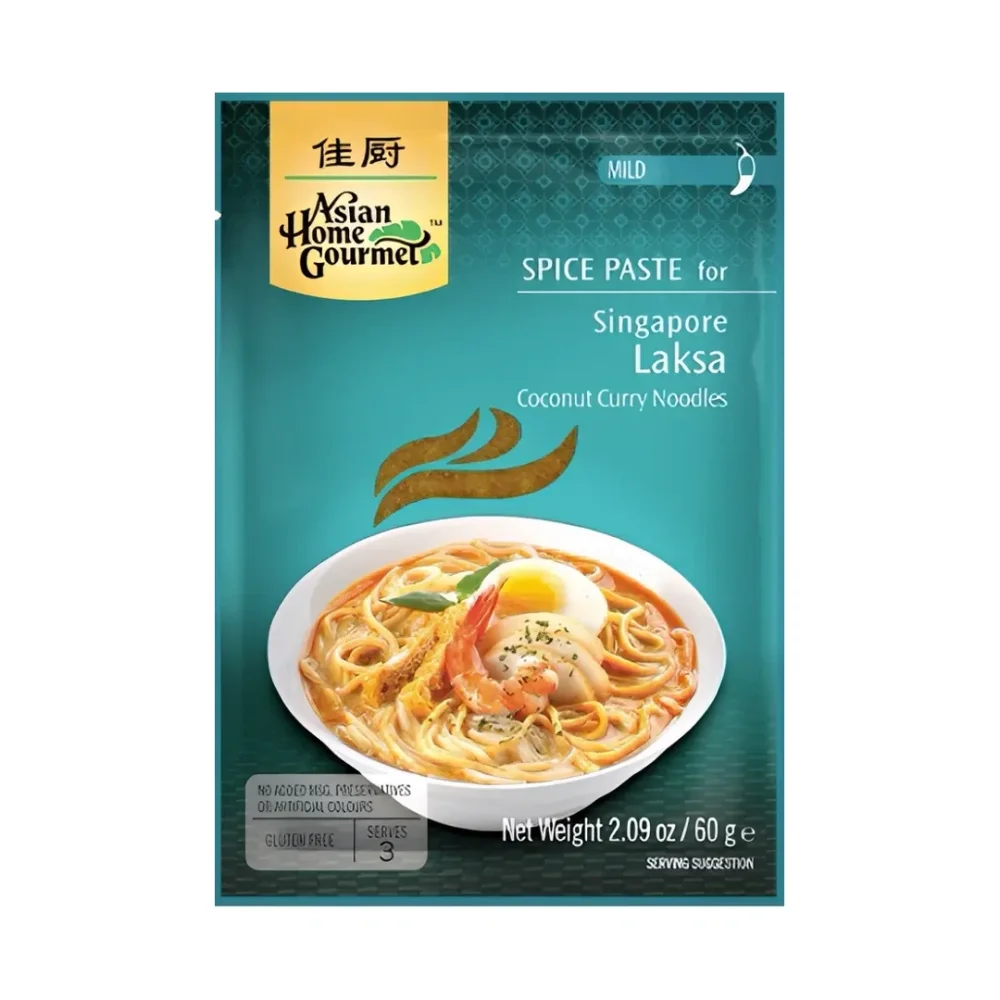
Tip for seasoning: always dissolve the paste first in a smaller portion of the liquid and add gradually – with such bases it’s usually easier to add than to take away. You can then use the coconut component to mellow and “round” the heat.
3) Kaya toast and soft-boiled eggs (toast with kaya + soft eggs)
This is a good reminder that the Singaporean world is not only noodles and rice. For a home start it’s a simple project where you’ll practice texture (eggs “just right”) and understand that even seemingly ordinary combinations have a fixed style of serving.
4) Nasi lemak (simpler home version)
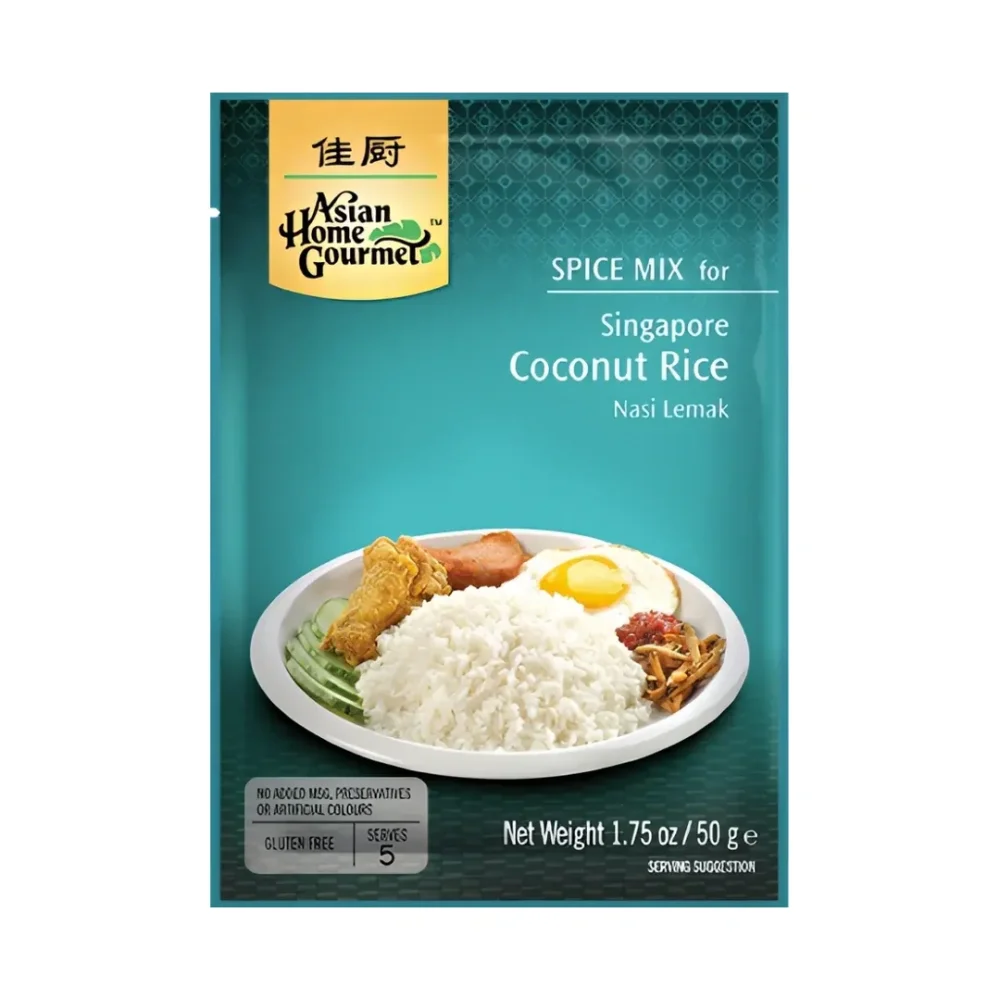
Nasi lemak is ideal for understanding the Malay/Peranakan layer: coconut rice + accompanying components + often sambal. If you want to start without long seasoning base tuning, a ready paste for coconut rice can help give the rice a clearer character. Practical example: AHG paste for coconut rice Nasi Lemak.
5) Stir-fry noodle dish (quick pan-fried noodles)
A quick noodle dish will teach you the “urban” rhythm: mise en place, high heat, quick cooking and final seasoning. Here the difference between “quick” and “simple” often appears: most work is in prep and timing.
6) One dish with sambal (sambal as a layer, not just heat)
Sambal (chilli paste) is often key in Singaporean and wider island cuisines. For a start choose one dish that you will always finish with the same style of sambal – you’ll learn dosing and how sambal alters the overall balance.
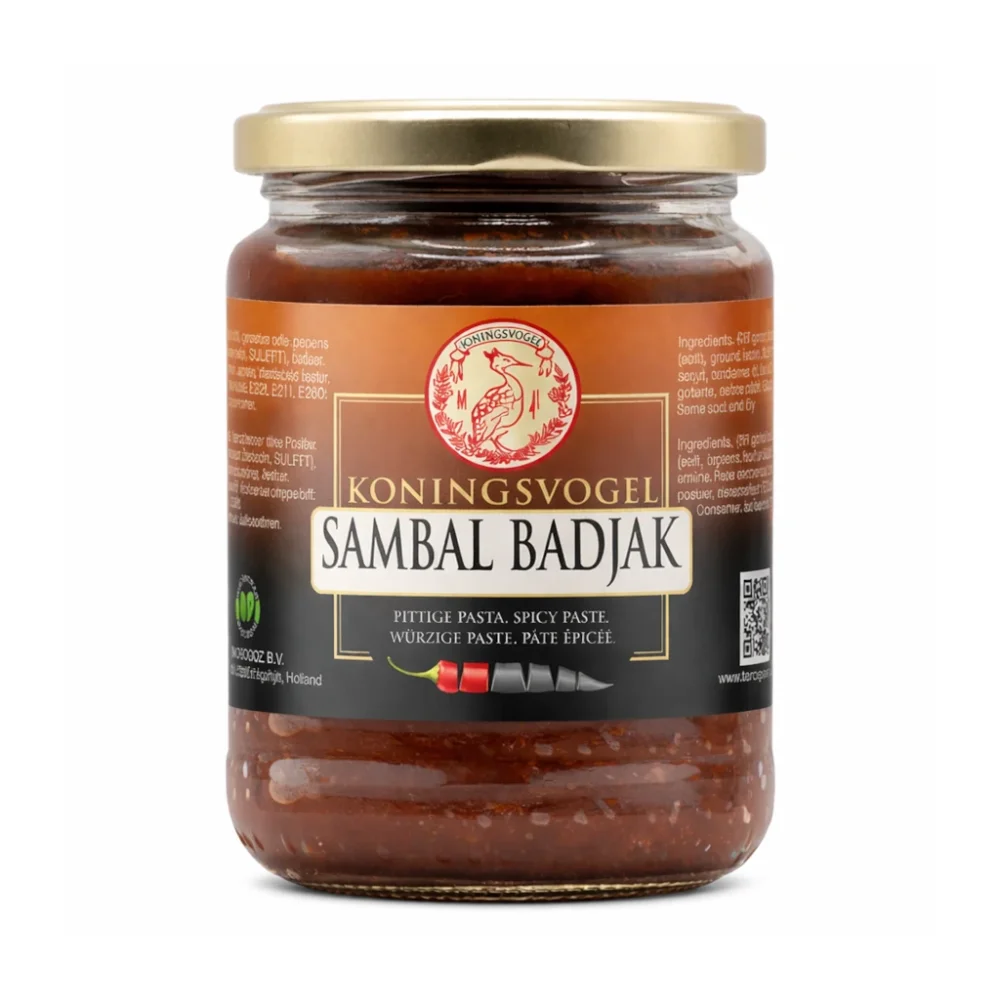
Practically: start calmly with 1/2 to 1 teaspoon per portion, dissolve into part of the sauce/broth or serve on the side as a dip and add little by little. Example of a sambal that mixes easily into a sauce: Koningsvogel chilli paste Sambal Badjak.
What to buy first (and how to choose so you’re not let down immediately)
A simple rule often helps beginners: shop by function in the dish, not by how “authentic” the name on the label sounds. A good choice is based on knowing what the ingredient should do in the recipe: build broth, soften with coconut component, or be a table seasoning.
1) Coconut milk as a tool for creaminess (not a universal “Asian cream”)
Coconut milk is important mainly in dishes where it forms part of the identity (e.g. laksa, nasi lemak and other Malay/Peranakan directions). Practical tip: when you want creaminess, start by adding the coconut component in parts and always taste whether the flavor has “rounded out” or whether it has already overwhelmed the broth depth. A useful signpost can be the category coconut milk.
2) Sambal and chilli pastes: table seasoning, dip and base
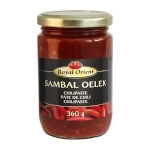
In the Singaporean style the chili component is often key. And this is where a lot of disappointment happens: people buy a chili sauce that's meant mainly for the table and expect it to replace a cooking base – or they use a very concentrated paste like ketchup. A quick guide to the types can help orient you sambal and chili pastes.
3) Read labels and watch for “base” vs. “seasoned product”
With Asian ingredients the packaging is often bold, but the small text matters. A practical filter:
- watch the first ingredients in the list (they are listed in descending order),
- ask whether you are buying a base for cooking, or rather a seasoned tabletop sauce,
- beware of products that promise intense flavor but are mostly water, sugar and thickeners – they often won’t provide the depth you expect from Singaporean food.
4) Don’t buy overly specialized items right away
Some ingredients aren’t bad, just not a good first purchase. Warning signs: very narrow use, need for precise dosing, extremely strong flavor without versatility, or large packaging of something you’ll use once at home.
Most common mistakes when starting (and simple fixes)
Mistake 1: “I want to start with Asia” = I start five cuisines at once
Fix: choose 1–2 Singaporean dishes and stick to them for several weeks. The Singaporean world is diverse itself – you don’t need to mix in other countries right away.
Mistake 2: Treating Singaporean dishes as random fusion
Fix: even though dishes often originated hybridly, they are not random mixes. Stick to one line (Chinese / Malay-Peranakan / Indian) and only start experimenting once you understand the flavors.
Mistake 3: Underestimating the dip and chili layer
Fix: when a dish is “good but still not quite right,” it’s often the tabletop seasoning that’s missing. Start with a small amount (e.g., 1/2 teaspoon of sambal per serving), add gradually and notice how the balance of saltiness, heat and coconut softness changes.
Mistake 4: Thinking “quick” means “no prep”
Fix: for stir-fries and noodle dishes the key is preparation. If you’re unhappy with the result, it’s often not a bad recipe but that you missed the correct order and timing of steps.
Mistake 5: Buying a wide pantry without a plan
Fix: shop backwards from your first dishes. For laksa and nasi lemak a coconut component and a suitable base make sense; for “a sambal dish” pick one chili paste and learn to use it. Add everything else only according to what you actually cook.
What to take away from the article
- Singapore is a culinary crossroads – it makes sense to distinguish Chinese, Malay/Peranakan and Indian lines.
- For a home start it’s best to think in “hawker logic”: choose a few specialties and repeat them, rather than cooking everything once.
- Singaporean dishes hold together with a repeating kit of components: rice/noodles, broth or sauce, coconut in selected dishes and most importantly chili dips and tabletop seasonings.
- The quickest first projects are: chicken rice, laksa, kaya toast and soft-boiled eggs, simple nasi lemak, stir-fry noodles and one sambal dish.
- When shopping choose based on the ingredient’s function in the dish, read labels and avoid overly specialized items at the very beginning.

Read next
If you want to explore this topic further, continue with these related blog guides and articles:
