

 Česky (CZK)
 Slovensky (EUR)
 Deutsch (EUR)
 Austria
 Belgium
 Bulgaria
 Croatia
 Denmark
 Estonia
 Finland
 France
 Germany
 Greece
 Hungary
 Italy
Italy Latvia
 Lithuania
 Luxembourg
 Netherlands
 Poland
 Portugal
 Romania
 Slovenia
 Spain
Spain Sweden










Indonesian Cuisine Guide

This guide focuses on Indonesian cuisine as a country-based chapter within the broader Asian food guide, bringing together reading on what defines Indonesian flavours, how dishes are commonly structured, and the kinds of ingredients and cooking approaches that appear across the cuisine.
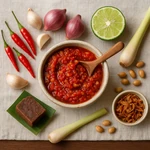
Sambal and Indonesian pastes: how to understand spiciness, depth of flavor, and proper use
Sambal in Indonesia does not mean one "chili paste," but a whole family of seasonings – from milder to very spicy, from fresh to cooked or fermented. In practice, sambal can function as a table condiment, but just as well as a base of a dish that transforms plain rice into a distinctive meal. In this article, we clarify the differences between types of sambal and ready-made pastes, how to choose them and how to start using them at home without the most common mistakes.
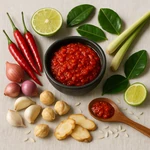
Typical Indonesian ingredients: what makes Indonesia Indonesian (and how to start with them at home)
Indonesian cuisine is a huge island world – from Sumatra through Java to Bali – yet it has a few common ingredients that you recognize at the first taste. In this guide, you will find an overview of key Indonesian ingredients, their role in the food, main differences (especially in sambal, kecap manis, and coconut products), and a practical guide on how to cook with them without unnecessary mistakes.
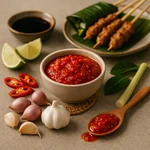
Typical Indonesian dishes: what to taste and how to quickly get your bearings
Indonesian cuisine is not a single uniform style, but a large world of regional traditions spread across a vast archipelago. Yet it has clearly recognizable common features: rice as the center of the meal, pronounced chili (often in the form of sambal), aromatic bases and frequent use of coconut. The article provides an overview of the most typical Indonesian dishes (nasi goreng, rendang, satay and gado-gado), an explanation of what makes them typical, and practical tips on how to start cooking them at home.
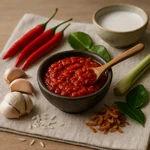
How to start with Indonesian cuisine: rice, sambal, kecap manis, and a few dishes that will teach you the most
Indonesian cuisine is not one "uniform" flavor, but a huge world of regional styles across the islands. The good news is that starting at home is surprisingly easy if you don't try to cook everything at once. In the article, we will show what is typical for Indonesia, how to recognize its flavor, what the most important differences are (including a brief orientation in island Southeast Asia), and how to choose your first ingredients and first dishes without unnecessary mistakes.
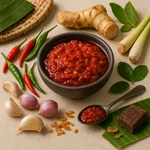
Taste of Indonesian cuisine: sambal, kecap manis, coconut, and rice as the center of the meal
Indonesian cuisine is not a single "national taste," but a broad family of regional styles spread across a vast archipelago. Yet, it repeatedly returns to several fixed points: rice as the center of the meal, chili and sambal, sweet-salty depth thanks to kecap manis, aromatic pastes, and coconut, which can both soften and intensely concentrate the flavor. In this article, we will put these pillars together so that when cooking at home for the first time, you know what you are actually looking for and why it tastes "Indonesian."
To compare neighbouring food traditions and broader context, continue with Malaysian Cuisine and Singaporean Cuisine , or zoom out to Regional Styles of Asia for cross-country influences.