


 Česky (CZK)
 Slovensky (EUR)
 Deutsch (EUR)
 Austria
 Belgium
 Bulgaria
 Croatia
 Denmark
 Estonia
 Finland
 France
 Germany
 Greece
 Hungary
 Italy
Italy Latvia
 Lithuania
 Luxembourg
 Netherlands
 Poland
 Portugal
 Romania
 Slovenia
 Spain
Spain Sweden










Typical Taiwanese Ingredients: What Shapes the Island's Flavor (And How to Start Using Them at Home)
Taiwanese cuisine is not just bubble tea and night markets. It is an independent and vibrant culinary world where local cooking meets various Chinese regional influences, a distinctive Hakka layer, indigenous traditions, Japanese heritage, and modern urban food culture. That's why it makes sense to start with the ingredients: how they taste, their role in the dish, and how to recognize if you've chosen the right type.
🍜 Taiwanese Cuisine in a Nutshell: Why It’s Better to Focus on Ingredients, Not Just the “Style”
It’s worthwhile to think of Taiwanese cuisine as a system based on several principles: great diversity of influences, a strong role of snacks and small dishes (often associated with night markets), frequent combination of rice, noodles, soups, and street food, and also an emphasis on texture.
It is also important what Taiwanese food typically does nothave to be: it doesn’t necessarily have to be very spicy or extremely seasoned. Often, on the contrary, it works with a gentler but precise tuning—saltiness, slight sweetness, broth depth, starchy texture (in sauces and coatings), contrast of soft and crispy, and good final seasoning.
Why Taiwanese Cuisine Is So Diverse: Five Layers of Influence That Also Change the Choice of Ingredients
The types of ingredients you find in Taiwanese cuisine relate to the fact that several culinary “layers” have long coexisted on the island:
- Local Taiwanese Base is perceived as fresher, more lightly seasoned, and more simply tuned—with an effort to let the ingredient speak, but also with sweet and sour and broth tones.
- Chinese Regional Influences bring various ways of working with noodles, sauces, and seasonings—which is why it’s so easy to make the mistake of “I chose the noodles, so they must be right,” even though in reality it’s not the right type for the given dish.
- Hakka Cuisine traditionally uses stronger flavors and dried or preserved ingredients—practical components that store well and give the dish a more pronounced character.
- Indigenous Peoples' Cuisine is more connected to nature and the local environment (fish, plants, mountain and coastal conditions). It helps understand that Taiwan is not just an urban snack culture.
- Japanese Heritage and Modern Urban Cuisine influence how food is eaten “outside”—the world of tea shops, breakfast spots, and small specialized businesses strengthen the emphasis on textures (for example in drinks and desserts) and final seasoning.
Practical Impact: the same “main” ingredients (rice, noodles, soy seasoning, starches) behave differently in different contexts. That’s why in Taiwanese basics it’s more important to understand function than to search for one universal “authentic” item.
🍜 Typical Taiwanese Ingredients: Flavor, Function, and How to Recognize Them in Practice
For home orientation, it is useful to have in mind several groups of ingredients that frequently recur in Taiwanese cooking. It’s not just a list—each has a specific role in the dish.
Rice: The Foundation on Which the Rhythm of a Meal Stands
Rice is one of the key starchy bases. In Taiwanese cuisine, it often acts as a “silent” flavor carrier: accompanying stronger proteins, sauces, and small sides, and helping balance saltiness and acidity. If you want your dish to have a Taiwanese feel, rice gives you a stable framework—while letting the seasoning and textures around it shine.
🍳 Rice and Wheat Noodles: Same Category, Completely Different Uses
Noodles are another backbone of Taiwanese cooking—but the crucial thing is to differentiate type and purpose. Not every noodle suits soup, quick stir-frying or a dish with thick sauce. The difference isn’t cosmetic: it changes preparation time, ability to carry sauce, and final texture.
Noodles often make the difference between the impression “this is it” versus “it’s just vaguely Asian”—even if you have the right sauce.
Pork and Beef: Proteins That Carry Flavor and Broth Depth
Pork and beef are important proteins in Taiwanese cuisine. In practice, they often link to the broth logic (depth, “cooked” flavor), soy-based sauces, and texture contrasts. If you are building a home dish “Taiwanese style,” it’s useful to think about meat not just as protein but as a carrier of sauce and broth.
Oysters and Other Seafood: Coastal Flavor and Umami
Taiwan is an island, so seafood makes sense not only culturally but also flavor-wise: it brings saltiness, umami, and a specific “sea” depth. Oysters are one of the typical examples counted among Taiwanese ingredient maps alongside other seafood.
Tofu: Versatile Texture from Delicate to Hearty
Tofu fits well into Taiwanese cooking’s emphasis on texture. It can be delicate, absorbent, and in combination with soy seasoning and aromatics (spring onion, ginger) works as a “linking” ingredient between broth, sauce, and starchy component.
Soy Sauces and Soy Seasoning: Saltiness and Umami as Backbone
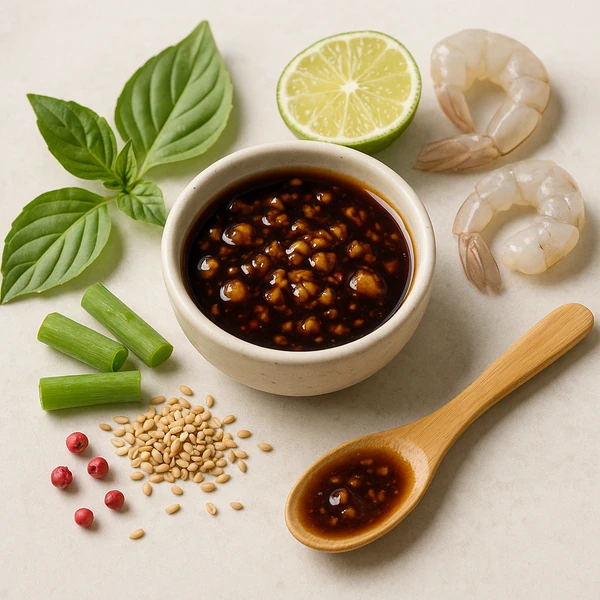
Soy seasoning (especially soy sauces) is one of the most important pillars. It adds saltiness and umami, the depth without which a homemade dish tends to be flat. In Taiwanese dishes, it’s often not about “a lot of sauce” but about precise dosing: so the food is light yet expressive.
Black Vinegar: Acidity That Makes the Dish “Sharper” and More Lively
Black vinegar is among typical Taiwanese ingredients in the acidity category. In practice, it’s often the component that lifts flavor, adds contrast, and prevents the salty and broth parts from feeling heavy. If you feel your dish is missing a “Taiwanese signature,” acidity is usually one of the first places worth checking.
👃 Spring Onion and Ginger: Aromatics You Recognize Even in a Simple Dish
Spring onion and ginger are typical aromatics. They often serve as a quick flavor start (aroma, freshness, sharpness) and also as a final finishing layer. Taiwanese food often relies on gentler but precise tuning—and aromatics are exactly the tool that allows “little but right.”
Starches: Thickening, Coatings, and Key Texture
Starches are important not only in sauces (where they help with shine, adhesion, and a sense of “roundness”) but also in coatings—that is, the way contrast between crispy and soft is created. If you want to achieve a typical impression at home, a good sauce alone isn’t enough: often it depends on how the sauce sticks to the ingredient and its final consistency.
Local Vegetables and Pickles: Freshness, Contrast, and “Final Signature”
Local vegetables and pickles (pickled and crunchy additions) play a practical role: they add freshness, acidity, or salty accents, and especially texture. In many dishes, it’s precisely small additions and “smaller bases” that decide whether a dish truly feels Taiwanese or just generally Asian.
Tea, Tapioca, and Textural Components: The World of Tea Shops at Home
Tea and tapioca (and other textural components for drinks and desserts) represent a distinctive modern urban dimension of Taiwanese cuisine. With bubble tea and similar drinks, the main theme isn’t just sweetness—it’s important tea quality, pearl texture and balance of the whole. Texture here is not a supplement but one of the main reasons why the drink is enjoyable.
🍳 How to Start with Taiwanese Ingredients at Home: Selection, First Use, and Checking the Result
The easiest way is not to buy “everything Taiwanese,” but to build a few certainties that return across dishes. It helps to think functionally: what gives saltiness and umami, what gives acidity, what provides starchy structure, what delivers the final aroma and texture.
1) Read labels and watch whether you are buying a base or already seasoned product
One of the most practical selection rules for Asian ingredients is to distinguish whether it is a basic productor a ready-seasoned product. With bases, you have greater control over the result. With seasoned products, you save time—but you must reckon with the fact that they already contain sweetness, saltiness, or aromas and can “overpower” the rest of the dish.
This is especially important for sauces, broth, and seasoning bases: quality is often recognized by the clarity of ingredients and by whether the product makes sense for the dish you intend to use it with.
2) Choose noodles according to technique: soup, stir-fry, or thick sauce
Before buying noodles, say one thing to yourself: what will I do with them. The same “category” of noodles can be a completely different ingredient in practice. If you pick the wrong noodles, even good seasoning won’t help—the texture and behavior in the pan or broth will be against you.
- For soup, you typically need noodles that hold their shape and don’t immediately fall apart into mush.
- For stir-fry (quick frying), you need noodles that can be quickly tossed, dry well, and don’t end up as a stewed mass.
- For thicker sauces, check whether the sauce can “stick” to the noodles (starch content and noodle surface treatment matter here).
3) Prepare starch in advance: a small step that makes a big difference
When cooking fast (pan, wok, quick noodles), there is no time to mix starch only at that moment. In Asian cooking, it is common to have everything prepared beforehand (mise en place): starch mixed, sauces measured, aromatics separate.
Practical tip: always mix starch smoothly in cold water and add it gradually to the dish. After each addition, let it cook for a few seconds, then decide whether more is needed. This gives you control over consistency and avoids a “jelly” effect.
🍳 4) Preparing Ingredients Before Cooking: In Taiwanese Style, Often the Cutting Board Decides, Not Just the Pan
In many Asian cuisines (and especially with quick techniques) the result is often determined even before cooking. Basic rules worth following:
- Cut and prepare everything in advance – especially for stir-fry, quick noodle dishes, fried rice, and dishes where ingredients are added in quick steps.
- Separate aromatics from main ingredients – aromatics (spring onion, ginger) are often added at a different moment than meat, tofu or vegetables.
- Controlling moisture: with quick frying it is a problem if ingredients are too wet. Typically, it’s good to dry vegetables, tofu, or mushrooms after washing so that they fry more than steam in the pan.
- Cut is not just aesthetics: size and shape change the speed of softening, ability to hold color, and how the ingredient coats with sauce. Uniformity pays off in quick dishes.
This discipline is often the difference between “the flavor is right, but something is off” and “suddenly it’s convincing.”
5) Bubble Tea-Type Drinks: Don’t Just Focus on Sweetness, But Also Texture
For drink bases, a different quality measure applies than for sauces: important is tea flavor, tapioca pearl texture, and balance of sweetness. If the drink is unpleasantly too sweet, it often helps to reduce sweetness and ensure the tea is not just a “background” but a genuine flavor component.
💡 Common Mistakes and What to Watch Out for So the Result Doesn’t Just Feel “Generally Asian”
- “Taiwanese = Very Spicy”: Taiwanese cuisine does not have to be extremely spicy. It is often more convincing when saltiness, acidity, broth depth, and texture are fine-tuned.
- One noodle as a universal solution: not every noodle suits soup, stir-fry, and thick sauce. The wrong type of noodles is a common reason why a dish doesn’t work, even if you “seasoned correctly.”
- Buying without function: the biggest disappointment arises not because the ingredient is bad, but because it wasn’t chosen for a specific use. It helps to start with the role in the dish (saltiness/umami, acidity, starch, texture) and then select the specific product.
- Too specialized items too early: warning signs are narrow usage, need for precise dosing, and unclear expectations of “what exactly do I want this for.” As a start, a few basics that return across dishes often suffice.
- Underestimating preparation: if you put wet ingredients in the pan, instead of frying, they start to steam. If you don’t have sauce and starch prepared, you lose rhythm and aromatics can burn before the rest is done.
What to Take Away from the Article
- Taiwanese cuisine is an independent system with many influences—that's why it’s worth starting with ingredients and their functions, not one “universal” sauce.
- Typical bases include rice, rice and wheat noodles, pork, beef, oysters and seafood, tofu, soy seasoning, black vinegar, spring onion, ginger, starches, pickles, and also tea with tapioca (texture).
- The most common practical mistake is choosing the wrong type of noodles and underestimating preparation (mise en place, moisture of ingredients, timing).
- “Taiwanese” often means light but expressive: precise seasoning, broth depth, and well-constructed texture.

Read next
If you want to explore this topic further, continue with these related blog guides and articles:
