


 Česky (CZK)
 Slovensky (EUR)
 Deutsch (EUR)
 Austria
 Belgium
 Bulgaria
 Croatia
 Denmark
 Estonia
 Finland
 France
 Germany
 Greece
 Hungary
 Italy
Italy Latvia
 Lithuania
 Luxembourg
 Netherlands
 Poland
 Portugal
 Romania
 Slovenia
 Spain
Spain Sweden










How to start with Sri Lankan cuisine: rice, coconut, sambols, and the smart first plate "rice and curry"
Sri Lankan cuisine is not "Indian curry on an island." It is based on rice, coconut products, bold spices, acidity, chili, and mainly on eating the whole as a combination of several small bowls – curry, sambols, and other accompaniments. If you want to start at home, you need to understand this logic: not chasing one perfect curry, but assembling contrasts so that the food begins to taste Sri Lankan.
Beginners often want to "start with Asia" as one package – but in practice, that doesn't work. In Sri Lanka's case, it's better to choose clear entry doors: learn how to build a plate that mixes rice, coconut curry, spiciness, acidity, and small bold elements. This article will guide you through what is typical for Sri Lankan cuisine, why it is so diverse, and how to make the first home steps without unnecessary shopping mistakes.
What makes Sri Lankan food Sri Lankan: rice in the middle, coconut around, and extra small bowls
Sri Lankan cuisine is based on several solid principles worth understanding before you start dealing with individual recipes:
- Rice as the center of the meal – often it is the "platform" on which everything else meets.
- Coconut in various forms – coconut milk, fresh coconut, and coconut sweeteners are essential parts of the identity.
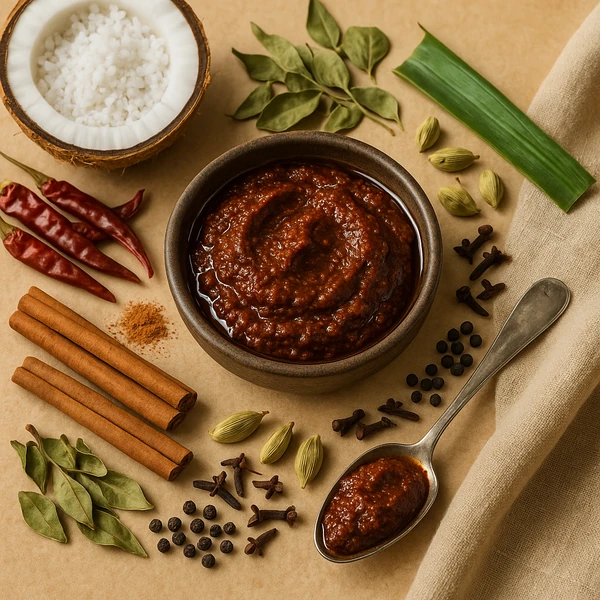
- Spices as aroma and depth – Sri Lankan food is often bold and layered. It is important that spices can also be roasted, thus gaining a different character.
- Contrast of spiciness, saltiness, acidity, and "aromatic depth" – it's not just about chili, but about how flavors alternate and complement each other.
- Sambols, pickles, and other accompaniments – small, concentrated ingredients that often decide whether the food feels lively or flat.
Why it is important to think in "a complete plate," not in one pot
One of the most practical ideas for beginners is this: more small components are more important than one big curry. The Sri Lankan taste often arises only when a milder coconut element meets a sour and spicy accompaniment (sambol or something pickled) on the plate.
This has two advantages: (1) you don’t have to master "perfect curry" right away to hit the character of the cuisine, and (2) you can adjust the spiciness and intensity gradually through the small bowls.
🕰️ Why Sri Lankan cuisine is so diverse: island, history, and different communities
Sri Lankan cuisine is not a single style. When talking about it, it's useful to remember that it is more than one dominant tradition – and that the "Sri Lankan taste" can have different accents.
Regions and communities: what to take from this as a beginner
- Sinhalese majority – a large part of everyday cuisine is built around rice, curry, sambols, vegetable dishes, and coconut bases.
- Tamil cuisine – is closely connected to the north and east of the island and the broader South Indian area; it may have different accents in working with spices, acidity, and typical dishes.
- Muslim and Malay layer – brings specific festive elements and distinct sweets; wattalappam belongs here as well.
- Burgher heritage – relates to urban and colonial history; lamprais is typically mentioned.
As a simple rule for home start: when a "Sri Lankan" recipe tastes different to you, it may not be a mistake – often it just comes from a different community or regional layer.
How to recognize Sri Lankan flavor (and why it can't be summed up by one dish)
Sri Lankan flavor is often spicier, spiced and coconut-flavored. Sometimes it is darker and roasted (when working with roasted spices), other times on the contrary fresh and sour through accompaniments like sambol. It's important that the character doesn’t arise from one sauce, but from the fact that several components are mixed together – main curry, sides, rice texture, and the intensity of small additions.
Sri Lankan food also does not have to be always extremely hot. Its strength is often in fullness and contrasts: milder coconut next to spiciness and acidity, a lighter side dish next to a more pronounced curry, and sometimes even a sweet touch after a spicy dish.
First home steps: what to cook and what you'll learn by it
If you want a quick, understandable start, stick to a few basic principles: rice as the center, more smaller components, coconut as identity, sambol as a key accompaniment, and awareness that spices can also be roasted.
1) "Rice and curry" plate: the fastest way to understand the whole dining
Start by trying to build a simple plate at home in the style of rice and curry. It’s not a single specific dish but a serving principle: rice in the middle and several smaller components around it. Here you best experience how Sri Lankan cuisine works with contrasts.
- Set a goal to have one "main" curry component and at least one bold accompaniment (sambol/pickle).
- Notice what happens when you combine rice, curry, and a small accompaniment on your fork/spoon – Sri Lankan taste often arises precisely by this "mixing on the plate."
2) Pol sambol: why accompaniments are more important than they look
Pol sambol is one of the best first steps because it immediately teaches you two things: (1) how essential coconut is to Sri Lanka's identity and (2) that small, concentrated accompaniments are not "something extra," but a full part of the flavor system.
Generally, it's useful to remember a rule from Asian dining: small volume, big impact. With accompaniments, start really sparingly and add gradually depending on how spiciness, acidity, and saltiness meet the milder coconut element on your plate.
3) Dhal curry: a “safe” base that combines well
Dhal curry is practical as a first curry because it typically works well in the logic of "rice + several bowls." The key for start is that it lets you focus on what makes the difference: which accompaniment you choose, whether you want fresher/sourer contrast, and how you work with spices (including possible roasting).
4) One coconut curry: understanding coconut as a flavor carrier
The next recommended step is one coconut curry. The goal is not to cook the "most authentic" version on the first try but to understand why coconut in Sri Lankan cuisine is not just a mellowing ingredient – it is a fundamental building block that then meets spices, heat, and acidity.
Sri Lankan cuisine is specific in this regard also because it often differs from other nearby styles: it works distinctly with coconut, black pepper, cinnamon, and also acidic and pickled components.
5) Hoppers and string hoppers: the breakfast and "street" layer of cuisine
In Sri Lankan cuisine, breakfast and street foods also have an important place. That’s why as a next step mentioned are hoppers and string hoppers – they also help pull you out of the idea "Sri Lanka = only curry." For starters, the main importance is that they broaden the perception of cuisine: it’s not just about sauce, but also about side dishes and how the food is composed.
6) Kottu: how to understand the street logic
Kottu is recommended as "understanding street logic" – as a reminder that Sri Lankan cuisine is not just a home plate of rice with bowls, but also a lively everyday style of eating. For onboarding, it is mentally useful: it adjusts your expectations and helps avoid narrowing Sri Lanka down to just one form of serving.
Spices and roasting: small change, big difference
In practice, it’s worth experimenting how the character of a dish changes when some spices are used roasted – Sri Lankan food can then feel darker and "deeper." Without roasting, the result can be more straightforward and lighter. If you don’t know which way you want to go on the first attempt, treat it as an experiment, not a mistake.
A typical example of an aromatic note in the Sri Lankan profile is also cinnamon. If you want to have one clearly recognizable ingredient at home that will help "switch" the flavor into the Sri Lankan direction, it may make sense to start right here – for example with ground cinnamon and use it consciously only where it should create a spiced aroma in the dish as a whole (not as a sweet dessert accent).
How not to get overwhelmed by shopping: read labels and watch if you buy a “base” or a seasoned product
A lot of disappointment in home Asian cooking doesn’t come from the ingredient being "bad" but from it being badly chosen for the specific use. Practical rules useful also for starting with Sri Lanka:
- Always read the label – with Asian ingredients, the decisive detail is often the fine print. The composition is listed in descending order: the first items determine the product's character.
- Check if it’s a base or a seasoned product – this is a common source of confusion. An ingredient that is meant as a building block is used differently than a "ready" seasoning.
- Beware of overly specialized first purchases – if you don’t have a clear idea how you will use them, you can easily end up with something that is great but you won’t use at home.
Most common mistakes at the start (and how to fix them quickly) ⚠️
- "It’s just Indian curry." Sri Lankan cuisine may at first glance resemble part of South India but is distinctive: it builds more on coconut, works with a different rhythm in constructing the dish, and often involves acidic and pickled components and small additions (sambols).
- Trying to cook one big curry and that’s it. Fix it simply: add at least one bold accompaniment (sambol/pickle) and observe what contrast does on the plate.
- Excessive focus on chili. Sri Lankan food can be spicy, but its strength is not only in chili. It’s often a combination of heat, saltiness, acidity, and spiced depth. When your food tastes "just spicy," it usually lacks contrast or a supplementary component.
- Ignoring sambols and "small bowls." Accompaniments are not decoration – they often decide whether the food feels lively or flat. Start calmly with just one (e.g., pol sambol), but treat it as a full part of the plate.
- Starting with five cuisines at once. The result is often a chaotic pantry without a plan. With Sri Lanka, it’s better to aim: master one rice and curry plate and only then add more dishes (hoppers/string hoppers, kottu).
- Choosing recipes by photo, not by principle. With Sri Lankan cuisine, it’s better to choose so that the first dishes teach you key principles: rice as the center, coconut as identity, accompaniments as contrast, possibility of roasted spices.
What to take away from the article
- Sri Lankan cuisine is distinctive: it is based on rice, coconut, spices, acidity, chili, and bold accompaniments (sambols, pickles).
- The fastest start is not "one perfect curry" but a rice and curry plate consisting of several smaller components.
- For the first steps, it makes sense to go for: pol sambol, dhal curry, one coconut curry, and to broaden horizons also hoppers/string hoppers and kottu.
- Spices can also be roasted – and that can be the difference between "just spiced" and "Sri Lankan deep."
- When shopping, watch the function of the ingredient: read labels, distinguish base vs. seasoned product, and don’t overwhelm yourself with overly specialized items.

Read next
If you want to explore this topic further, continue with these related blog guides and articles:
