


 Česky (CZK)
 Slovensky (EUR)
 Deutsch (EUR)
 Austria
 Belgium
 Bulgaria
 Croatia
 Denmark
 Estonia
 Finland
 France
 Germany
 Greece
 Hungary
 Italy
Italy Latvia
 Lithuania
 Luxembourg
 Netherlands
 Poland
 Portugal
 Romania
 Slovenia
 Spain
Spain Sweden










Beverages and teas in Asian cuisine: from "real" tea to bubble tea and matcha latte
Asian drinks are not just sweet drinks with ice. Alongside traditional tea culture, there is a modern world of drinks where texture, visuals, tea base, syrups, and the possibility to "assemble" a drink exactly to taste play a role. In this guide, we will clarify what real tea is, what the main types of tea are, why bubble tea is more than a trend, and how to avoid the most common disappointments in practice.
Why Asian drinks are more than "something sweet with ice"
Modern Asian drinks often meet at one point today: traditional tea culture, urban street food, café service, and the desire for a distinctive experience. The result is a wide spectrum – from pure loose tea to drinks that work almost like a small snack.
Typical common features of modern Asian drinks:
- strong connection to tea or tea base (even if the resulting drink is milky, fruity, or iced),
- combination of traditional ingredients with modern service (for example, matcha in latte form),
- a big role of texture (pearls, jelly, foams, fruit pieces),
- frequent use of ice, milk, syrups and jelly elements,
- an emphasis on " drink as snack" – a drink that not only quenches thirst but also entertains and sometimes lightly satisfies,
- possibility of personalization (sweetness, ice, toppings, type of milk).
Two worlds under the single word "tea": real tea vs. modern tea drinks
🌶️ What is "real tea" and why it matters
In Asian tea traditions, it is important to distinguish one basic thing: real tea is made from the leaves of the plant Camellia sinensis. The differences between types of tea (green, oolong, black, etc.) do not arise because they come from different plants, but primarily by the method of processing.
In practice, this means that two packages labeled "green tea" can taste significantly different – and it's not just about the brand but about origin and style of processing.
What is often sold today as "tea drink"
Alongside that, there is a modern concept of "tea": milk teas, fruit teas, iced teaades (tea lemonades), drinks with foam or various textural elements. Tea here is either the main flavor or the "framework" on which the rest is built (milk, syrup, ice, topping).
An important shift: such a drink is often not just a complement to food but an independent product with its own identity.
Basic major types of tea: how to quickly orient yourself in taste
Under the word "tea" lie several major traditions. For quick orientation, it is useful to know the main categories of "real" tea and their typical taste impression:
- White tea: belongs to the least processed, tastes delicate, light, sometimes floral or mildly fruity sweet. It is not automatically "weak tea", rather a more subtle profile.
- Green tea: oxidation is halted early, resulting in a fresher, grassy, seaweed, vegetable or nutty tone.
- Yellow tea: rarer; simply put, it stands between green and a "rounder" profile, often less grassy and softer.
- Oolong: a wide and diverse category between green and black; can be light and floral, but also darker, baked, mineral or honey-fruity.
- Black tea: usually fuller and stronger; Indian styles often feature maltiness and strength.
- Dark / post-fermented tea: a separate world of more expressive, mature profiles (important to know mainly that it's not "stronger black tea" but a different category).
Chinese vs. Japanese green teas: why they don’t taste the same
With green teas, the importance of processing style is beautifully apparent: in China, leaves are often pan-fired, whereas in Japan they are typically steamed. That’s why Chinese green teas can taste smoother and nuttier, while Japanese teas tend to be more pronouncedly “green” and umami for many people.
Bubble tea: a textural drink and "drink as snack"
Bubble tea is a good example of how a modern Asian drink works with what European drinks often neglect: texture. It’s not just about the tea’s taste and sweetness, but about what "happens" in the drink while drinking.
🌶️ What’s unique about bubble tea
Important in bubble tea is the combination of:
- tea or milk base,
- personalization options (sweetness, ice, toppings),
- cultural story and the transfer of traditional ingredients’ principles into a modern urban form.
Textures most commonly found in modern Asian drinks
Bubble tea is the most famous, but textures are a broader topic. Common textural elements:
- tapioca pearls,
- aloe pieces,
- jelly,
- fruit pieces,
- milk foam or cheese foam,
- crushed ice,
- thicker tea or milk base.
This very layer makes the drink an experience: it can simultaneously quench thirst, entertain, lightly satisfy and act as a small reward.
Interesting fact about ingredients: tapioca spread to Asia only after cassava was introduced from America – yet it became a crucial part of Southeast Asian sweets and modern textured drinks.
Matcha as a traditional base of a modern drink
Matcha shows how the traditional tea world can be transferred into a modern café reality. In practice, matcha often appears in drinks where not only taste but also color and ability to work well with a milk component play a role.
What makes matcha "different"
Matcha in modern drinks is recognizable visually too: it has a deep green color and is often contrasted with white milk. This contrast is not just for effect – it helps "read" the drink: color signals flavor and layers indicate what experience to expect while drinking.
Matcha latte and other modern matcha drinks
Matcha latte is today one of the most common modern formats. It’s important to understand that under a similar name various products and ratios may be hidden (from drinks mainly built on matcha profile to sweet mixtures where matcha mainly adds color and a light "tea-ness").
Korean fruit and syrup drinks: yuja (yuzu) and maesil
Asian beverage culture does not only rely on tea leaves. A good example is Korean fruit and syrup bases traditionally used also as celebratory and refreshing drinks – today they naturally transfer into icy modern drinks.
Yuja: a citrus base that also works "on ice"
The traditional beverage yuja hwachae is defined as a citrus punch from yuja (a citrus type like yuzu/yuja), pear, honey, and water. It is important that it was drunk cold and served as both a refreshing and festive drink. For modern home use, a simple logic follows: citrus syrups in the style of yuzu/yuja translate well into iced drinks, whether with water, sparkling water, or as a foundation for "teaade".
Maesil: plum extract as a drink base
Maesil-cha is a drink made from plum extract (maesil-cheong) diluted with water. It is also mentioned that maesil can serve as a base for other drinks and is associated with refreshment and digestion. Practically: it is another example of how in Asia syrup/concentrate is treated as the "core" of the drink, which is softened with water, ice or other elements as needed.
Practically: how to choose and prepare an Asian tea drink at home without disappointment
How to read the tea packaging (and not be misled by the name)
With teas, the packaging is often half the orientation. When choosing, it pays to watch especially:
- Country and region of origin – “Japanese green tea” means something different than “tea in matcha style.”
- Type of tea – green, oolong, black, dark, matcha, genmaicha or flavored tea. One word can decide more than the design.
- Ingredients – with pure tea this should be simple. For blends, check if added flavor, sugar or milk component is present. In blends for “matcha latte,” sugar and dried milk often make up a large part instead of actual matcha.
- Form – loose leaf tea offers more space for the whole leaf and finer control of preparation; bags are convenient but often contain smaller particles.
How to start: three simple home scenarios
- I want to understand the tea base: start with pure tea (for example, green vs. black) and notice the difference in taste and aroma. Only then does it make sense to consider milk and sweetness.
- I want a modern iced drink: build on tea or syrup base and add ice gradually. In modern Asian drinks, ice is commonly not just “cooling,” but part of the final texture and drinkability.
- I want a "drink as snack": add texture (jelly, fruit pieces, pearls). The point is not to thicken the drink at any cost, but to create contrast – a smooth base and something to chew.
Visuals are not just marketing: how to work with color and layers
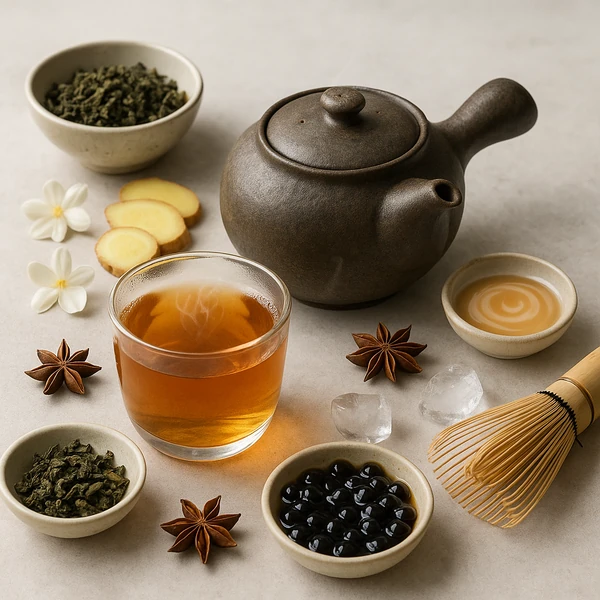
Modern Asian drinks are often designed to look good: layering colors, contrast of white milk and dark tea, vivid green matcha, dark “pearls,” clear ice cubes, bright citrus or fruit tones. This visual also relates to function:
- layers show texture (what will be at the bottom, what on top, what mixes),
- color signals taste (matcha vs. black tea vs. citrus),
- overall impression supports the drinking ritual – the drink is “read” with the eyes even before the first sip.
Drink in the context of food: when tea makes sense and when a sweet drink does
A modern Asian drink often stands on its own, but sometimes naturally pairs with food. If you prepare a specific cuisine at home, it might be helpful to consider the drink as part of the whole: for example, to Japanese food many people choose a cleaner tea profile, while with "street" and snack styles, more pronounced sweet and textured drinks fit easily.
If you feel tempted to combine them for one evening, practical projects often include homemade sushi (see sushi rice) or Indian style meals, where aroma of black teas and spiced milk tea are commonly used (many dishes use basmati rice).
💡 Common mistakes and what to watch out for
- "Tea" as a uniform flavor: green tea is not a single type. Chinese and Japanese green teas can differ even by the fact that in China they are often pan-fired, and in Japan they are steamed – resulting in a different character.
- "Chai" = spiced drink: in common speech, "chai" is used as a synonym for spiced Indian milk tea, but the word chai actually just means "tea." What is usually meant is masala chai.
- Matcha latte blend = matcha: in some blends, a large part is sugar and powdered milk. If you want the taste of matcha, always check the ingredients and product type.
- “Extra” texture without meaning: with textured drinks, it is easy to overdo the number of components. It is better to build the drink on one clear base (tea / milk / citrus syrup) and add one texture that provides contrast.
- Visuals as a trick: layering and color are not necessarily just effects. They are often part of how the drink is consumed and how it communicates taste and texture.
What to take away from the article
- Modern Asian drinks are based on tea, texture, visuals, and the possibility of personalization – they often work as a "drink as snack."
- "True tea" is Camellia sinensis; differences between white, green, oolong, or black tea are mainly in processing and origin.
- Bubble tea is a typical textured drink, but textures are a broader world (jelly, aloe, foams, slush, fruit pieces).
- Matcha is a traditional base that works in modern drinks also due to its color and ability to create a strong contrast with milk.
- Korean syrup bases like yuja (yuzu) and maesil show that Asian beverage culture is not just about tea leaves.
- The best prevention against disappointment is to read the packaging: origin, type of tea, ingredients, and form often say more than the name.

Read next
If you want to explore this topic further, continue with these related blog guides and articles:
