


 Česky (CZK)
 Slovensky (EUR)
 Deutsch (EUR)
 Austria
 Belgium
 Bulgaria
 Croatia
 Denmark
 Estonia
 Finland
 France
 Germany
 Greece
 Hungary
 Italy
Italy Latvia
 Lithuania
 Luxembourg
 Netherlands
 Poland
 Portugal
 Romania
 Slovenia
 Spain
Spain Sweden










Bubble tea, matcha drinks and other modern Asian beverages: how to understand taste, texture, and selection
Modern Asian drinks are not just "something sweet with ice." They often stand on a tea base, distinct aroma, and especially on texture – meaning the drink is not only sipped but sometimes also "bitten." In this guide, we clarify what makes bubble tea and matcha drinks so specific, their main variations, and what to watch out for so that taste and texture make sense.
🌶️ Modern Asian drinks: what is really typical about them
"Modern Asian drinks" is a broad category where traditional tea culture, urban street food, and contemporary café service meet. That's why bubble tea, matcha latte, milk teas, fruit teas, iced citrus drinks, or plum concentrates naturally coexist – along with older Korean and Japanese drinks, which today often get a modern form (for example, bottled or "to go").
In practice, three things repeat mainly:
- Strong connection to tea or tea base (even though the final drink can be milky, iced, or dessert-like thick).
- Combination of traditional ingredients with modern service – typically "traditional ingredient in a new form."
- Big role of texture: pearls, jelly, aloe, foams, layers, crushed ice. Texture is not decoration but part of the experience.
Personalization is also important personalization – many drinks commonly adjust sweetness level, amount of ice, or choice of "toppings" (textural add-ons).
Bubble tea (pearl milk tea): why it is so important
Bubble tea (often also called pearl milk tea) is one of the most distinctive modern Asian drinks. According to tourist materials from Taiwan Tourism Administration, it is a Taiwanese beveragebased on black tea, fresh milk and "pearls" made from sweet potato or tapioca starch. Its origin is connected with the city Taichung, where they looked for a way to give the classic drink a chewy texture.
This is key: bubble tea is not a phenomenon just because it is sweet. It is famous mainly because it combines several things into one "drink":
- a drink (tea base),
- texture (pearls and other add-ons),
- fun and "playful" service,
- individualization (sweetness, ice, toppings),
- a clear Taiwanese identity.
🌶️ What is unique about bubble tea (and why there are so many styles)
One reason bubble tea has so many variants is already in the "basic model":
- the base can be black, green, or oolong tea,
- it can be with or without milk,
- it can be hot or iced,
- the textural component can be tapioca pearls, but also jelly, aloe and other toppings,
- often sweetness is adjusted and ice quantity according to preferences.
In other words: bubble tea is a "platform" that can be adapted to taste and mood – and that is exactly what made it a cultural export.
Texture as part of the drink: pearls, jelly, aloe, foams, and crushed ice
Modern Asian drinks often stand on the principle that texture is part of the drink. In the European approach, a drink is typically mainly a liquid. But with textural drinks, often at the same time:
- you drink (tea, milk, syrup base),
- you bite (pearls, jelly, pieces of fruit),
- you perceive layers (for example creamy foam on top and tea below).
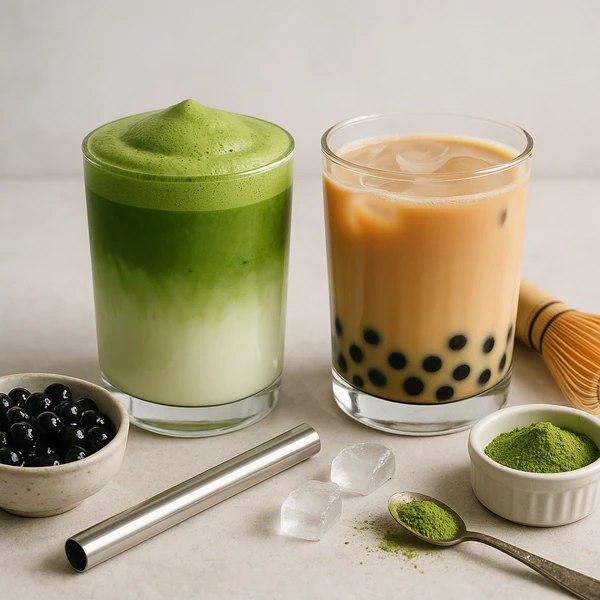
Bubble tea is the most famous in this, but the same logic appears elsewhere: jelly cubes, aloe pieces, fruit "pearls," creamy layers, tea foams (including milk foam or cheese foam), or crushed ice. Thanks to this, the drink can not only quench thirst but also entertain, sometimes lightly satiate and serve as a small sweet reward.
This connection is also close to part of the Asian dessert culture, where texture is often as important as sweetness itself – and where ingredients like starches (tapioca) or gelling agents (agar, various jelly types) are commonly used.
Matcha in modern drinks: traditional tea base in a café form
Matcha is finely ground green tea and at the same time a traditional ingredient that is very naturally used in modern drinks – just in a different service than people often associate with the classic idea of a "tea ceremony."
The key is that matcha tastes different from many common teas: it has its own character, typically working with umami and subtle bitterness. And that is why with modern matcha drinks it is so important not to treat matcha just as a "color."
Matcha latte, iced matcha, and other modern matcha drinks: how to keep the taste clear
Materials from MAFF for everyday use of Japanese tea show that matcha today commonly lives outside traditional forms – for example, in cafés and beverage establishments. In practice, you can encounter forms such as:
- matcha latte,
- iced matcha (iced matcha),
- matcha with milk and foam,
- matcha float,
- matcha-based smoothies and dessert drinks.
For most of these variants, a simple rule applies: don't overdo the sweetness. Matcha works best when its umami and subtle bitterness remain recognizable, milk does not "smother" it, and the sweet component balances rather than overpowers the taste.
How to navigate modern Asian drinks at home: choice of base and first steps
The easiest is to start by dividing modern Asian drinks according to their "core" into two groups: tea-based (where tea is supposed to play the main role) and more dessert-like (where tea can be present, but creaminess, texture, and sweet component are crucial).
1) Choose a tea base: not all "tea" is the same
It helps to know what true teais: it is a beverage made from leaves of the tea plant (Camellia sinensis). From one plant, green, white, yellow, oolong, black, and dark/post-fermented teas arise – the differences are mostly in processing (oxidation, heating leaves, rolling, aging).
This practically helps you mostly with drinks where you want the tea to "stand out":
- Green tea: fresher, vegetable to nutty tones; Chinese and Japanese styles can differ significantly (e.g., heating method vs. steaming).
- Oolong: a broad category between green and black tea – can be light floral or darker roasted.
- Black tea: often a more robust base, which doesn't get lost easily in milk drinks.
2) Check what you are actually buying: type, composition, form
With teas and tea blends, it pays to watch several things at once: origin (country/region), tea type (green/oolong/black/matcha…), composition (whether it is not rather a sweetened blend with dried milk) and form (loose tea vs. bags). One word on the package often decides more than the design.
With modern matcha drinks, it is important to consider that a matcha latte mix with sugar is not the same as pure matcha. If you expect the taste of matcha but reach for a heavily sweetened mix, the result will be different – and often unnecessarily "overly sweet."
3) Texture matters: treat pearls and toppings as a "time-sensitive" component
In bubble tea and similar drinks, texture is the main star. Tapioca pearls or other toppings are not "just an ingredient" – their consistency changes over time, so it pays to plan to drink when the texture is best.
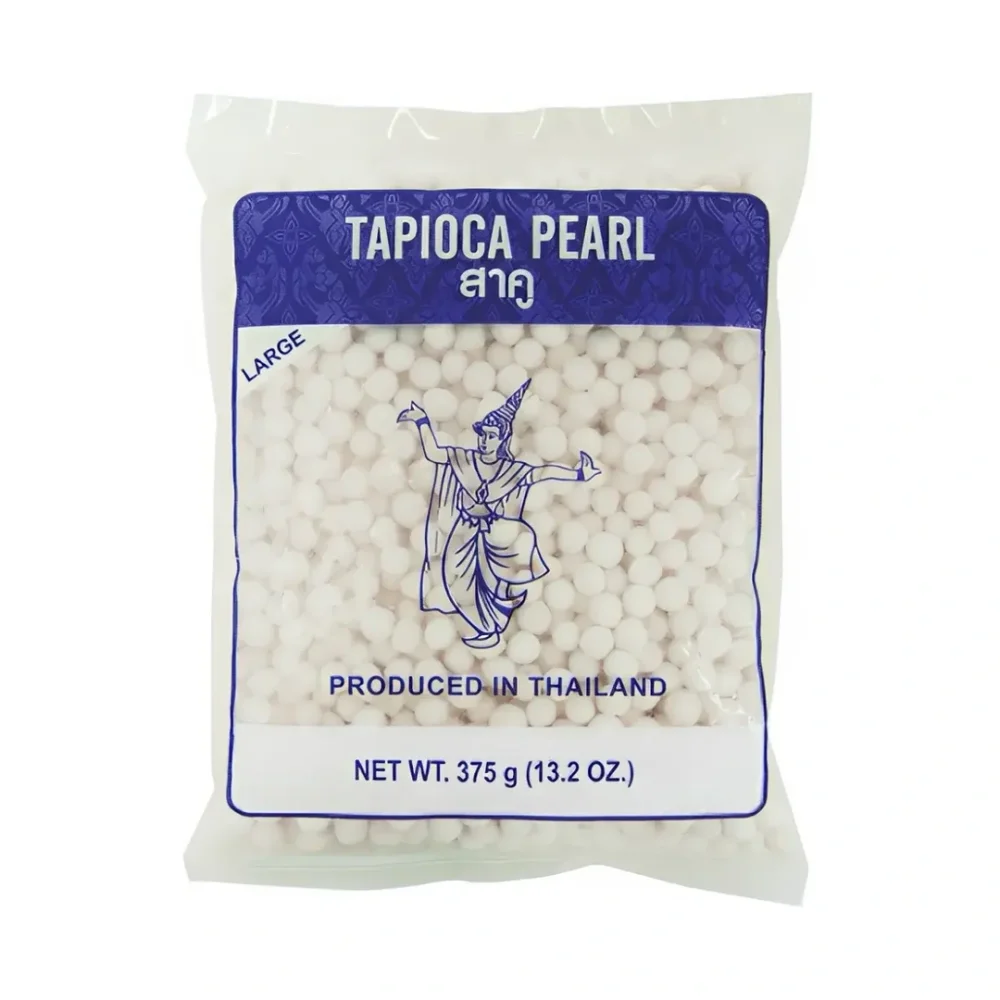
If you want to try homemade bubble tea, it makes sense to start with one proven textural component and only then add others. As a basic building block, for example, tapioca pearls Thai Dancer (size L) – after cooking, they have a flexible, chewy structure typical for bubble tea.
4) Take sweetness and milk as "settings," not as the main flavor
The two most common reasons why a modern Asian drink doesn't work at home are:
- too sweet an ingredient, which overpowers the tea and aromas,
- too heavy a milk base, which especially with matcha turns the drink into just "sweet milk with a green color."
A helpful approach is to adjust sweetness gradually (prefer adding in small doses) and for matcha to consider milk as a partner that softens the flavor but doesn't cancel it out.
💡 Common mistakes and what to watch out for
- "Bubble tea is just a sweet soda." No: its point is the combination of tea, texture, and customization. Ignoring the tea base means losing half the meaning.
- Underestimating texture. Pearls, jelly, or foams are a key experience. If toppings are left standing too long or an unsuitable combination of liquid and texture is chosen, the drink will seem "off," even if it tastes good.
- Confusing pure matcha with a sweetened mix. If you expect umami and subtle bitterness of matcha but use a heavily sweetened mix, the resulting drink will be of a completely different type.
- Too much sugar and milk at once in matcha. For modern matcha drinks, sweetness should balance the taste, not overpower it – and milk should not smother it.
- "Tea" as a universal label. Not everything commonly called tea is true tea from the tea plant. This affects taste and expectations for tea drinks.
What to take away from the article
- Modern Asian drinks often rely on a tea base, texture and customization options.
- Bubble tea is important mainly because it combined a drink and a "chewy" experience; it's not just about sweetness.
- For many modern drinks, it holds that texture is part of drinking (pearls, jelly, aloe, foams, slush).
- Matcha works great in latte and iced versions, but only when you don't overpower it with sugar and milk.
- For a home start, it's best to choose one clear direction (e.g., bubble tea with pearls, or simple matcha latte) and adjust sweetness gradually.

Read next
If you want to explore this topic further, continue with these related blog guides and articles:
