


 Česky (CZK)
 Slovensky (EUR)
 Deutsch (EUR)
 Austria
 Belgium
 Bulgaria
 Croatia
 Denmark
 Estonia
 Finland
 France
 Germany
 Greece
 Hungary
 Italy
Italy Latvia
 Lithuania
 Luxembourg
 Netherlands
 Poland
 Portugal
 Romania
 Slovenia
 Spain
Spain Sweden










What wok pan material makes sense at home (and when a wok actually makes no sense at all)
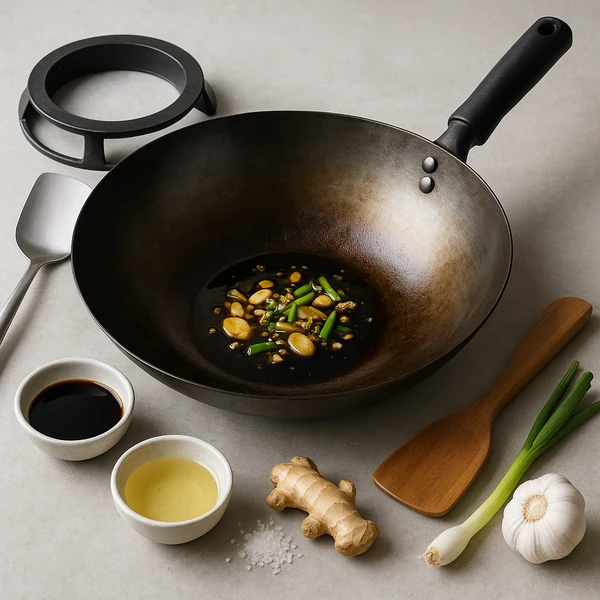
A wok is an iconic piece of cookware, but it doesn't automatically work well at home. The outcome is influenced much more than by its exotic shape by how you manage heat, what type of stove you have, the portion sizes you cook – and also by the wok's material and surface. In this article, we will clarify why carbon steel is most often recommended for home cooking, when heavy cast iron falls short, and what to watch out for to make a wok practical at home.
Why material matters with a wok: wok is mostly about working with heat
The wok is important not only because of its shape but also by how it handles heat. It has the shape of a shallow bowl that concentrates heat in the center while allowing food to be moved along the sides. This naturally creates different temperature zones during cooking: the greatest heat is in the center; milder areas on the sides where you can temporarily set aside ingredients.
Under the right conditions, a wok is excellent for stir-frying (fast frying with constant movement), quick frying, short sautéing, but it can also be used for boiling, braising, poaching, frying, and with a rack and lid, for steaming. Here, the material is not an “extra detail” – it determines how quickly and precisely you will be able to work with high heat and a fast rhythm.
At the same time, it's good to be realistic: on weak electric or induction cooktops, without a suitable bottom shape and sufficient power, a classic round wok will not work as it does in a professional kitchen. That's why in home cooking, it often makes more sense to choose a shape and material combination that matches your conditions – not the ideal from a video.
🌶️ What a wok means in home practice (and when you can do without it)
The most common mistake when equipping for “Asian cooking” is buying based on the exotic impression: wok, bamboo steamer, special spoons, knives, bowls... only to find out you don't use them at home. It's more practical to think according to function.
- Tools for very high heat: includes wok or pan, stove power, spatula, and overall working rhythm.
- Tools for steam: if you are attracted to dim sum, bao, dumplings, or steamed vegetables, steam equipment is often more important than the wok.
- Tools for rice and starches: for Japanese or Korean cooking, a rice cooker makes a lot of sense for many households.
- Preparation: cutting board, knife, small bowls for prepared ingredients – crucial for quick techniques like stir-fry.
In other words: a wok makes the most sense if you really cook dishes that rely on high heat and speed. If you are more interested in broths, long simmering, soup bases, and slow simmering techniques, a good pot might be more important than a top wok.
Wok materials most often encountered at home: carbon steel vs. heavy cast iron
Carbon steel: most often the best choice for home cooking
For home cooking, the best choice is usually mentioned as carbon steel. It is often recommended in home settings because the wok is meant to be a “working” vessel: fast, simple, without unnecessary surface treatments – and suitable for high temperatures and quick work in the stir-fry style.
Part of the reality of carbon steel is that you expect to care for the material. Even the question "Am I willing to care for the material, like carbon steel?" is, according to the recommended selection framework, more important than trying to find a universal answer for everyone.
Heavy cast iron: often impractical at home
In home settings, it is often indicated that carbon steel instead of heavy cast iron makes more sense. The main difference here in practice is not just about flavor – it’s about how comfortably you can work with the wok at a fast pace. Stir-fry is a technique where speed, order, and movement matter. If the vessel is hard to handle, it typically leads to slower cooking, ingredients braising rather than frying, and the wok not delivering what you expect.
Surface and seasoning: why a simple working wok pays off
For home cooking, it’s often recommended a simple working wok without unnecessary surface treatments. The reason is practical: the wok must handle high heat and fast work, while in real life you'll also have to consider long-term use and how the surface behaves.
In relation to woks, the concept of seasoning is frequently mentioned – the practice where the surface gradually “breaks in” with use. It’s important to consider this as part of the decision: if you want a material that will serve you well at high heat and fast frying, it's fair to expect to treat it as a working tool, not as decorative cookware.
Home reality: bottom shape and size often matter more than the material itself
Bottom shape: why a flat bottom often wins at home
A classic round wok can be problematic on weaker electric or induction cooktops. Therefore, flat bottoms are often recommended for home cooking. flat bottom instead of round. The logic is simple: if heat isn't transferred efficiently to the cooking area, you'll struggle to get the wok as hot as stir-fry needs.
Size: must fit the stove and portion size
Choosing the right size is just as practical: at home, it makes sense to choose a size that matches your stove and portion size. A wok is most effective when the ingredients contact the hot center and you can work quickly with them. If the wok is "off scale" for your burner/cooking zone, you lose control of temperature and rhythm.
How wok material relates to what you want to cook: 3 practical scenarios
Reasonable decisions can be based on a few questions: what dishes do I cook most often, do I need high heat or rather steam, how many portions do I cook, what kind of stove do I have, do I want a universal tool or a specialty, and am I willing to care for the material (e.g., carbon steel).
1) I often cook stir-fry and quick pan dishes
Here a wok makes a lot of sense. Its main strength is concentrating heat in the center, fast movement of ingredients, and working with temperature zones. For home conditions, a combination typically recommended is: carbon steel, flat bottom, simple working wok and a size matching how much you cook.
2) I’m mainly attracted to steaming (dim sum, bao, dumplings, vegetables)
A wok with a rack and lid can steam, but if steam is your main focus, steam equipment often helps more than finding "the best wok material." In other words: wok material isn't the key to success here – what’s more important is having a reliable way to work with steam.
3) I cook soups, broths, and slower dishes
Asian cuisine isn’t just fast wok cooking. Broths, slow simmering, stews, and long base cooking play a big role. In such a mode, a wok can be more a supplement than a basic tool. But if you want it as a universal vessel, consider its material and bottom shape primarily as a choice for working with heat – then as an “Asian symbol.”
🍳 Practical use: how to get what the wok (and its material) promises
Stir-fry is fast frying at high heat with constant movement of ingredients. It sounds simple but is a discipline. This is where it fully shows whether the wok’s material and shape make sense at home.
🌶️ What is key for stir-fry (and what to watch from the start)
- High heat: the wok must really be hot; otherwise, ingredients start releasing moisture and more steam than sear.
- Small amount of food in the pan: if you overcrowd the wok, the temperature drops and instead of frying you get braising. A practical test without numbers: ingredients shouldn’t form a shapeless heap; you need space to move.
- Correct ingredient order: in fast technique, timing is crucial. Adding everything at once means losing control.
- Speed and readiness: it’s good to have ingredients prepared beforehand as the actual cooking is short.
- Cutting: in Asian cooking, ingredients are often cut into small or thin pieces beforehand – for fast and even cooking, better sauce coverage, time-saving, and control of texture.
How to use wok’s temperature zones in practice
One of the biggest advantages of a wok is that it "doesn't cook evenly everywhere." The center is extremely hot, and on the sides, you have a milder zone. Practically, it means: you fry in the center, and when you need to pull something off the highest heat for a moment (to prevent burning or wait for the next step), you push it to the sides. This is one reason a wok can be so effective at home if the center really gets hot.
Common mistakes and misunderstandings: why a wok “doesn’t work” at home and how to fix it
Mistake 1: buying a wok based on impression, not what you cook
“Asian cuisine” doesn't require a full set. If you mainly do stir-fry at home, focus on wok/pan, stove power, spatula, and ingredient prep. If making dim sum or bao, steam equipment is more appreciated. Cooking Japanese or Korean styles often makes a rice cooker very useful. If you get the function right, you get the material right too.
Mistake 2: round wok on induction (and then frustration with low temperature)
In home settings, a flat bottom often makes more sense. If your stove can't heat the wok center effectively, the wok loses its main advantage: extremely hot center and fast frying.
Mistake 3: overcrowding the wok and expecting “wok results”
Among the most common stir-fry mistakes is too many ingredients in the pan. The result is often dull, watery, and without real sear. The fix is simple, though not always convenient: cook in smaller batches and maintain a fast rhythm.
🍜 Mistake 4: wok isn’t hot enough, or ingredients are too wet
Other common mistakes are insufficiently heated wok, long stirring without real sear, and wet ingredients steaming the pan. For a wok, the “temperature feel” is crucial: without high heat, the wok behaves completely differently than expected.
Mistake 5: adding sauce too early and everything starts to braise
Typical mistakes also include adding sauce too soon. With fast frying, you usually need to create sear first and then combine the dish. If you get confused, it almost always is a problem of order and timing, not a “lack of one miraculous ingredient.”
What to take away from the article
- Wok is primarily a tool for working with heat: it concentrates heat in the center and allows temperature zones – that’s why it’s great for stir-fry, but it can also boil, braise, fry, or steam.
- At home, carbon steel often makes the most sense and a simple working wok without unnecessary surface treatments – if you are willing to accept it as “working” material.
- On many home stoves a flat bottom wins; a round wok without suitable conditions can be a source of disappointment.
- Size must fit the stove and portion: an overcrowded wok steams instead of searing.
- The most common problems are not in the recipe, but in technique: temperature, amount in pan, ingredient order, speed, and readiness.

Read next
If you want to explore this topic further, continue with these related blog guides and articles:
