

 Česky (CZK)
 Slovensky (EUR)
 Deutsch (EUR)
 Austria
 Belgium
 Bulgaria
 Croatia
 Denmark
 Estonia
 Finland
 France
 Germany
 Greece
 Hungary
 Italy
Italy Latvia
 Lithuania
 Luxembourg
 Netherlands
 Poland
 Portugal
 Romania
 Slovenia
 Spain
Spain Sweden










Good equipment for Asian cuisine is not about having a "set" of Asian dishes at home. In practice, it is more important to understand, which tools really change the outcome, which just increase comfort, and which are rather optional for home cooking. This guide sets a simple framework: how to divide equipment by function, where to start, when a wok, steamer or rice cooker makes sense, and how to avoid the most common mistakes.
1) How to Think About Equipment Properly (and Not by "Exotic Impression")
The most common mistake when buying equipment for Asian cooking is shopping based on impression: someone sees a bamboo steamer, wok, chopsticks, porcelain bowls, cast iron pot, special spoons, and various knives and starts feeling that "Asian cuisine" requires a complete set. That is a mistake.
It's more practical not to perceive equipment as a style collection but as a set of tools for specific tasks. Once you clarify what type of dishes you actually cook at home (or want to cook), it becomes clear what you need right away and what can wait.
2) Six Functions by Which Equipment Is Chosen
For home cooking, it works well to divide equipment by function. This way you avoid buying "in stock" and better recognize what you really lack.
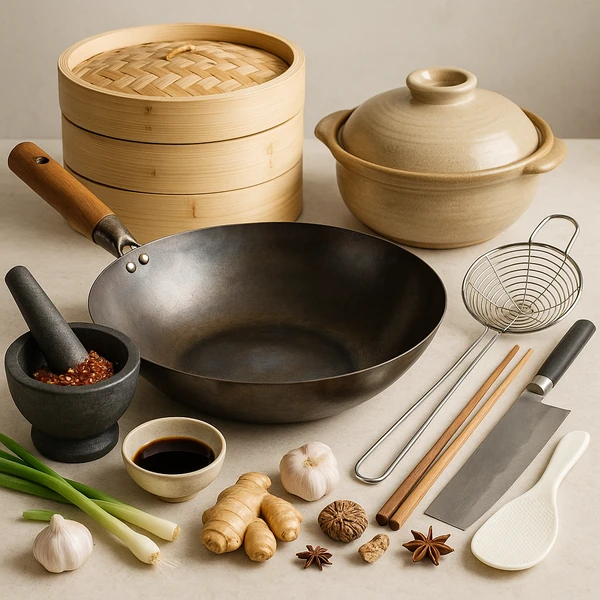
- Tools for very high heat – typically for quick stir-frying. Those who stir-fry often focus mainly on the pan or wok, stove power, spatula, speed of work, and readiness of ingredients.
- Tools for steam – for dim sum, bao (steamed buns), dumplings, or steamed vegetables. Here, steam equipment can be more important than the wok.
- Tools for rice and starches – typically a rice pot or rice cooker. Those cooking Japanese or Korean style can often benefit from a good rice cooker.
- Tools for cutting and preparation – knife, cutting board, bowls for prepared ingredients. In Asian techniques, preparation is often as important as cooking itself.
- Tools for crushing, grinding, and pastes – for example, a mortar and pestle. Those making Thai curry and chili pastes find a mortar very helpful.
- Tools for serving and dining – bowls, chopsticks, soup spoons. It's not just about aesthetics; the shape of the dish changes how the food is eaten and perceived.
This perspective is also practically useful: instead of asking "What should I buy for Asian cooking?", ask "What is currently stopping me from making the dishes I like?"
3) Equipment by Cooking Type: Basics, Second Wave, Specialization
A) Basics for beginners (highest value for home cooking)
This set allows you to cook a surprisingly wide range of Asian dishes without feeling something essential is missing:
- a good versatile knife,
- a larger cutting board,
- a quality pan or a reasonable wok,
- a rice pot or a standard pot with a lid,
- a fine sieve,
- several smaller bowls for prepared ingredients.
Smaller bowls for "mise en place" are often underestimated in Asian cooking; for fast techniques (like stir-fry), the work rhythm is crucial, and it's advantageous to have ingredients and sauces ready beforehand.
B) Second wave (for those who cook often)
- rice cooker,
- bamboo or metal steamer,
- mortar and pestle,
- spider strainer (mesh ladle),
- long chopsticks or tongs,
- a second larger pan or an additional pot for broths and noodles.
This "second wave" makes sense once you know what you cook repeatedly: someone may appreciate steam, another rice, another working with pastes or conveniently removing noodles from water.
C) More specialized equipment (once you know why)
- a wider range of steamers and molds,
- specialized knives,
- cast iron or ceramic vessels for specific dishes,
- table grills or hot pot equipment,
- tools for dumplings, bao, and delicate dough work.
This is equipment worth investing in only when you dedicate yourself regularly to a particular style. Otherwise, you risk having a tool that looks "right" but you don't use.
4) Wok: when it makes good sense and when not
Wok is a typical "icon" of Asian cooking, but it does not hold the same value for everyone. If you often cook at home quick stir-fry, it makes sense to get a wok (along with stove power, a habit of working quickly, and prepared ingredients). However, if you only use these techniques occasionally, it might be more sensible to start with a quality pan and take the wok as a next step when you know you will use it.
What to watch for in a wok
Instead of universal advice like "buy this wok," it’s more practical to check several features that determine whether it will work for you in home conditions:
- Material – different materials mean different care demands. If you know you don’t want to deal with maintenance, better admit it upfront rather than buying something you will resist using. With some materials (typically carbon steel), willingness to care for the surface is important.
- Shape of the bottom – the bottom must suit your type of stove (gas, induction, ceramic glass, or combinations). It’s not about "authenticity," but about contact and stability.
- Size – choose according to how many portions you usually cook. Too small a wok can be frustrating; too large can be impractical in a home kitchen.
- Surface and seasoning – some woks are designed to have their surface "cultivated" by use and care (seasoning). It is mainly important whether you are willing to accept this type of care as a routine part of cooking.
A good control question: Do I want one universal tool or a specialized utensil? Wok is a great helper but works best when you cook the way it's intended for.
5) Steam, rice, pastes: when a steamer, rice cooker, and mortar make sense
Asian cooking isn’t just about high heat. Many dishes rely on steam, good rice, and pastes or seasoning mixes prepared by crushing.
- Steamer makes a lot of sense if you want to make dim sum, bao, dumplings, or often steam vegetables at home. In that case, steam equipment can change your repertoire more than another pan.
- Rice cooker is a practical choice for those who cook rice often and want convenience and repeatability. Especially in home Japanese or Korean cooking, the benefit can be significant.
- Mortar and pestle is a typical helper for Thai curry and chili pastes – a cooking style where flavor is built by crushing and grinding aromatics into a paste.
An important principle: equipment for steam, rice, or pastes isn't "mandatory Asian cookware." It answers the question: What type of dishes do I really want to cook at home?
6) Chopsticks, spoons, bowls: small items that change the way of dining
Dining is not just an aesthetic addition. The shape of bowls, spoons, or chopsticks changes how food is eaten and perceived.
Chopsticks
Chopsticks are not universally the same. They differ in length, tips, material, and practical use. For home use, it’s good to distinguish two situations:
- long cooking chopsticks – useful for frying and handling hot food,
- dining chopsticks – can be shorter, longer, blunter, or sharper depending on the country (which affects how comfortably you can eat certain types of food with them).
Bowls
Many Asian dishes are eaten from bowls not just because it's "traditional" but because it’s functional: the bowl retains heat, allows comfortable mixing of rice, sauce, broth, and side dishes, and facilitates working with chopsticks and spoons.
Soup spoons
In broths, noodle dishes, and some desserts, wide soup spoons have real significance. They are not decoration but part of a practical way of consumption.
7) How to Choose Equipment Without Unnecessary Mistakes (practical decision set)
If you want to decide wisely and avoid unnecessary purchases, base your choice on a few questions. It’s not about everyone having the same equipment – it’s about the equipment matching your cooking.
- What dishes do I cook most often at home? (stir-fry vs. broths and noodles vs. dim sum and steam vs. curry pastes)
- Do I need high heat, steam, or rather precision and comfort?
- How many portions do I usually cook?
- Do I have gas, induction, ceramic glass, or combinations?
- Do I want a universal tool or a specialized utensil?
- Am I willing to care for the material (for example, carbon steel or bamboo)?
Once you answer these questions, it often becomes clear that the first purchase doesn’t have to be the "most Asian" but the most functional: a good knife, larger cutting board, one quality pan (or a reasonable wok), a pot with a lid, and bowls for preparation.
8) Common mistakes and warnings
- Mistakes like "I need a complete Asian set": most home dishes can be cooked with a small basic set. Special equipment makes sense only when you know you will use it.
- Buying based on looks instead of function: bamboo steamer or wok can be great but only if they match what you want to cook (steam vs. high heat).
- Ignoring stove type and size: especially for woks, compatibility with the cooking surface and the number of portions you cook matters.
- Underestimating care for the material: if you know you don’t want to manage maintenance (such as with carbon steel or bamboo), choose so that using it doesn’t discourage you.
- Specializing too early: tools for dumplings, bao, and delicate dough work are great but their value shows only with regular use.
What to take away from the article
- Equipment for Asian cuisine is not one "set" – it’s best chosen by function (high heat, steam, rice, preparation, pastes, dining).
- Start with a minimum of highest value: knife, cutting board, pan or reasonable wok, rice pot, fine sieve, and bowls for prepared ingredients.
- Wok makes the most sense when you often cook stir-fry and consider stove power and quick work rhythm.
- Steamer, rice cooker, and mortar are the "second wave" – get them according to whether you cook dim sum/bao, Japanese/Korean, or Thai curry and chili pastes.
- Chopsticks, bowls, and soup spoons are not just aesthetics: they really change comfort and how food is eaten.
- The best defense against unnecessary purchases is a simple question: what dishes do I cook most often and what type of heat/steam/comfort do I need?