


 Česky (CZK)
 Slovensky (EUR)
 Deutsch (EUR)
 Austria
 Belgium
 Bulgaria
 Croatia
 Denmark
 Estonia
 Finland
 France
 Germany
 Greece
 Hungary
 Italy
Italy Latvia
 Lithuania
 Luxembourg
 Netherlands
 Poland
 Portugal
 Romania
 Slovenia
 Spain
Spain Sweden










How to choose a wok: material, bottom, size, and how to actually use it at home
A wok is an iconic vessel of Asian cooking, but its advantage is not that it "looks Asian." It makes sense mainly when you use what it can do: concentrate extreme heat in the center, create different temperature zones, and allow fast handling of ingredients.
In this article, you will clarify when a wok is really worthwhile at home (and when it’s not), which parameters are key when choosing one, and how to use it so that the results match what you expect from a wok.
Why consider the wok: it’s not a "special pan," but a tool for a specific cooking style
Good equipment for Asian cuisine is not about collecting things that look exotic. This is doubly true for the wok: either you utilize its handling of heat and the fast cooking rhythm, or you will just have another big pan at home that does not behave on your stove as you expected.
A practical way to think about equipment is to look at it by function: what handles very high heat, what is for steaming, what is for rice and starches, what is for preparation and cutting, and what is just serving and dining. If you often make stir-fry at home (quick frying with constant movement), the wok is more essential for you than, for example, "Asian bowls." If you’re drawn to dumplings, dim sum, or steamed vegetables, you will appreciate steaming equipment more. And if you often cook Japanese or Korean food, a rice cooker can be key in practice.
🌶️ What is a wok and how it differs from a regular pan
A wok is a shallow "bowl" shape that concentrates heat in the center and allows ingredients to be moved along the sides. In practice, this means that one vessel has multiple temperature zones: the center is the hottest, the sides milder. Thanks to this, you can quickly fry part of the food and just "set aside" another part away from the highest heat without stopping the entire cooking process.
This heat management is precisely why the wok spread also for practical reasons: it can shorten cooking time and historically helped save fuel. So it’s not just a shape for effect but a functional tool for fast heat treatment.
When the wok makes great sense (and when you might be disappointed)
Under the right conditions, the wok is more versatile than many think. It's not only good for stir-fry: it can also boil, braise, poach, fry, and with a rack and lid, steam. However, its main strength still lies in fast work at high temperatures and the ability to use temperature zones.
At the same time, you need to be realistic. On a weak electric or induction cooktop (especially without a suitable bottom shape and sufficient power), a traditional round wok often does not perform like in a professional kitchen. The result is more often "braised food in a pan" than quickly fried ingredients. In this situation, the problem is not your skill but the combination of shape, power, and heat transfer method.
What to watch when choosing a wok: four parameters that change the outcome
1) Material: why carbon steel often pays off in home cooking
The most practical choice for home cooking is often carbon steel: it heats quickly and supports the cooking style typical for the wok well. In home settings, it often makes more sense than heavy cast iron because the wok is "hand equipment" – you work with it dynamically and want it to respond quickly.
2) Bottom shape: round vs. flat and why it matters more than the brand
The bottom shape directly decides whether you can create a really hot center and at the same time use the wok stably on a specific stove. If you cook on a regular home cooktop, a flat bottom often makes sense instead of the classic round one – precisely because of contact with the heating surface and the actual heat transfer.
On the other hand, a round wok can make sense where you have the right conditions for it (power and appropriate heating method). Without them, it is a common source of disappointment: the wok looks "right" but does not work as you expected.
3) Size: it must fit the stove and how many servings you usually make
Choose a wok that fits your stove and usual portion size. Too small a wok invites overfilling (and then the food steams). Too large can behave unbalanced on weaker heat – the center heats, but overall it’s harder to maintain the work pace the wok requires.
4) Surface and "seasoning": it’s normal for a working wok to change over time
With a simple working wok without unnecessary surface treatments, you need to expect that the surface will gradually "settle in." With carbon steel, this is often called seasoning – simply put, creating a protective layer and patina by use. Don’t see it as a flaw: it’s part of why such a wok suits quick frying and why it behaves differently in practice than "cookware that must always remain shiny."
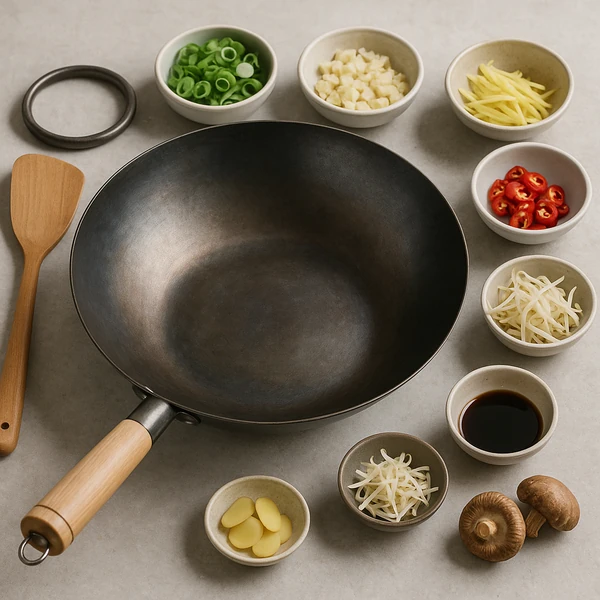
🍳 How to use a wok at home so it works: speed, discipline, and preparation in advance
Stir-fry is not just "stirring": the key is high heat and small amounts of food
Stir-fry is quick frying at high heat with constant movement of ingredients. It sounds simple, but it’s a technique that requires precision. To make the wok really fry (and not stew), it helps to follow some rules:
- Don’t overfill the wok – when there are too many ingredients, they release juice, the temperature drops, and instead of frying, everything steams.
- The wok must be really hot – without this, the typical fast "wok character" does not appear.
- The order of ingredients matters – each ingredient needs a different time; if you stir without a plan, some parts will be overcooked and others underdone.
🍳 Preparation of ingredients: why cutting is so important in Asian cooking
In Asian cooking, ingredients are often cut into small or thin pieces before cooking. It’s not just because of chopsticks but mainly to ensure everything cooks quickly and evenly to allow the ingredients to coat well with sauce and keep the work rhythm. The wok naturally "pushes" you toward this preparation style: if you start cutting only when the wok is hot, you sabotage the technique yourself.
🍜 Sauces and wet ingredients: when to add them so the food doesn’t turn into stew
One of the most common causes of disappointment is sauce added too early or ingredients that are too wet. If liquid quickly accumulates at the bottom, the wok stops frying. A practical rule is simple: first create the sear and structure, only then add the sauce and finish the flavor connection.
The wok is not just for stir-fry: when to use boiling, braising, or steaming
An advantage of the wok is that it can handle more techniques: you can boil or braise in it, and with a rack and lid, steam. This is useful if you want one versatile vessel that besides fast frying can also handle gentler tasks (like poaching or preparing simple broth bases). It’s just good to distinguish when you want to use the wok "wok-style" (quickly, at high heat) and when you use it simply as a practical deeper vessel.
Most common mistakes when choosing and using a wok (and how to avoid them)
- Buying based on impression instead of function – the wok is not a mandatory "Asian gadget." If you don’t make fast wok dishes at home, other equipment (a good knife, cutting board, prep bowls, etc.) can improve your cooking more.
- Round wok on a stove where it doesn’t make sense – without suitable heating and power, the expected wok behavior does not show up. At home, choosing a flat bottom often helps.
- Overfilled wok – instead of frying, the food steams. If you need more portions, cook in batches.
- Sauce added too early – the food starts to stew before it gets a sear. First sear, then sauce.
- Wet ingredients – water is the enemy of high temperature; ingredients then release liquid and reduce the heat.
- Expectation of a "maintenance-free" working surface – it’s normal for a simple wok’s surface to change with use. If you don’t expect this, you might think the wok is "low quality," while it is just different from an ordinary pan.
What to take away from the article
- The wok makes sense mainly for fast cooking at high heat and for working with temperature zones (hot center, milder sides).
- At home, a flat bottom often wins – heat transfer and stability are more important than the "traditional" shape.
- Carbon steel is often a practical choice for a home wok, because it supports quick heat response and work rhythm.
- The technique influences the result more than the wok itself: don’t overfill, have everything cut in advance, add sauce at the right moment.
- The wok is more versatile than it looks – besides stir-fry, it can also boil, braise, poach, fry, and (with a rack and lid) steam.

Read next
If you want to explore this topic further, continue with these related blog guides and articles:
