


 Česky (CZK)
 Slovensky (EUR)
 Deutsch (EUR)
 Austria
 Belgium
 Bulgaria
 Croatia
 Denmark
 Estonia
 Finland
 France
 Germany
 Greece
 Hungary
 Italy
Italy Latvia
 Lithuania
 Luxembourg
 Netherlands
 Poland
 Portugal
 Romania
 Slovenia
 Spain
Spain Sweden










How to choose a kitchen knife for Asian cooking: what really matters on the cutting board
Many people focus mainly on the wok, but a large part of the result of Asian cooking is decided before the stove is turned on: on the cutting board. The size, thickness and uniformity of cuts affect cooking speed, texture and whether different ingredients cook evenly. In this article we'll clarify which knife makes the most sense for home Asian cooking, what to expect from the “Chinese cleaver” and how to avoid mistakes that spoil the result and safety.
Why decisions in Asian cooking are often made on the cutting board
Asian dishes are often cooked quickly, at high temperature and in short steps. That means a cook cannot "finish off" mistakes made during prep: if pieces are too large, uneven, or if you cut during cooking, some parts will overcook, others will stay tough and the whole dish will lose its rhythm.
That's why for home cooking a reliable knife and a work surface usually have high value. It's not about collecting exotic tools, but about tools that change the outcome almost every time.
What a “good knife” means for Asian cooking (and what belongs with it)
In practice there is no single “right Asian knife” type. What matters is that the knife allows you to prepare ingredients as Asian techniques typically require:
- Sharpness and control of the cut – so you can make thin slices of meat and even pieces of vegetables without crushing or tearing.
- Uniformity – so you can cut repeatedly the same way (not "by eye" different each time).
- Comfort and confidence in the hand – because Asian prep often means more cutting ahead of time (mise en place) and a faster working pace.
- A stable larger cutting board – without it even a good knife won't help, because the work will be uncertain and chaotic.
- A system for moving chopped ingredients – for stir-fry and similar dishes you need to quickly send ingredients from the board to the pan. A wide blade or a “spatula-like” way of working is a big advantage.
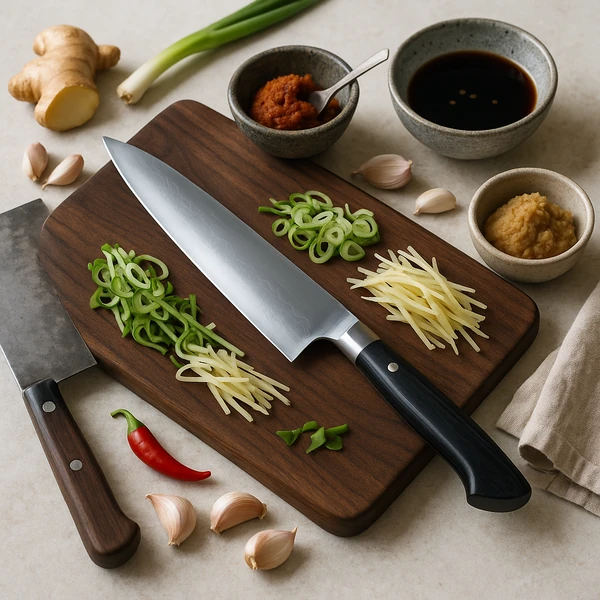
From a practical point of view it often turns out that the biggest difference is not made by the most "Asian-looking" knife, but by the combination: a sharp versatile knife + a large stable cutting board + prepared ingredients in bowls or piles.
Main variants: a versatile knife, a wide Chinese cleaver and a small detail knife
For home Asian cooking three practical roles recur. You don't have to have them all at once, but it's good to know what each option addresses.
1) Sharp versatile knife (chef's knife)
This is the safest start: one knife with which you can handle vegetables, herbs, tofu and regular meat work. For a beginner it's more important that the knife is reliably sharp and comfortable to use than that it's a "specialty" for a particular cuisine.
2) Wide “Chinese cleaver” (and why there's confusion around it)
Many people imagine a “Chinese cleaver” as a heavy tool for bones. But in Chinese-style cooking often lighter, more versatile wide knives are also used lighter, more versatile wide knives, which are not primarily intended for cutting bones but for everyday cutting of vegetables, meat, herbs and tofu.
Their big advantage for home Asian cooking is also practical: the wide blade works like a “scoop” for carrying chopped ingredients from the cutting board to the pan. That speeds up work and helps keep things tidy.
Important warning: the “Chinese cleaver” is not one single thing. If someone expects a bone tool and buys a wide versatile knife (or vice versa), unnecessary disappointment and the risk of misuse can arise.
3) A smaller knife for more detailed work
Alongside the main knife a second smaller knife may make sense for finer tasks that require more precision (for example small finishing touches, cleaner trimming or work with small ingredients). It's not a necessity for everyone, but for frequent cooking it's practical.
How to choose a knife based on what you cook: the cut must match the technique
The key rule is: the cut (and thus the choice of knife) must match the technique. There is no single “best cut” for everything – and the same logic applies to which knife will suit you best.
For wok and stir-fry: speed, small even pieces
- Expect that you'll be cutting more smaller and even cuts.
- Meat typically works better in thinner slices (so it can quickly sear).
- Vegetables are worth cutting with regard to hardness and time: harder pieces smaller/thinner, softer ones larger.
- Avoid large pieces that won't "finish" cooking before other components are done.
For this style of cooking a wide blade (for moving ingredients) or at least a convenient way to quickly send ingredients from the board to the pan is very practical.
For soups and broths: the base can be heartier, the topping finer
- Aromatics for the base (for example “base” pieces) can be larger and heartier.
- Final components for the finished bowl (toppings) often work better finer.
- It helps to distinguish what goes into long simmering and what goes in at the end – you choose the cut accordingly.
For salads and cold dishes: delicacy and easy eating
- Important are tenderness and “eatable size” – pieces should be easy to pick up and eat.
- Shape affects how much dressing an ingredient holds; therefore it's worth cutting deliberately, not randomly.
For grill and roasting: pieces must withstand longer time
- Pieces must endure longer heat without drying out.
- Thin parts must not burn before thick ones – that's why it's important to cut so they behave similarly.
For dumplings, pancakes, fillings: hold together but don't turn into a paste
- The filling should hold but not feel like a shapeless paste without texture.
- The cut (fine dice vs. coarser pieces) will affect juiciness and the "bite" of the filling.
Practical work at home: how to simplify prep and improve results
Asian-style cooking often relies on preparing ingredients ahead of time and then quickly assembling the dish. Here are procedures that have an immediate effect even without changing the recipe.
Mise en place: cut ahead, not during cooking
- Prepare your cuts in the order the ingredients will go into the pan/pot.
- Work with smaller piles or bowls so you don't mix ingredients with different cooking times.
- In stir-fry it's the difference between smooth cooking and "chasing" the pan while you finish cutting.
Uniformity is more important than “perfect shape”
For even cooking it's often crucial that pieces are similarly sized. They don't have to be geometrically perfect, but extremes shouldn't meet side by side (a large chunk of carrot next to a thin slice that burns).
A wide blade as a tool for moving ingredients
If you use a wide knife (Chinese style), use it as a “spade”: scoop ingredients onto the blade and quickly transfer them to the pan. In practice this speeds work and reduces spillage around the kitchen. If you have a classic chef's knife, it's still worth having a way to move ingredients quickly (and above all not to overload the cutting board).
🍜 Don't throw wet ingredients straight into the pan
One of the mistakes that spoils the result the most (and often makes working at high heat harder) is tossing wet ingredients into the pan. Practically this means: after rinsing or marinating, make sure ingredients going into the pan are as little "watery" as possible (depending on the dish you may just let them drain or pat them briefly dry). This also applies to cutting: when you have a clean, sharp cut and reasonably dry ingredient, work is faster and more controlled.
💡 Most common mistakes and what to watch for (including hygiene)
Some mistakes are "just" culinary, some are safety-related. In Asian cooking, where several components are often prepared ahead and at high pace, both categories tend to meet.
Mistakes that spoil the result the most
- Cutting "by eye" regardless of technique.
- Too large differences in piece sizes.
- Cutting during cooking.
- Throwing wet ingredients into the pan.
- Insufficient separation of hard and soft components (then one part falls apart and the other stays raw).
- Confusing a cut suitable for salad with a cut suitable for wok.
- Working on an overcrowded and untidy workstation.
Knife, cutting board and hygiene: simple rules that save trouble
- Ideally separate the cutting board for raw meat and the cutting board for vegetables or ready components.
- After working with raw meat wash everything thoroughly (knife, cutting board, hands, work surface).
- Do not use deeply damaged cutting boards that are hard to clean.
- Do not transfer raw juices onto ready components with a “dirty” knife.
- Quick cooking is no excuse for mess: when you prepare multiple bowls, knives and boards, the risk of cross-contamination increases – a system is essential.
Takeaways from the article
- In Asian cooking preparation often decides the outcome: size, thickness and uniformity of cuts affect cooking speed and final texture.
- For a home start a sharp versatile knife, a stable larger cutting board and a simple system of prepping ahead are usually enough.
- A “Chinese cleaver” is not automatically a heavy bone tool – it is often a wide versatile knife for everyday cutting and quick transfer of ingredients.
- Cuts must match the technique: different cuts work for stir-fry, soups, salads, grilling or dumpling fillings.
- The most common problems are uneven pieces, cutting during cooking, wet ingredients in the pan and underestimated hygiene of knives and cutting boards.

Read next
If you want to explore this topic further, continue with these related blog guides and articles:
