


 Česky (CZK)
 Slovensky (EUR)
 Deutsch (EUR)
 Austria
 Belgium
 Bulgaria
 Croatia
 Denmark
 Estonia
 Finland
 France
 Germany
 Greece
 Hungary
 Italy
Italy Latvia
 Lithuania
 Luxembourg
 Netherlands
 Poland
 Portugal
 Romania
 Slovenia
 Spain
Spain Sweden










Summer rolls, Asian salads, and cold noodle bowls: how they work and how to assemble them at home
Asian cold dishes are not "lighter versions" of hot cuisine nor just vegetables with dressing. Their strength lies in freshness, herbs, acidity, a strong umami base (often from soy or fish sauces), clever textures, and a dip or dressing that holds the whole meal together. In summer, this gives you a quick lunch, dinner, or practical meal to-go – and often a full main dish, not just a side.
Why Asian cold dishes are such a good idea in summer
In many parts of Asia, cold or lukewarm dishes have a clear practical role. They make sense in warm and humid climates: they refresh, don’t feel heavy, and naturally work with herbs, citrus, and acidic components. At the same time, they fit perfectly with urban rhythm and street food culture – many dishes can be quickly assembled, seasoned, and eaten without long cooking.
The "flavor logic" is also important: the cold format is ideal for herbs, acidity, chili, and light umami elements. Thanks to this, the dish can feel extraordinarily lively even without complex heat treatment.
🌶️ What is typical for summer rolls, Asian salads, and cold noodle bowls
The most common misunderstanding is the idea that "cold food" automatically means raw, diet, or bland. In the Asian context, this often works exactly the opposite: cold dishes tend to be flavorful and technically precise – just built on different pillars than hot cuisine.
- Herbs and fresh vegetables are not decorations but the main flavor engine.
- Acidity works as an active element that "opens up" flavor (and helps the dish not to taste flat).
- Umami base is often made by fish sauce, soy sauces, or other strong seasonings – in small amounts but with a big effect.
- Spicy accent (chili) is usually more of a "final spark" than dominant heat.
- Textures are key: soft vs. crunchy, juicy vs. elastic (typically noodles), sometimes even pickled elements.
- Dressing or dip is as important as the "filling" itself. Often it decides if the dish tastes like just a mix of ingredients or a finished meal.
That’s why it pays off not to think only in categories "salad = leaves + dressing," but rather "cold dish = freshness + acidity + umami + texture + the right dip/dressing."
Three summer formats: rolls, salads (not just leafy), and cold noodle bowls
The names often overlap in practice, but at home, it helps to divide the cold world based on how it is eaten and what holds the flavor together.
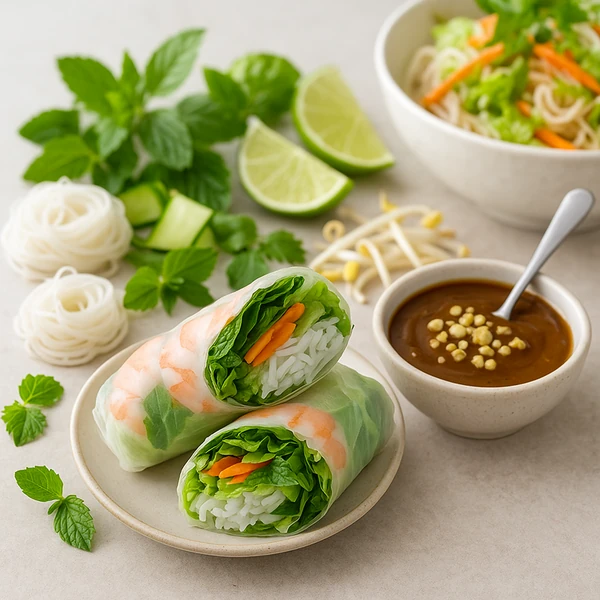
1) Vietnamese fresh rolls (gỏi cuốn): rice paper, herbs, and dip
Vietnam is a great example of how cold food can be both light and satisfying. Fresh Vietnamese rolls gỏi cuốn (often simply called "summer rolls" here) typically rely on a combination of:
- rice paper,
- fresh herbs,
- rice noodles,
- vegetables,
- shrimp, pork, or a vegetarian filling.
Their strength is not in heat treatment but in freshness, texture, and especially the fact that they come with the right dip. Without the dip, a roll easily feels "just like wrapped salad." With the dip, it starts to make sense as a complete dish.
Vietnam also shows that "roll" isn’t just a cold handheld roll: there are other rolled worlds (for example bánh cuốn and related forms) that work with softer rice sheets and can be cold or lukewarm. For home reference, it’s a useful reminder: rolling isn’t one technique but a whole family of approaches.
2) Asian "salad" is often not a leafy salad
In the Asian context, the word "salad" can mean much more than a bowl of leaves. It’s often a seasoned mix, where dressing plays the main role and textures are as important as the vegetables themselves. Such a salad naturally includes noodles, tofu, seafood, or grilled meat – and it still makes sense because the salad is not a "side," but a format.
Practical note: if you want a cold salad to feel "ready," follow the dressing. Vegetables without a clear direction taste "clean." Seasoned salad tastes "like food."
3) Cold noodle bowls: noodles as a centerpiece, not a side
Cold (or lukewarm) noodle bowls are great because the noodles aren’t a supplement – they form the body of the dish and carry the dressing, toppings, and texture. In Vietnamese cuisine, there is a strong logic behind bowls built on:
- cold or lukewarm noodles,
- grilled meat or tofu,
- herbs,
- pickled vegetables,
- dressing in the style of fish sauce.
This model is an excellent "home compass": when you have noodles and dressing, you can build the rest according to season and taste – and it will still work.
Cold bowls and snacks are important in other street food contexts as well – for example, the Taiwanese approach (night markets and small eats) shows that cold food can be short, texturally playful, and ideal for urban rhythm: cold noodles, light bowls, snacks with sauce, pickles as contrast.
How to choose noodles for cold bowls (and why they can’t all be "lumped together")
Asian noodles are not one thing but a large family of products that differ in ingredients, structure, elasticity, and how they behave after cooking and cooling. For cold dishes, it is crucial to choose noodles based on function: they must hold texture even after cooling and should not fall apart when mixed.
For basic orientation, it’s useful to perceive noodles based on what they are made from:
- Wheat noodles: a huge group ranging from very thin to thick; some types are used in cold preparations and dips.
- Rice noodles: typical for many Southeast and East Asian cuisines; often work very well in light cold bowls and rolls.
- Buckwheat noodles (e.g., soba): appear in some Japanese styles even in cold seasonal versions.
- Starch and "glass" noodles: bring different elasticity and a different type of "bite," can be interesting when you want a lighter and more elastic texture.
- Special variants (e.g., konjac): there are special types targeting specific needs, but for the flavor logic of bowls, function and texture are more important than the "trendy" category.
It is also important that some noodles (e.g., ramen) have typical elasticity due to an alkaline component (kansui) and easily get overcooked – this shows up very quickly in cold dishes. Therefore, it pays to treat cooking noodles as a separate step, not "something you just boil."
How to assemble a cold noodle bowl or rolls at home so they taste "finished"
The following procedure is not a recipe for one specific dish, but practical onboarding: how to compose cold Asian food so it holds flavor and structure.
Step 1: Decide if you want "to hand" or "in a bowl"
- Rolls require ingredients that can be layered into rice paper and hold shape (herbs, noodles, vegetables, protein).
- Bowls can take a looser composition and are ideal when you want to add pickled components and more dressing.
- Salad is the quickest but requires a well-tuned dressing, otherwise it will seem unfinished.
Step 2: Watch time and texture for noodles
In cold bowls, noodle texture matters more than in many hot dishes – because over- or undercooking shows after cooling.
- Don’t overcook them. A common mistake is that noodles are overcooked in the pot and then "finished off" in sauce or by standing too long. The goal for cold bowls is elasticity and clear bite.
- Separate them after draining. Some noodles tend to stick after draining – quick stirring and using them without long waiting helps.
- Choose noodles according to role. For cold, look for those that hold structure after cooling; other types are made for broth or wok and may feel "off" in a cold bowl.
Step 3: Build flavor on dressing (not on "too many things" )
Cold dishes often fail not because they are "lacking ingredients," but because they don’t have a clear flavor control element. In Asian cold cuisine, this role is typically played by dressing or dip.
- Acidity (e.g., citrus or other acidic component) gives the dish energy and "cleanliness."
- Umami and saltiness (often through fish sauce or soy base) provide depth even without cooking.
- Chili should be taken as a final accent: a small amount often does more service than "overheating" the whole bowl.
As a rough guide: for one serving of a bowl, start with a small amount of dressing (about 1–2 tablespoons), mix, and adjust. For rolls, consider that flavor mainly comes from the dip, so the filling can stay cleaner and more herbal.
Step 4: Add fresh contrast and textures
Textural contrast is essential for the cold world. In practice, this means mixing at least two to three "characters":
- soft (noodles, tofu, meat),
- crunchy (fresh vegetables),
- juicy (part of vegetables, herbs),
- elastic (noodles, some starch components),
- pickled (pickles) as acidic contrast.
In Vietnamese logic of cold bowls, the connection of noodles, herbs, pickled vegetables, and fish sauce-based dressing is very natural – and the pickled element often makes the difference between "salad" and "finished dish."
Step 5: Protein as a supplement (not as the only source of flavor)
In cold bowls and rolls, shrimp, pork, or vegetarian versions are often used; in bowls, also grilled meat or tofu. Practical advice: take protein as texture and satiety while leaving the main "flavor control" to dressing, herbs, and acidity. This keeps the dish light and summery.
Most common mistakes with summer rolls and cold bowls (and how to quickly fix them)
- "Cold = bland" – usually lacks acidity or umami base. Fix: adjust dressing to be clear (acidic + salty/umami + lightly spicy), not just "oily" seasoning.
- Confusing noodles by dish name, not by function – "Asian noodles" are not universal. Fix: choose noodles based on whether they need to hold in a cold salad/bowl, broth, or wok.
- Overcooked noodles – in cold bowl, disintegration and sticking is most obvious. Fix: shorten cooking time, watch texture, and quickly process noodles after cooking.
- Noodles stuck together after draining – form "one block" which the dressing doesn’t coat evenly. Fix: separate noodles immediately after draining and use without long waiting.
- Bad sauce-to-noodle ratio – fine noodles can easily "drown" in heavy sauce, thicker noodles may feel dry. Fix: add dressing gradually and mix; goal is coating, not bathing.
- Ignoring composition – a typical mistake is to assume all rice noodles are gluten-free or every soba is purely buckwheat. Fix: the specific composition matters, not the name.
- Too many ingredients without direction – cold food then tastes like "a bowl of everything." Fix: stick to one flavor style (dressing/dip) and build around it freshness + textures.
What to take away from the article
- Asian cold dishes are not "vegetables with dressing" – they are full formats where dressing/dip, acidity, herbs, and texture matter.
- Summer rolls (gỏi cuốn) rely on rice paper, herbs, noodles, and the right dip; without it, they feel unfinished.
- "Salad" in the Asian sense is often not leafy – it can be a seasoned mix where flavor is held by dressing and umami base.
- Cold noodle bowls work when noodles hold texture after cooling and when there is a clear contrast in the bowl: herbs, acidity, possibly pickles.
- The most common home problem is the wrong choice of noodle type and their over-/undercooking; the second most common is a flat dressing without acidity and umami.
If you enjoy this world, the next logical step is to pick one format (rolls or noodle bowl) and repeat it a few times with small variations. Repetition will quickly show you how much difference proper noodle texture, fresh herbs, and a clearly directed dressing make.

Read next
If you want to explore this topic further, continue with these related blog guides and articles:
