


 Česky (CZK)
 Slovensky (EUR)
 Deutsch (EUR)
 Austria
 Belgium
 Bulgaria
 Croatia
 Denmark
 Estonia
 Finland
 France
 Germany
 Greece
 Hungary
 Italy
Italy Latvia
 Lithuania
 Luxembourg
 Netherlands
 Poland
 Portugal
 Romania
 Slovenia
 Spain
Spain Sweden










Steamers, rice cookers, and other helpers: what you will really use at home (and why)
Good equipment for Asian cooking is not about "having a special set," but about choosing a few tools that really change the outcome or significantly simplify the work. This applies twice as much for steaming and rice: the right steamer and a sensible approach to cooking rice will help you maintain texture, moisture, and cooking rhythm – without unnecessary purchases based on impressions.
First clarify what the equipment should change: outcome vs. convenience
The most common mistake when "equipping Asian style" is shopping based on exotic impressions: bamboo steamer, wok, chopsticks, special spoons, various knives... and a person feels that without a complete set it won't work. It's more practical to think functionally: which tools you need for a specific technique you want to repeat at home.
In home reality, it makes sense to divide equipment according to functions:
- Tools for very high heat (typically quick frying, stir-fry).
- Tools for steam (steaming dumplings, bao, vegetables, fish, tofu, warming up).
- Tools for rice and starches (rice as a meal base, rice bowls, working with different types of rice).
- Tools for cutting and preparation (work pace, cleanliness and “mis en place” – prepared ingredients).
- Tools for crushing and pastes (e.g. curry and chili pastes – typically a mortar).
- Tools for serving and dining (useful, but often a second wave).
From this perspective, it immediately becomes clearer why someone values mainly a pan/wok and quick handling, while another benefits most from a rice cooker or steam equipment: it depends on what cooking style you do most often at home.
🌶️ What has the highest value for home cooking (and what is more of an “afterwards”)
Instead of a long list, it is more useful to think in waves: the minimum that lets you make many dishes; then expansions for frequent cooking; and finally specialization only when you know you will really use it.
Basic for a beginner: to make cooking flow
- A good universal knife and a larger cutting board (speed and order when preparing ingredients).
- A quality pan or one reasonable wok (if you do stir-fry).
- An ordinary pot with a lid (for rice and many other things).
- Fine sieve (for straining broths, sauces, starch mixtures).
- Several small bowls for prepared ingredients (mis en place – essential for fast dishes).
This is a set with which you can cook a large number of Asian dishes without feeling that you are missing something essential.
Second wave for those who cook often: comfort and consistency
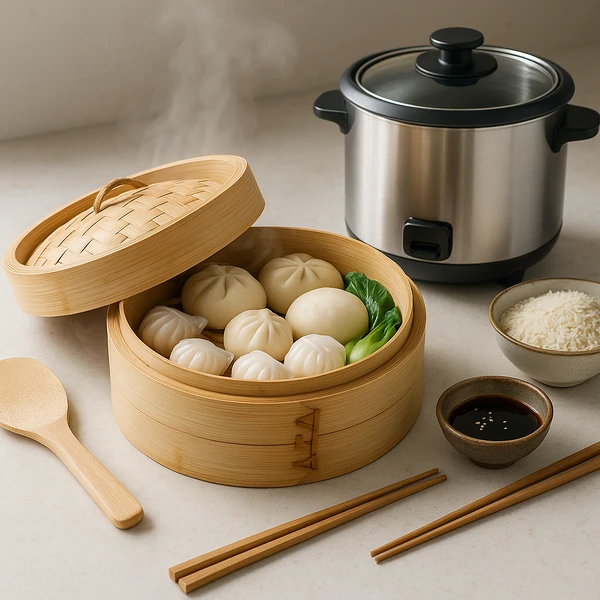
- Rice cooker (when rice is a regular staple at home).
- Bamboo or metal steamer (dim sum, bao, dumplings, vegetables, fish, tofu, and warming).
- Mortar (those who make Thai curry and chili pastes often notice the difference right here).
- “Spider” / wire skimmer (for lifting noodles, dumplings, and fried pieces).
- Long chopsticks or tongs (for frying and handling in heat).
- Another pot or larger pan (when cooking multiple things in parallel – broths, noodles, sauces).
Specialization: only when you know it is “your” style
A wider range of steamers and molds, specialized knives, cast iron/ceramic cookware for specific dishes, tabletop grills or hot pot equipment and tools for dumplings and finer work with dough make sense mainly when you use them regularly and intentionally. Otherwise, at home, they often just take up space.
Steaming in practice: bamboo, metal, and why “steam flow” is often more important
Steaming is a fundamental technique in Asian kitchens because it preserves the delicacy, moisture, shape, and pure flavor of ingredients. It is suitable for dumplings, bao, vegetables, fish, tofu, some desserts, and simple warming without drying out.
Home solutions, however, don’t need to be complicated. The basic options are:
- Bamboo steamer over a wok or pot.
- Metal steaming basket.
- Multi-tier stainless steel steamer.
- Steaming insert for a standard pot.
🍽️ Bamboo steamer: light, compact, and good for serving
The bamboo steamer is practical, stacks well, and works great for smaller portions even just by placing it directly on the table. But it has its demands:
- It needs to dry after use.
- It doesn’t like prolonged soaking (bamboo is not a “pot”).
- It’s good to protect the bottom with paper, a leaf, or a perforated insert so food doesn’t stick.
These are small details that decide whether working with bamboo will be a joy or a series of sticking and soaking.
Metal steamer: durability and easier maintenance
Metal steamers and baskets tend to be more durable and often easier to maintain. They may seem less “traditional,” but in a typical home they are often very practical – especially if you want to quickly steam vegetables, fish or tofu and then wash and put away without worries.
🌶️ What's more important than material: stable steam and the right size
In steaming, what often matters more than material is that your set fits well size-wise and that there is a stable steam flow. When containers don’t fit, steam escapes from the sides, condenses where you don’t want it, and the result is inconsistent. It’s also useful to remember that a steamer isn’t just “for dim sum”: at home, it often saves the day even for warming, which needs to remain juicy and not dried out.
Rice cooker and rice: when it makes sense and when a pot is enough
Rice is more than a side dish in many Asian kitchens. It is often the center of the meal – the framework around which other flavors, textures, and sides are arranged. That’s why it makes sense to think about how you cook it at home: it’s not just about convenience but also about consistency of the result.
When you typically appreciate a rice cooker
If you cook at home in a style where rice is really a daily staple, a rice cooker is often a very grateful helper. From the materials selected, it appears it mainly makes sense for those who cook Japanese or Korean style – that is, in kitchens where rice frequently appears as a regular, stable base for other bowls and sides.
When an ordinary pot with a lid is enough
For broad home use, a simple pot with a lid is perfectly fine. More important is that you choose rice depending on what you want on your plate – because different types of rice behave differently after cooking and have different roles in dishes.
How to orient yourself in rice so that equipment choices make sense too
What a layman often perceives simply as “rice” is actually a wide group of varieties and usage styles. They differ in aroma, starch structure, and what dishes they suit. One useful shortcut is that rice with a higher amylose content tends to be looser, firmer, and less sticky, while other types can be significantly more cohesive.
You can practically recognize this mainly in these groups:
- Short and medium grain rice: after cooking, they are more cohesive than long grain types, so they are used for sushi and foods like onigiri (the rice must hold its shape and be easy to pick up with chopsticks). But they are not automatically the same as sticky rice – they behave differently.
- Sticky rice (glutinous/sweet rice): it’s not “overcooked rice” and the term “glutinous” does not mean gluten from wheat. It is a type of rice with a very cohesive, elastic texture. It is often prepared differently than regular rice – common is soaking followed by steaming. Here steam equipment (steamer) becomes more important than a rice cooker.
- Special rice: for example, black (striking color, often deeper, slightly nutty flavor; also used in sweet dishes, sometimes combined with coconut milk), red (firmer, nutty, more flavorful) or broken rice (broken rice; in some cuisines it has its place and is suitable where shorter and irregular grains don’t matter or when you want a different texture).
This connection is key: rice choice often decides whether your biggest “upgrade” is a rice cooker (if you want to cook rice consistently as a frequent base) or a steamer (if you’re interested in sticky rice and steamed styles).
Small tools that keep pace (and why they are often more important than they look)
Big tools like wok or rice cooker are visible, but everyday convenience is often made by the “inconspicuous.” In practice, they can save a lot of hassle and help keep pace, cleanliness, and control over cooking.
For straining, clean sauces, and calmer broths
- Fine sieve is good for straining broths, sauces, and starch mixtures – that is for things that should be smooth and clear.
For noodles, dumplings, and frying without unnecessary fishing around
- Wire “spider” or wire skimmer is great for lifting noodles, dumplings, and fried pieces from oil or hot water.
- Tongs or long eating chopsticks help safely handle hot items.
For work organization: mis en place bowls
- Bowls for prepared ingredients are a simple habit that significantly improves cooking flow – especially with quick dishes where ingredients are added one after another.
- A small ladle is good for broths and sauces: dosing is then more precise and clean.
- A grater or mandoline helps with fine and quick slicing if you often prepare ingredients into thin slices or strips.
Most common mistakes and how to avoid them
- Shopping by impression instead of technique:: if you don’t make dim sum at home, a steamer can become a “one-time attraction.” Conversely, if you often cook rice bowls, it makes more sense to focus on rice and consistent cooking.
- Confusing rice types: short grain rice for sushi is not automatically the same as sticky rice. Sticky rice has a different goal (elastic, cohesive texture) and often a different preparation method (soaking + steam).
- Misconception that “glutinous” means gluten: sticky rice describes behavior after cooking, not wheat gluten.
- Poor care of the bamboo steamer: long soaking and insufficient drying unnecessarily shorten the lifespan. It is also worth protecting the bottom (paper/sheet/perforated insert) so that the food does not stick.
- Underestimating the size and positioning of the assembly: with steaming, it is often more important than the material that the assembly fits well and maintains a stable steam flow. When steam escapes and condenses outside, the result will be uneven.
- The idea that natural rice is "automatically the best": natural (brown) rice is more pronounced and firmer, but it is not suitable for every dish. In delicate or quick meals, its taste and texture can be too dominant.
What to take away from the article
- It is worth selecting equipment according to function and cooking style, not according to what looks "Asian."
- For most households, the best approach is in waves: the basics (pot, sieve, bowls, knife) → the second wave (rice cooker, steamer, spider strainer) → specialization only with regular use.
- In steaming, the choice between bamboo and metal is important, but often even more important is stable steam and the right size.
- A rice cooker makes the most sense where rice is a regular staple (often Japanese/Korean cooking rhythm). With sticky rice, on the other hand, the path often leads through soaking and steam – that is, through a steamer.
- The biggest difference in everyday cooking is sometimes made by "small" things: fine sieve, spider strainer, tongs/chopsticks, and mise en place bowls.

Read next
If you want to explore this topic further, continue with these related blog guides and articles:
