


 Česky (CZK)
 Slovensky (EUR)
 Deutsch (EUR)
 Austria
 Belgium
 Bulgaria
 Croatia
 Denmark
 Estonia
 Finland
 France
 Germany
 Greece
 Hungary
 Italy
Italy Latvia
 Lithuania
 Luxembourg
 Netherlands
 Poland
 Portugal
 Romania
 Slovenia
 Spain
Spain Sweden










How to serve Asian food at home so it makes sense
Serving is not just "nice extra dishes." For many Asian dishes, it directly determines how they will be eaten: whether they will keep the temperature, whether it will be easy to combine rice with sauce or broth with noodles, and whether the communal meal in the middle of the table will work naturally or chaotically. In this article, you will find a practical home model that makes sense even without collecting and without the feeling that you need a complete exotic set.
🍽️ Why serving is so important in Asian food (and why it’s not just aesthetics)
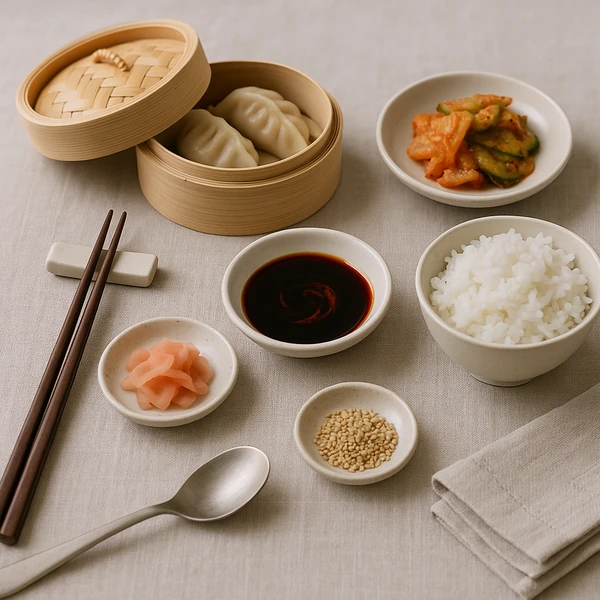
For many Asian dishes, "dishes" are not neutral. The shape of bowls, spoons, or chopsticks changes the way you scoop food, how quickly it cools, and how easily (or difficultly) you assemble bites from multiple parts.
A practical example: a bowl can retain heat and at the same time allows you to have rice, sauce, and side pieces in one “working zone.” That’s exactly the type of comfort you appreciate with dishes where you eat in smaller bites and where flavors combine progressively – not by mixing everything at once on a large plate.
🍽️ What to imagine under “Asian serving” in practice: sharing and multiple bowls
One of the most typical signs of dining in many parts of Asia is sharing. Often it’s not the model of “my plate and my portion of everything,” but a shared table with several bowls in the middle. Everyone usually has their base (typically rice or another starch) and takes bites from several shared dishes.
For home serving, this means two things:
- There should be bowls/parts in the middle of the table from which to take food (so that everyone can reach them, or so that they can be moved without "reaching across half the table").
- Everyone needs their own “personal space” – a small bowl or plate where they first put their food and only then eat it. Thanks to this, sharing doesn’t feel disorderly and it’s pleasant even for guests who are not used to communal dining.
Chopsticks, spoons, and bowls: what are the differences and when does what make sense
The most common mistake is to take chopsticks, spoons, and bowls as “one universal Asian thing.” In reality, they differ according to use and the type of food they are practical for.
Chopsticks are not universal: different ones for cooking, different ones for eating
Even within the household, it makes sense to distinguish two roles:
- Longer cooking chopsticks are useful for hot food (for example when quickly working in a pan): they keep distance from heat and are more precise than “fork attempts.”
- Eating chopsticks differ in length, tip, and material – and thus how you eat with them. In some countries they tend to be shorter, elsewhere longer; they can be blunt or pointed. It’s not a small detail: it affects how easily you pick up slippery noodles, crunchy vegetables, or small pieces.
If you want guests to feel comfortable, feel free to combine: those who don’t eat with chopsticks can have a spoon. The point is that the food can be eaten naturally, not that dinner turns into a skills test.
Soup spoon is not decoration: it has a specific function for broths and noodles
For broths, noodle dishes, and some desserts, a wide soup spoon is practically part of the “correct” way to consume. It allows you to scoop hot broth safely and comfortably, and it also helps to combine solid and liquid parts of the food so that the bite makes sense.
Why so much is eaten from bowls: heat, combining, and working with the bite
The bowl is the most practical service for many dishes:
- It keeps the temperature (for rice as well as for sauces and broths).
- It facilitates combining – rice, sauce, pieces of meat/tofu and vegetables “meet” in one container, but you don’t have to mix them into a homogeneous mass.
- It’s easier to eat with chopsticks and spoon – the bowl can be moved closer and food is scooped at a natural angle.
Practical home model: how to set the table so sharing works
The goal is simple, repeatable serving that works for different dishes. You don’t need an “Asian set” – rather clear roles for dishes and a few rules so no one gets lost at the table.
The minimum that covers most common dinners
As a foundation to build on, it makes sense to have:
- One bowl per person (for rice or their own portion of food) and a spoon.
- 1–3 shared bowls in the middle (depending on the number of dishes), ideally those from which it’s easy to scoop.
- Several smaller bowls for prepared components and small side dishes – this helps not only during service but already in preparation when you want everything set and clear.
- Chopsticks (for those who want), or alternatively second “serving” chopsticks or a spoon for scooping from shared bowls, so sharing is cultured and hygienic.
This is also important psychologically: when sharing has a clear structure, people relax at the table. When structure is missing, chaos often arises – and food that was supposed to be “communal and playful” feels stressful.
How to serve shared dishes so it’s pleasant for everyone
- First onto your own bowl/plate, then eat. This is one of the most functional principles for shared meals.
- Don’t reach aggressively over others and don’t fight for the “best pieces” – sharing is very much about rhythm and consideration.
- Handle the last piece sensitively. In some situations, it can be culturally sensitive to “take the last bite” without offering it to others. Even if you don’t play by strict etiquette at home, as a general principle it works great.
Cold dishes and “cold bowls”: how to arrange them so they taste finished
Cold Asian dishes are not just a “lighter option.” They often rely on freshness, texture, acidity, herbs, and a good dip. At home it’s useful to think in a simple layered logic so the result doesn’t feel like a random mix.
A practical home guide is five layers:
- Base: rice, noodles, leaves, vegetables, rice paper.
- Main texture carrier: tofu, tempeh, eggs, grilled meat, shrimp, mushrooms.
- Crunchy/fresh layer: cucumber, carrot, papaya, sprouts, cabbage, herbs.
- Dressing or dip: fish sauce / soy sauce / citrus / vinegar / peanut / sesame / sambal.
- Final contrast: chili, lime, sesame, peanuts, fried onions, pickles.
When you balance these layers, the dish will feel “finished” even without complicated cooking. A typical example of cold logic is Vietnamese fresh rolls gỏi cuốn: their strength is not in cooking, but in freshness, texture, and the right dip.
Sauces on the table: flavor framework, not universal “Asian seasonings”
Sauces in Asian cuisine often form not just an accessory but the very flavor backbone. It’s often the sauce that decides whether a dish feels flat or deep – and whether it leans toward a specific style or remains vaguely “Asian.”
More useful than “salty/sweet/spicy” is classification by function
- Sauces that primarily salt and carry umami: typically soy and fish sauces. They create not only saltiness but also fermentation depth.
- Sauces that unify and round the dish: a typical example is oyster sauce – it adds roundness and “closure” to the flavor.
- Sauces with sweet-salty thickness: for example hoisin or kecap manis – they often help with color, glaze, and a specific tone.
- Sauces for highlight at the end: for example ponzu and citrus-soy blends that open up and lighten the dish.
This division is also important when serving: when at the table you know whether a sauce “builds the dish” or just adjusts it, guests are less likely to accidentally overpower the flavor before the first bite.
Home minimum without overload: fewer bottles, clear roles
For regular home cooking (and subsequent serving), you typically don’t need ten bottles. A functional minimum can be built around several clearly distinguished roles:
- one universal soy sauce,
- one fish sauce,
- one oyster sauce,
- one sweeter/thicker specialized sauce depending on what you cook most often,
- and optionally one “finishing” sauce for a specific style.
Important warning: sauces are not automatically interchangeable. If you replace one role with something that has a totally different function (for example, a “just salty” sauce instead of a sauce that rounds the dish), the result often falls apart flavor-wise even with the best service.
🍽️ Most common mistakes in home Asian serving (and how to fix them fast)
Mistake 1: buying by exotic impression instead of function
Common scenario: someone sees a steamer, wok, chopsticks, porcelain bowls, and special spoons and gets the feeling that “Asian cuisine” requires a complete set. It’s more practical to think functionally: what do you need for serving and dining (bowls, spoons, chopsticks, shared dishes), what for steaming, what for high heat, etc. Only then is it clear what truly helps you and what will just be decoration in the cupboard.
Mistake 2: chopsticks as a “universal utensil” and unnecessarily stressful rules
Several principles make sense even in an informal home environment:
- do not point with chopsticks, do not stab with them,,
- do not stick them vertically into rice,
- do not use them as a knife or “fork for skewering,”
- do not pass food directly from one pair of chopsticks to another,
- do not take directly “from the shared dish to the mouth” – first to your own bowl.
These points are not pointless: in many cultures inappropriate chopstick movements have strong associations and are disturbing. And even without cultural context, sharing is simply more hygienic and pleasant with these rules.
Mistake 3: everything on one big plate (and then wonder why it “doesn’t make flavor sense”)
When Asian food is served as “one pile on a plate,” its logic often gets lost: sauce soaks things that should stay crispy, food cools faster, and bites are either monotonous or confusing. The quick fix is simple: divide the service into a personal bowl + shared bowls in the middle and add a small bowl for resting/portioning. Suddenly it starts working well even without any other “tricks.”
What to take away from the article
- Serving is part of flavor. Bowl, spoon, and chopsticks are not decoration – they change the temperature, how the bite is handled, and how the dish is composed.
- Home Asian dining often relies on sharing. Shared bowls in the middle + a personal bowl for each is a simple model that works surprisingly universally.
- Chopsticks are not all the same. Cooking chopsticks are different from eating ones – and a few basic sharing rules greatly improve the atmosphere at the table.
- Cold dishes have their own logic. When you layer them (base, texture, crunch, dressing, contrast), they will feel “done” even without complex cooking.
- Sauces are not interchangeable. Think about them by function (umami/salting, rounding, thickness, finishing) – and serving will no longer be random.

Read next
If you want to explore this topic further, continue with these related blog guides and articles:
