


 Česky (CZK)
 Slovensky (EUR)
 Deutsch (EUR)
 Austria
 Belgium
 Bulgaria
 Croatia
 Denmark
 Estonia
 Finland
 France
 Germany
 Greece
 Hungary
 Italy
Italy Latvia
 Lithuania
 Luxembourg
 Netherlands
 Poland
 Portugal
 Romania
 Slovenia
 Spain
Spain Sweden










How to choose a rice cooker and steamer: what will really make cooking easier (and what is just "nice equipment")
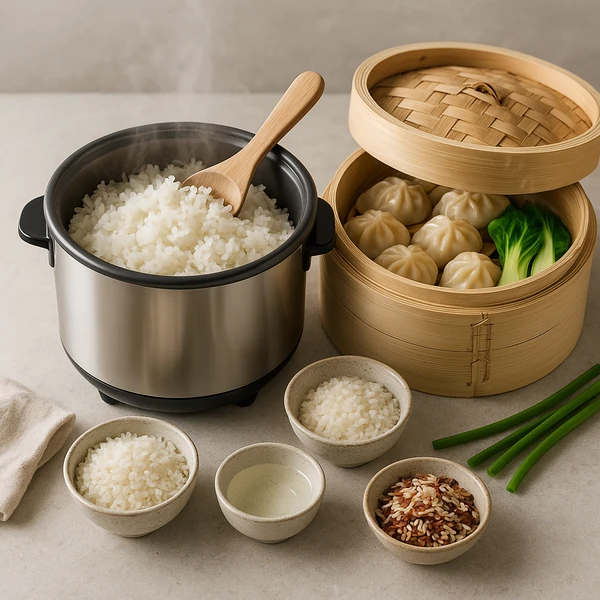
A rice cooker or steamer is not mandatory equipment – you can cook good rice in a pot and improvise with steam. However, they are among the tools that people often retrospectively call extraordinarily practical: they increase the consistency of the result, reduce errors, and especially free up hands for the rest of the cooking. In the article, we clarify when a rice cooker makes sense, when a pot is enough, and how to think about steaming in a way that matches what you actually cook at home.
Why rice cookers and steamers belong to the "second wave" of equipment
The most common mistake when buying equipment for Asian cooking is to shop based on the "exotic impression": you see a bamboo steamer, wok, chopsticks, bowls, and other things and get the feeling that you can't do without the whole set. It's more practical to think functionally – what handles high heat, what uses steam, what is for rice and starches, what is for preparing ingredients.
From the perspective of an ordinary household, the most valuable items are those that repeatedly improve the outcome and simplify work: a reliable knife and work surface, a quality pan or wok, and precisely the "rice" and "steam" parts of the equipment. In a simple model of equipment according to cooking style, the rice cooker and bamboo or metal steamer typically come in the second wave – that is, when you cook more often and know that rice and steaming will regularly return in your home.
🌶️ Rice cooker vs. pot: what is the real difference
It's not that you can't cook good rice without a rice cooker
A rice cooker is not a "must-have for proper Asian cuisine." Its main advantage lies elsewhere: it repeatedly reduces errors and frees hands for other parts of cooking. You especially appreciate this when:
- you cook rice often,
- you switch between several types of rice,
- you want to focus attention on other dishes instead of watching the stove,
- you need a stable result without constant supervision,
- you appreciate maintaining temperature (rice is ready and "waiting" in good condition).
When an ordinary pot is absolutely sufficient
If you cook rice only occasionally and have the technique down, a quality pot with a well-fitting lid is enough. For many households, it makes sense to first understand the basic variables (water ratio, resting after cooking, and differences between rice types) and only then consider a device. In other words: a rice cooker simplifies and stabilizes but does not replace knowing which rice you actually need for a particular dish.
Steaming: when a steamer makes sense and what it opens up for you at home
Steam is a standalone technique – it is not just "healthier cooking." In practice, you will appreciate steaming equipment mainly when you want to make dishes at home that are based on steam: dim sum, bao (yeast-filled buns), dumplings and other steamed items, or when you want to regularly prepare steamed vegetables as a clean texture alongside more pronounced sauces.
From the standpoint of home equipment, a simple rule applies: if you know you will revolve around steamed dishes, a steamer makes more sense than buying another "special" accessory just because it looks Asian.
Sticky rice and why it is often prepared with steam
A good example when steam becomes a key technique is sticky rice (often labeled as glutinous rice or sweet rice). It is not "overcooked rice," and the word "glutinous" does not mean gluten as in wheat – it describes behavior after cooking: it is elastic, cohesive, and sticky.
Common practice for sticky rice is soaking and subsequent cooking with steam. This helps achieve the typical elasticity without a mushy result. If you are tempted by desserts like mango sticky rice or dishes where the rice is picked up in cohesive pieces, steaming for you is not a detail – it is the way to make it work by texture.
Before you start dealing with settings: a brief orientation in rice types (and texture)
What a layperson often perceives as "rice" is actually a wide group of varieties and usage styles. They differ by origin, starch structure, aroma, and how they behave during cooking – and therefore by what result to reasonably expect from a rice cooker or steaming.
How to choose rice according to the dish (a practical shortcut)
- Jasmine rice: when you want a fragrant and tender side dish to a sauce.
- Basmati: when you want fluffy, longer, and "elegant" rice.
- Sticky rice: when you want an elastic, cohesive texture (often prepared by soaking and steaming).
- Sushi rice (short grain): when you want to shape, pick up with chopsticks, and work with the cohesiveness typical for sushi style.
- Natural (brown) rice: when you want a more rustic, pronounced variant – but expect a different texture and longer preparation; it is not automatically "better for everything" and can be too dominant in taste and texture for delicate, quick dishes.
Why one rice is fluffy and another sticky: amylose and amylopectin
Texture is significantly influenced by the starch ratio in the grain. Generally: rice with a higher amylose content tends to be fluffier, firmer, and less sticky, while rice with lower amylose is softer and stickier. Sticky rice has very little or almost no amylose – that is why it holds together and is elastic after cooking.
This is an important mental block when choosing equipment: if you can't "make fluffy rice" from a type that is naturally stickier, the problem is often not the rice cooker – but expectations and the choice of rice for the given dish.
How to choose a rice cooker in practice (without overpaying)
You don't have to aim for the most expensive model right away when choosing a rice cooker. In home practice, it is more useful to watch a few things that will affect you repeatedly:
- Capacity corresponding to your household: a rice cooker is most beneficial when you use it often and "just right" – not when you constantly cook either too little or too much because of volume.
- Easy cleaning: in everyday operation, it matters whether the inner pot cleans well. If maintenance is inconvenient, the rice cooker easily becomes a "thing in the cupboard."
- Keeping temperature: people appreciate the rice cooker among other things because rice can be ready earlier than the rest of the meal and still remain prepared without further attention.
- It makes sense especially when cooking often and switching types of rice: if you try jasmine, basmati, sushi rice or occasionally other varieties, a rice cooker helps maintain consistency and "guessing" less at the stove.
Practically: if you are not sure whether it is for you, ask yourself a simple question: How many times a week do you cook rice and how many times have you had to watch it at the expense of the rest of the cooking? The more often, the more the rice cooker turns from a "gadget" into a routine.
How to choose a steamer: bamboo vs. metal (and how to decide)
In home equipment, you most often encounter bamboo or metal steamers. Regarding this choice, it is good to stick to functional thinking: what you will steam and how often.
- If you want to regularly make dishes based on steam (dim sum, bao, dumplings), you will appreciate when steaming becomes an "easy routine" for you – meaning that the steamer is easy to work with and you will use it.
- If you mainly deal with sticky rice, take steaming as a technique crucial for achieving the typical elastic texture (soaking + steam). Then the choice of the steamer is no longer about decoration, but about being comfortable preparing this rice with it.
Because the specific construction details differ among individual designs, it makes sense to choose so that the size and usage fit your normal cooking: a household that wants to occasionally steam vegetables as a side dish has different needs than one that wants to build dinners around steam.
Common mistakes and unnecessary disappointments (and how to prevent them)
Mistake 1: Buying equipment based on impression, not based on what you cook at home
A bamboo steamer or rice cooker alone do not create "Asian cuisine." The tool makes sense when it has a regular role in your cooking style: a stir-fry household typically uses a pan/wok and a work rhythm, a dim sum household uses steam, Japanese or Korean-oriented cooking often benefits from a good rice cooker.
Mistake 2: Expecting the rice cooker to fix poorly chosen rice
One of the most common mistakes is choosing rice solely based on what you have at home. It's better to start from the dish: jasmine for fragrant tenderness, basmati for fluffiness, sushi rice for shaping, sticky rice for elastic cohesion. When you repeatedly fail to achieve "the right" texture, it is more effective to first adjust the rice choice than to change the equipment.
Mistake 3: Skipping the basic orientation in cooking variables
For many households, it makes sense to first understand water ratios, resting, and differences between rice types – and only then automatically buy a device. A rice cooker reduces errors but works best when you know what result you actually want (fluffy, tender, sticky) and choose rice accordingly.
What to take away from the article
- A rice cooker is not mandatory – its biggest value is consistency and convenience: fewer mistakes, less watching, more time for the rest of the cooking, and often practical temperature maintenance.
- A pot is perfectly fine for occasional rice cooking, especially when you have the technique down and know what type of rice you want.
- A steamer makes sense when steam is not just an "add-on" – dim sum, bao, dumplings, or regularly steamed vegetables are typical situations when it becomes a daily helper.
- Choosing rice is as important as choosing equipment: jasmine, basmati, sushi rice, and sticky rice are not interchangeable because they aim for different textures and different types of dishes.

Read next
If you want to explore this topic further, continue with these related blog guides and articles:
