


 Česky (CZK)
 Slovensky (EUR)
 Deutsch (EUR)
 Austria
 Belgium
 Bulgaria
 Croatia
 Denmark
 Estonia
 Finland
 France
 Germany
 Greece
 Hungary
 Italy
Italy Latvia
 Lithuania
 Luxembourg
 Netherlands
 Poland
 Portugal
 Romania
 Slovenia
 Spain
Spain Sweden










Nasi goreng, fried rice and “Cantonese” rice: how to tell them apart and what to expect on the plate
On menus and in home cooking, three names for “pan” rice often meet: nasi goreng, fried rice and Cantonese rice. They sound similar but do not mean the same thing. In this guide we'll clarify what is a technique (fried rice), what is a specific national style (nasi goreng) and why it makes sense to ask for clarification with “Cantonese rice.” And most importantly: how to choose the right rice and how to achieve good flavor at home without cooking “by one universal recipe.”
Why it's worth distinguishing the names (and not calling everything just “fried rice”)
In Asian logic, rice is often the center of the meal, not just a side dish. It can be a neutral carrier for sauces, but it can also become a full-fledged dish itself: fried, seasoned, cooked in coconut milk or served with a strong topping. That is precisely why it makes sense to distinguish what type of rice dish you order or want to cook.
Good orientation protects you from two common disappointments:
- you expect “just rice with vegetables,” but a strongly seasoned dish with a specific profile arrives (typically with nasi goreng),
- you expect the typical taste of a particular country, but get a more generic fried rice without a clear identity (which can happen when names are used loosely).
What exactly fried rice, nasi goreng and “Cantonese rice” mean
Fried rice is mainly a technique
“Fried rice” is a general term for fried rice – that is rice that is quickly pan-fried and combined with other ingredients (egg, vegetables, meat/tofu, sauce). In practice it is one of the most typical ways rice is transformed from a side into a main dish: everything is in one pan and the flavor arises from the combination of the base and seasoning.
Nasi goreng is not just “fried rice”: it has its own flavor profile
Nasi goreng is one of the best-known Indonesian styles of fried rice. Crucially, it is not just any “pan rice” – nasi goreng has its own character:
- it uses cooked and often cooled rice,
- the rice is quickly fried with an aromatic base,
- a big role is played by kecap manis (in practice this is a typical Indonesian sweeter seasoning that shifts the flavor away from “neutral” fried rice),
- common additions include things like egg and various toppings (including a pickled component and crunchy textures like crackers).
Nasi goreng also nicely shows the “everyday” logic: it can make use of rice from the previous day, but the result is still not a leftover in the fridge – it is a dish with a strong identity.
“Cantonese rice”: a name best taken as shorthand
The term Cantonese rice is often used in Czech as shorthand for a “Chinese” style of fried rice. It is important to expect that the name itself usually will not tell you a single fixed standard – in different establishments it can mean different compositions and seasonings.
Practical tip: if you want to know what to expect, it's better to orient yourself by how the rice is seasoned (salty/umami vs. sweeter), and by the toppings (egg, vegetables, meat/tofu), rather than relying on “Cantonese” always meaning the same thing.
Rice decides the outcome: texture, starch and grain type
What a layperson perceives as “rice” is actually a wide group of types that differ in aroma, cooking behavior and how they perform in a pan. For fried rice it is crucial that the grain after cooking and possible cooling holds its structure and does not become mushy.
What determines stickiness: amylose and amylopectin
Rice texture is related among other things to starch:
- rice with a higher proportion of amylose tends to be loose, firmer and less sticky,
- rice with a lower proportion of amylose tends to be softer and stickier.
For fried rice you typically want one that after cooking is not “mushy” and that when stirred in the pan does not turn into a uniform mass.
Practical orientation: jasmine, basmati, sushi rice and why not to confuse glutinous rice
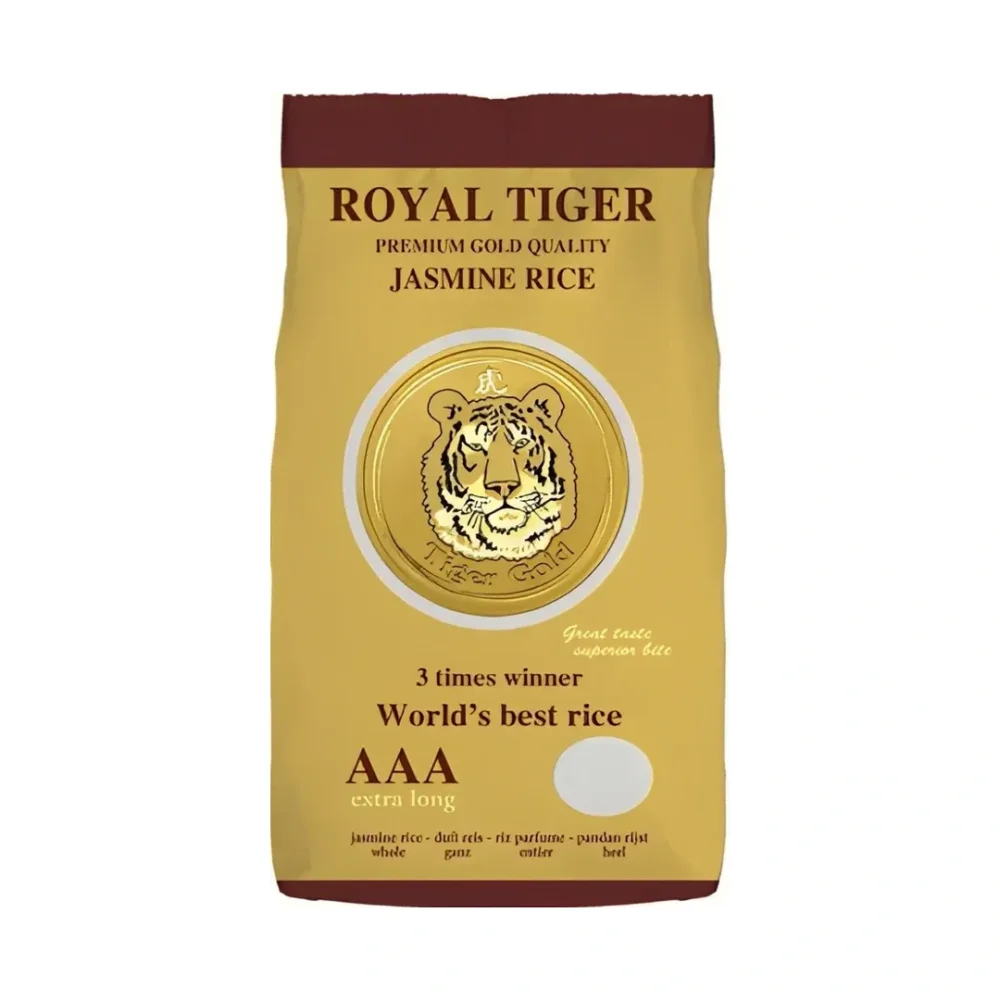
- Jasmine rice is aromatic and after cooking tends to be soft, slightly cohesive, but when prepared properly does not seem overcooked. It carries sauce well and is excellent for quick everyday dishes. If you are looking for this style, it makes sense to check the jasmine rice category or choose a specific type that is built for loose long grains, for example Royal Tiger Jasmine Rice Gold 1 kg.
- Basmati is often used where the goal is long, separate and aromatic grains. For orientation the basmati riceguide helps.
- Sushi rice (Japanese short-grain) is stickier and suits places where the rice should hold together more (e.g., for sushi or donburi bowls). It can work for fried rice, but the resulting texture will be different from long-grain types. If this direction interests you, there is a sushi riceguide.
- Glutinous rice (glutinous/sweet rice) is not “overcooked rice.” It is a specific type with a elastic, sticky and cohesive texture and has a completely different role (often desserts, dumplings, cakes). Do not use it in fried rice as a “better option” – it is a different ingredient with a different purpose.
If you want a broader overview and to compare types without the prejudice of “one rice for everything,” a practical start is the guide to rice and rice products.
How to choose between nasi goreng, fried rice and “Cantonese” rice by taste and situation
Before you start worrying about “correctness,” try asking yourself two questions: do I want the rice itself to carry a strong flavor? And do I want the dish more as a standalone meal, or as a base for additional toppings?
When you want the rice to have a strong identity
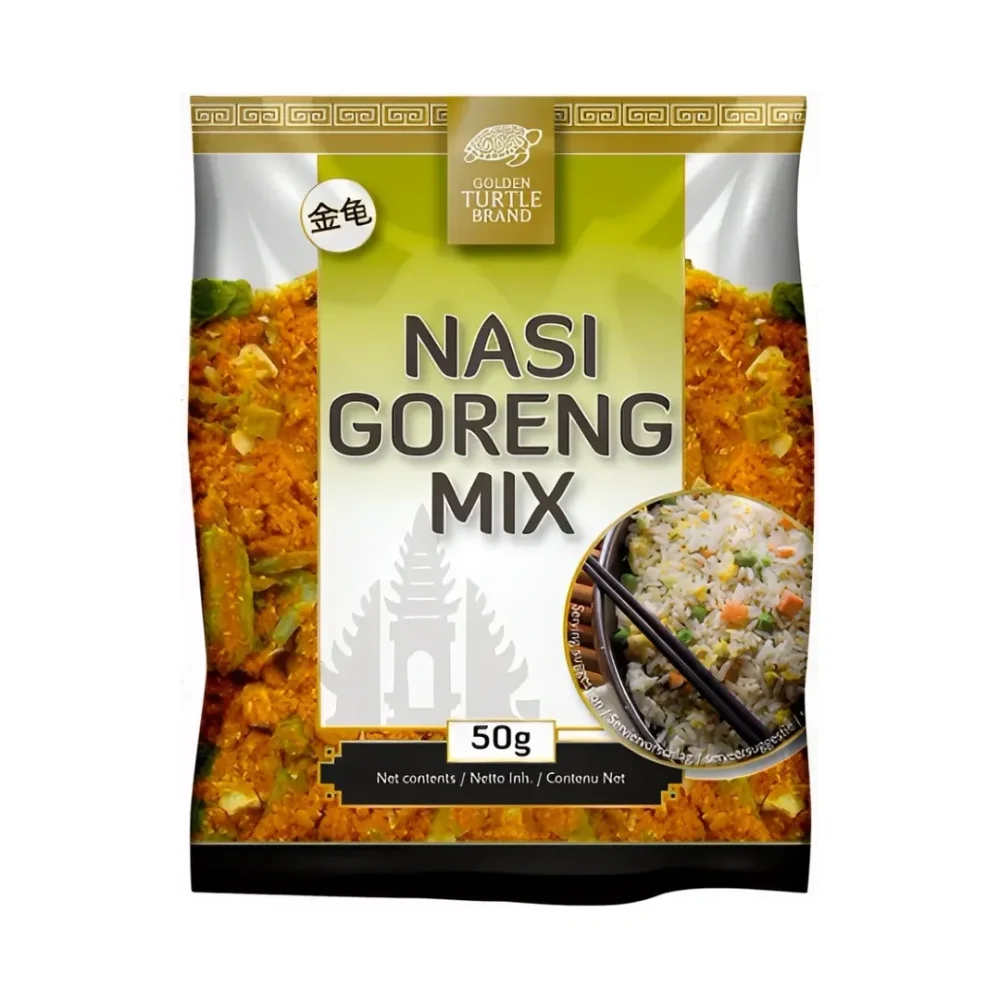
Then it makes a lot of sense to aim for nasi goreng. By definition it is a style where the rice is quickly fried with an aromatic base, kecap manis plays an important role and additions like egg and crunchy/pickled components are common. If you want to try this profile at home without long fine-tuning, a practical start can be the spice mix Golden Turtle Chef Nasi Goreng Mix 50 g – treat it as a flavor guide, not as a substitute for understanding the style.
When you want a more universal fried rice (closer to “fried rice” / “Cantonese”)
General fried rice is often perceived as a “composed” dish: rice forms the frame and you add what you need (vegetables, egg, meat/tofu, sauce). With the name “Cantonese” it is therefore more helpful in practice to check the composition and seasoning, than to expect one specific flavor template.
Practical home start (without a full recipe): how to make good fried rice step by step
The point of fried rice is speed and control: short heat, clear structure and seasoning that either gives the rice its identity (nasi goreng) or supports it as a base (general fried rice).
1) Prepare the rice so it doesn't fall apart in the pan
- Choose the rice type according to the target texture (see above). For fried rice you generally appreciate when after cooking the grain holds together and can handle cooling.
- Take inspiration from the logic of nasi goreng: it uses cooked and often cooled rice. It's not a dogma, but a very practical principle to get the structure.
2) Build flavor on “functional” bases, not random bottles
Home Asian cooking is better built functionally than “by country.” Even for fried rice it's typically useful to have on hand:
- saltiness and umami (basic seasonings that give depth),
- sweetness (essential in some styles, in others just a mild counterpoint),
- fat and aroma (what “opens” the aromatics),
- acidity or a pickled component as contrast (typically as a side/topping).
With nasi goreng it's also important to account for the prominent role of kecap manis and local seasonings – that's why it tastes different from “just rice with soy sauce.”
3) Toppings are not decoration: they make rice a full meal
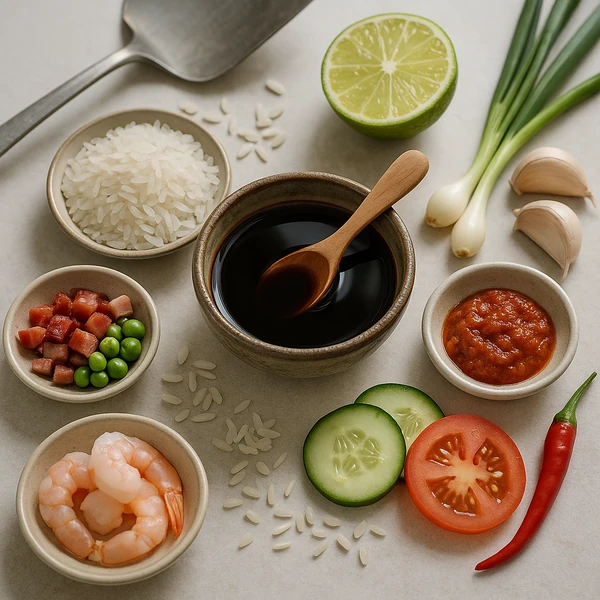
Common additions for nasi goreng include egg, pickle (pickled component) and crackers (crispy texture). Even if you choose a different style of fried rice at home, this principle works great: rice is the base, but contrasting texture and “something extra” make the result convincing.
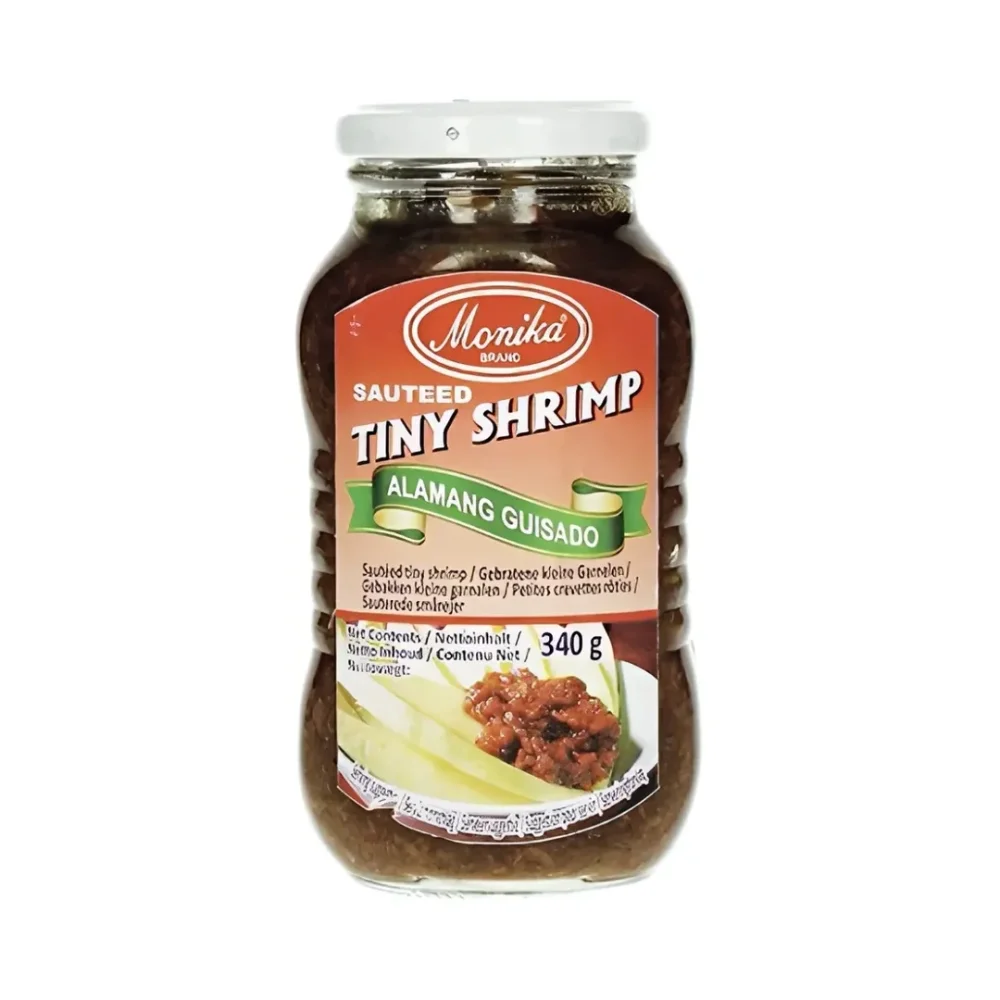
As an example of a pronounced finishing texture you can use a crunchy topping like Monika Fried Shrimp 340 g (just a small amount is enough). Consider it a tool for marine flavor and crunch, not as a mandatory part of a specific national recipe.
Common mistakes and misunderstandings (and how to fix them)
- “All rices are the same.” They are not. The difference in texture (loose vs. cohesive) is immediately visible in fried rice. Choose the type based on how the rice should hold together after cooking and cooling.
- Mixing up sticky rice with “better rice.” Sticky rice is a specific ingredient with its own function; for fried rice the goal usually isn’t a springy cohesive mass.
- “Nasi goreng = any fried rice.” Nasi goreng has its own flavor profile (including the role of kecap manis) and typical accompaniments. If you cook it as a neutral fried rice, it might be a good dish, but it won't be that style.
- Oversalting and overdone umami. Add intense seasonings gradually. For salty sea components it’s doubly true that “a little goes a long way.”
- Lack of contrast. Fried rice easily slips into a uniform impression. Egg, a pickled component (acidity) and a crunchy topping help—exactly in line with how rice is considered in nasi goreng.
What to take away from the article
- Fried rice is generally a technique; nasi goreng is a specific Indonesian style with its own flavor profile (including the role of kecap manis and typical accompaniments).
- About the name “Cantonese rice” it’s reasonable to want clarification: composition and seasoning will tell you more than the name alone.
- The result rests on the right type of rice and on how it holds its structure after cooking and cooling.
- Flavor at home is assembled functionally (saltiness/umami, sweetness, fat and aroma, contrast), not by randomly mixing “Asian” sauces.
- Toppings like egg, a pickled component and a crispy texture are not details—they often determine whether the rice feels like a complete meal.

Read next
If you want to explore this topic further, continue with these related blog guides and articles:
