


 Česky (CZK)
 Slovensky (EUR)
 Deutsch (EUR)
 Austria
 Belgium
 Bulgaria
 Croatia
 Denmark
 Estonia
 Finland
 France
 Germany
 Greece
 Hungary
 Italy
Italy Latvia
 Lithuania
 Luxembourg
 Netherlands
 Poland
 Portugal
 Romania
 Slovenia
 Spain
Spain Sweden










How to read a soy sauce label: what really matters (and what confuses you)
Soy sauce looks simple at first glance: dark, salty, “somehow Asian.” But under the same name, there are more distinctly different styles - from Japanese shoyu through Chinese light and dark sauces to Thai variants for wok cooking or sweet Southeast Asian directions. That's why it's worth reading the label: not for the details themselves, but so you don't bring home a sauce that behaves completely differently in the kitchen than you expect.
🌶️ What is soy sauce (and why there is so much confusion around it)
Soy sauce is not just a single ingredient with a fixed profile. It's a broad group of liquid seasonings based on soy, salt, and fermentation – or on a mixture of fermented and technologically processed components. Under one name, you can thus buy sauces that differ in color, saltiness, depth of flavor, and whether they are more meant for cooking or for final seasoning.
The confusion is further increased by the fact that different countries use different classifications and names, and the market mixes the language of origin, export terminology, and marketing. And mainly: the words “light” and “dark” do not mean the same everywhere – somewhere they refer to color, elsewhere to function in the dish, and elsewhere to the overall style.
🕰️ A short history for orientation: China → Japan → Korea and Southeast Asia
The roots of soy sauce lie in ancient China, where its distant predecessor was fermented salty seasonings of the jianggroup. Originally, it was not just about soy – older forms also worked with meat, grains, and salt. Gradually, soybeans prevailed and liquid seasonings developed, from which later soy sauces evolved.
The idea of fermented salty sauces came to Japan from the Chinese cultural area; in the Japanese environment, the path to miso pastes and liquid shoyu gradually separated and a very elaborate classification emerged. Korea developed its own fermentation line within the jangsystem, from which also came ganjang. Southeast Asia adapted soy sauces to local tastes: somewhere emphasizing sweetness, elsewhere pure saltiness, elsewhere quick kitchen use in wok and noodle dishes.
Which styles are commonly hidden under the name “soy sauce”
Before you start dealing with individual lines on the label, it's useful to know which types coexist on the market side by side. The key is to distinguish pure soy sauces from flavored derivatives (and also from sauces that only share a “dark” appearance with soy sauce).
Japan: shoyu as its own world (koikuchi, usukuchi, tamari…)
The Japanese system is the most precisely classified and it's worth knowing at least the basics:
- Koikuchi – the most common Japanese soy sauce, balanced and universal. When a recipe just says “shoyu,” it often means this one. Suitable for everyday cooking and at the table: marinades, dips, noodles, rice, meat, vegetables.
- Usukuchi – lighter in appearance but not necessarily less salty. Created for cuisine where a delicate color of broths and ingredients is important. Typically for delicate broths, soups, and dishes where the sauce should not darken.
- Tamari – more soybean flavor, thicker and usually stronger. Often has less wheat than common shoyu, but it is not correct to automatically assume it is gluten-free. Typically for dips, glazes, and stronger final seasoning (meat, tofu, grilling).
- Saishikomi – "twice brewed" / re-fermented sauce, style-wise even deeper and rather for targeted use than as the only universal bottle.
Practical impact on reading labels: for Japanese bottles, it often makes more sense to look for the word koikuchi/usukuchi/tamari rather than relying on “light” being mild and “dark” being dense.
Thailand: similar bottles, different role in the pan
The Thai market is tricky for European customers: several types of bottles may look similar but function differently in the kitchen.
- Thai light soy sauce – often corresponds to what people expect from “light soy sauce”: a working salty sauce for wok, stir-fried noodles, fried rice, vegetables, and marinades.
- Thai dark soy sauce – used mainly for color and subtle rounding; usually not the only source of saltiness. It gives a darker tone and shine (wok, noodles, braising, darker surface).
- Thai sweet dark soy sauce – thicker, sweeter, and darker style closer to glaze than usual salty seasoning sauce. A small amount can quickly change the color and “surface” taste of the dish.
Practical impact on reading labels: if you want a universal working sauce, look on the label for the actual type (light vs dark vs sweet dark) – not just “dark bottle = good.”
Sweet Southeast Asian directions: different logic than “regular soy sauce”
The same family also includes sweet variants (typically Indonesian styles, often known as kecap manis). Their logic is different: pronounced sweetness, dark color, thicker texture, and glazing ability. In dishes like fried rice, fried noodles, or marinades, they can be great – but they are not sauces you want to mechanically use as a basic salty soy sauce because they can easily disrupt the sweetness and overall tone of the dish.
How to read a soy sauce label step by step: 4 things that matter
Asian ingredient packaging can be visually strong, but the crucial part is the fine print. The basic rule: the ingredient list is given in descending order by weight – the first ingredients are the most important for the product's character. For soy sauce, it is also essential whether you hold pure sauce or a flavored product.
1) Product name: more important than the color of the bottle
On the market, types that may look similar sit side by side but are not interchangeable: pure soy sauces, dark and sweet dark sauces, mushroom soy sauces, “seasoning sauce”, “soup soy sauce”, also citrus and other flavored derivatives (e.g. ponzu) or mixtures like teriyaki.
If you are looking for a universal bottle for regular cooking, don't start by how dark the liquid in the bottle is. Start with exactly what is written in the name – that most often reveals whether it is a basic sauce or a blend "for something."
2) Ingredient list: short vs long (and what to take from it)
Sauces intended for direct seasoning and universal cooking usually have simple composition which is often a good sign. On the other hand, a long list may indicate that the product is stylized, tailored for a specific purpose, or that it is based not mainly on long fermentation but on a combination of more technologically processed ingredients.
It's not that "long = bad" and "short = always best." It's about expectations: when you buy sauce as a working base, you usually don't want a strong hidden sweetness or thickening to go into the food. And if you opt for a sweet dark version, you want to be sure it's intentional – not a surprise on the first sip.
3) Allergens: soy and wheat (and why it's necessary to read the specific bottle)
The most important allergens in soy sauces are soy and wheat. Wheat is very common in soy sauces. Those concerned about gluten must read the specific label of the specific bottle – relying on a general idea of the type is not enough.
A typical example is tamari: it often has less wheat than common shoyu, but it is not correct to automatically assume gluten-free. The label is more important in this regard than “internet shorthand.”
4) Salt: for soy sauce more important than calories
For practical cooking, it's often more important to monitor saltiness than calories or fat in soy sauce. High salt content itself doesn't mean "bad sauce" – it mainly means you have to treat it as a concentrated seasoning and adjust dosing and the rest of the recipe accordingly.
Practically: when cooking wok, noodles, or fried rice, soy sauce is often one of the main sources of saltiness. For dark and sweet dark variants, saltiness may not be the only (or main) role – sometimes the goal is color, shine, and smoothing. That's why it's worth reading the label together with the type name (light/dark/sweet dark) and thinking about the role the sauce should play in the specific dish.
🍳 How to choose your first bottle by use (to fit both in the wok and at the table)
The most common disappointment does not arise because the sauce is objectively bad but because it was chosen poorly for the specific use. It helps to clarify a simple question: do you want a working sauce for cooking, or a stronger sauce for finishing seasoning?
If you want a “working” sauce: saltiness and umami for everyday cooking
For stir-fry, noodles, rice, quick pan cooking, and marinades, it's practical to have reliable light soy sauce on hand. When using it for the first time at home, it's safe to start cautiously (sauces vary): for example, 1–2 teaspoons per serving at the base, mix, taste, and possibly add more with another teaspoon. In dishes where water evaporates (wok), saltiness concentrates quickly.
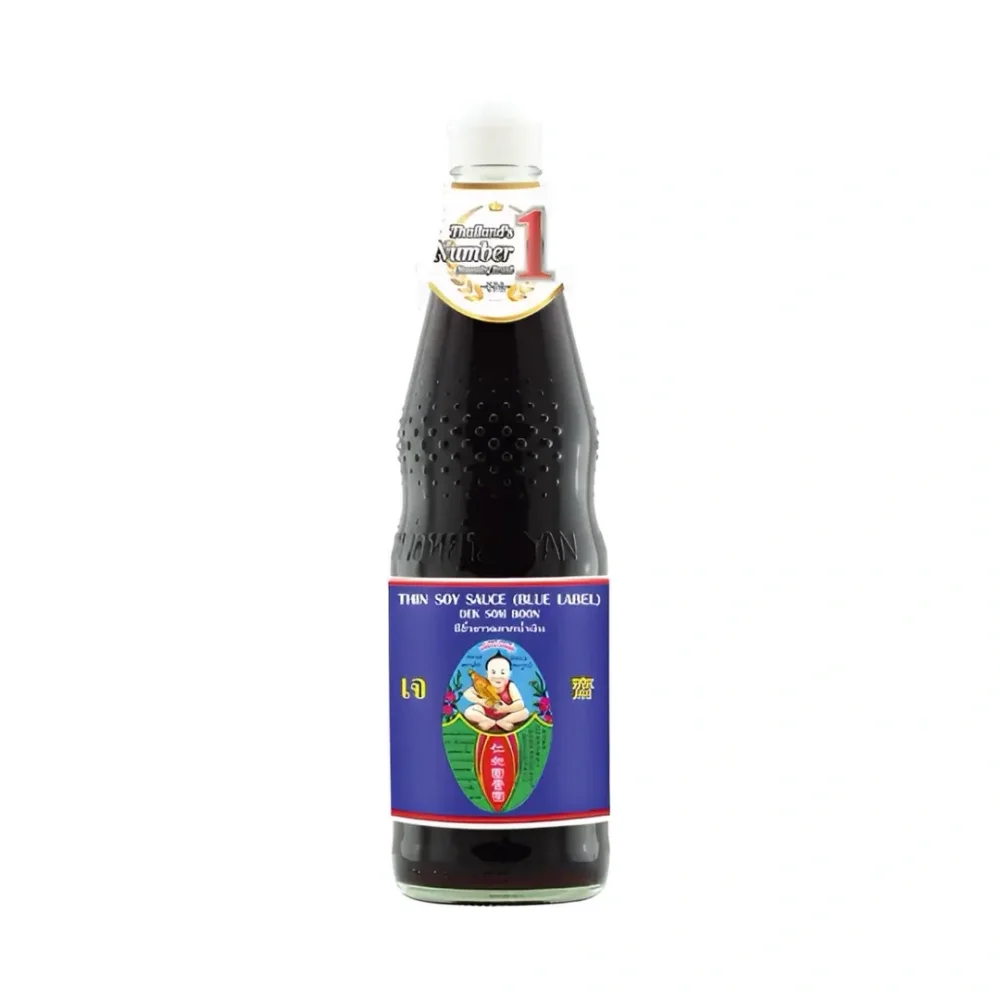
An example of a light sauce suitable for quick seasoning can be Dek Som Boon light soy sauce (recipe C) – exactly the type typically suitable for wok, rice, noodles, marinades, and dips.
If you want a sauce for color and “surface”: dark and sweet dark
Dark soy sauces are often used where you want to add color, shine and subtle rounding. Sweet dark variants go further: they are closer to glaze and even a small amount can change the final impression of a dish. That is great when you want it – but confusing when you expect a purely salty working sauce.
Practical advice: add dark variants in small doses. When the goal is color, often less is needed than with light sauce which “pulls” saltiness through the whole dish.
When the recipe says “shoyu”: usually koikuchi
If you cook following Japanese recipes, the word “shoyu” often refers to the universal koikuchi. If you want more detail, usukuchi helps where you don't want to darken a broth or ingredients; tamari is used as a stronger final seasoning or dip. But always: if you deal with allergens (especially wheat), the specific label is decisive.
💡 Common mistakes and what to watch out for
- “I'll take the darkest bottle, it will have the most umami.” Dark color can mean different things: a different style, a different role in the dish, sometimes sweetness or glazing effect. Color isn't a reliable indicator of versatility.
- Confusion of “light/dark” across countries. The Chinese light/dark pair does not behave the same as the Japanese shoyu classification. And Thai dark often serves mainly for color and rounding, not as the only saltiness source.
- “Tamari = gluten-free.” Tamari often has less wheat than common shoyu, but it's not correct to take this automatically. If you are concerned about gluten, read allergens on the specific bottle.
- Mixing pure soy sauce and flavored blends. Teriyaki, ponzu, or various seasoning sauces can be great but address a different situation than basic soy sauce. Always start with the product name.
- The assumption that “dark and salty” = interchangeable. Not all dark sauces are soy sauces. For example, Maekrua oyster sauce is a different category: it typically adds a fuller, slightly sweet flavor and behaves differently than soy sauce. Similarly, Lee Kum Kee hoisin sauce is sweet-salty and often used as a dip or glaze – it's not “just dark soy.”
- Underestimating saltiness. Soy sauce is a concentrated seasoning. If you overshoot, the dish is just “salty.” It's better to dose in smaller steps, especially with wok dishes where liquids evaporate quickly.
What to take away from the article
- Soy sauce is a family of styles, not a single universal ingredient – that’s why the label is more important than the appearance of the bottle.
- Start with the type name (light/dark/sweet dark, shoyu/tamari…), because "light/dark" does not mean the same everywhere.
- In the ingredients, mainly watch out for the first items (they are the most important for the character) and in allergens soy and wheat.
- Salt is a crucial cooking detail: higher saltiness is not automatically bad, but it changes the dosing and how you use the sauce.
- Do not confuse soy sauce with other dark sauces and blends: similar color does not mean similar function in food.

Read next
If you want to explore this topic further, continue with these related blog guides and articles:
