


 Česky (CZK)
 Slovensky (EUR)
 Deutsch (EUR)
 Austria
 Belgium
 Bulgaria
 Croatia
 Denmark
 Estonia
 Finland
 France
 Germany
 Greece
 Hungary
 Italy
Italy Latvia
 Lithuania
 Luxembourg
 Netherlands
 Poland
 Portugal
 Romania
 Slovenia
 Spain
Spain Sweden










How to build bowls and plates with a good flavor balance: a practical guide for light and balanced Asian meals
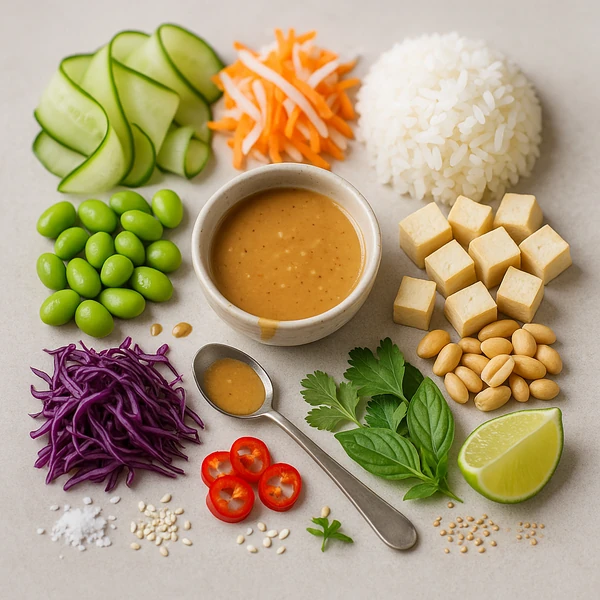
A "light" Asian bowl is not about having less food or making it bland. It works when the flavors are clearly readable, it doesn't feel heavy, and yet it fills you up: the starchy base holds its shape, the protein is flavor-specific, the vegetables and herbs are not just decoration, and the whole is linked by a precise (rather small) amount of sauce. The article offers a practical logic for assembling bowls and plates, differences between types of dishes, and the most common mistakes that make "home food taste unfinished."
🍜 Why focus on flavor balance (and not just "healthy ingredients")
In light and balanced Asian meals, often less the actual list of ingredients matters and more their ratio and contrast. In practice, this means that even with simple ingredients you can create a dish that:
- fills you up without feeling "heavy or tired",
- has clearly readable flavors (nothing is overpowering),
- is based on freshness, acidity, texture, and umami – not just sweetness, spiciness, or a layer of sauce.
This is why a Vietnamese noodle bowl or Japanese plate style (e.g., teishoku) can be filling but still "lighter" than the same sized portion of food that is all combined with one heavy sauce.
📌 What to take away from the article
In light and balanced Asian meals, often less the actual list of ingredients matters and more their ratio and contrast. In practice, this means that even with simple ingredients you can create a dish that: fills you up without feeling "heavy or tired," has clearly readable flavors (nothing is overpowering), is based on freshness, acidity, texture, and umami – not just sweetness, spiciness, or a layer of sauce. This is why…

Read next
If you want to explore this topic further, continue with these related blog guides and articles:
