


 Česky (CZK)
 Slovensky (EUR)
 Deutsch (EUR)
 Austria
 Belgium
 Bulgaria
 Croatia
 Denmark
 Estonia
 Finland
 France
 Germany
 Greece
 Hungary
 Italy
Italy Latvia
 Lithuania
 Luxembourg
 Netherlands
 Poland
 Portugal
 Romania
 Slovenia
 Spain
Spain Sweden










Dining in Asia: communal serving, tea, and small gestures that change the atmosphere
Asian dining is often not just about "how to eat it," but part of what food means. In many cultures, the table is approached with respect for the host and the food, sharing from common bowls, with order and small gestures – and tea can play a similarly important role as the dish itself.
Why the topic of dining in Asia is more than just a set of rules
Etiquette and dining in Asian cuisines are often not just formal "polite behavior." They are often directly part of the meaning of the meal and the gathering: how communal food is handled, who starts, how respect is shown to the host (or elders), what role chopsticks or spoons play, and how tea is served.
Also important is that food often functions as a shared experience – a space for family and guests, a way of building relationships, and an expression of hospitality. From this follows that "doing it right" is sometimes recognized more by the atmosphere than by a single universal norm.
How to recognize typical "Asian dining": bowls, sharing, and the importance of order
Across Asia, there are often repeated key principles behind why dining differs from an environment where everyone has one main plate in front of them:
- Respect for the host and the food – expressed through small signs of attention and consideration.
- Emphasis on sharing – a smaller role for "an individual plate" and a larger role for shared bowls.
- A table set with multiple bowls and side dishes – the meal is not just one piece on a plate but a whole composed of various components.
- The importance of order, placement, and serving method – when something is brought, where it is placed, who starts, and how it is taken.
- Small gestures – etiquette often shows in details (e.g., how chopsticks are handled, whether one waits for elders, how tea is poured).
These principles are interconnected: as soon as part of the meal is shared, the importance of consideration, rhythm, and "readable" behavior at the table naturally grows.
🍽️ Communal serving: why sharing happens and what comes from it
Communal serving is one of the most important things worth understanding. In practice, it often means that there are multiple dishes on the table and everyone takes what they feel like – but in a way that maintains harmony at the table.
Basic principle: first onto your bowl, then eat
A very useful rule that works across many situations: from the common dish, first take onto your smaller bowl or plate and only then eat. It helps hygienically, but mainly socially: it gives others space and reduces the "scramble" at the shared meal.
Pace and space: don't grab aggressively, don't reach over others
Because the food is shared, how you move at the table matters:
- avoid "quickly grabbing" the best pieces,
- don’t try to reach over others – rather wait for the right moment or ask for the dish to be moved,
- notice if others have already taken (or if someone is hesitating and would appreciate being offered).
It’s not about stiffness. It’s a simple way to show: "I’m not alone here; we eat together."
The "last piece" can be sensitive
In some situations, the last piece or last portion can be a culturally more sensitive topic than it seems. It doesn’t mean it "must never be finished," but it is worth choosing a careful, considerate approach: briefly checking if others still want some, offering it, or waiting.
This rule isn’t equally strict everywhere – but as a general principle, it works very well if you’re unsure about the level of formality appropriate in the situation.
More formal vs. informal dining: what stays the same and what relaxes
Specific "exact rules" differ depending on region, household, and type of event. Still, you can orient yourself well by what tends to be stable:
- In a more formal context order and serving method, precision of gestures, and respect for dishes and the host are more closely observed.
- In an informal context rules often simplify, but principles remain: sharing without aggression, consideration for others, and small signs of attention.
Practical tip: if you’re unsure, choose "silent consideration" – take smaller portions, leave space for others, notice the table’s pace, and don’t take the lead unless you are the host.
Tea and hospitality: a drink that sets the atmosphere
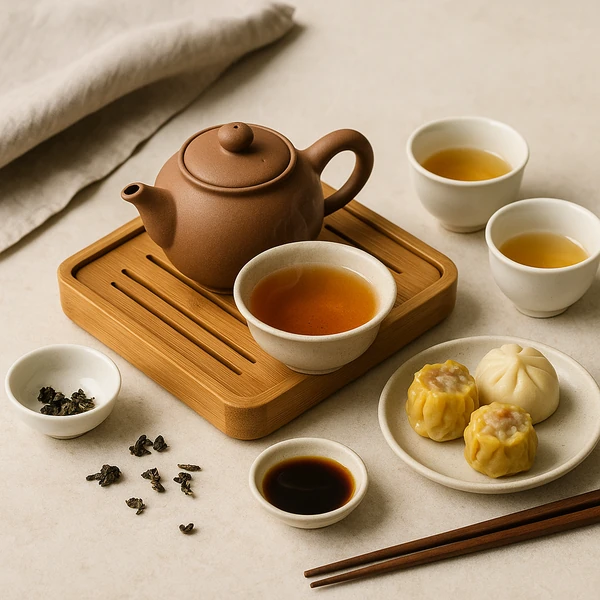
In many Asian cultures, tea is more than a drink. It can be a sign of hospitality, a way to calm and focus, a ritual act, or simply a way to create the right atmosphere for a meeting.
🍳 Japan: preparation and serving as an art
The Japanese tea ceremony elevates the preparation and serving of tea to an art form. Important is precision, order, purity of gestures, respect for vessels, and attention to the guest. This illustrates the broader logic well: tea is not just "what we drink," but also "how we are together."
Korea: tea as part of the host–guest relationship
Korean tea culture emphasizes that serving tea is part of the host and guest relationship. It’s not just about the beverage itself but about acceptance, calm, and attention – the atmosphere in which the meeting takes place.
Broader Asia: a symbol of hospitality even outside formal settings
Even where tea isn’t part of a formal ritual, it often symbolizes hospitality. Typically this involves simple but meaningful gestures: pouring tea, offering it to the guest, refilling the cup or sitting together, which gives rhythm and calm to the gathering.
How to apply this at home (even if you’re not an “expert”)
If you want to create a pleasant, "Asian-style shared" atmosphere at home without stress over rules, several very concrete steps work.
1) Set the table for sharing, not a "battle for the dish"
- Expect that people will need their own smaller bowl or platewhere they can first set aside food.
- Place shared dishes so they can be easily moved and no one has to reach over others.
- Where it makes sense, add to shared dishes a serving spoon or another simple way to scoop – this makes "first onto your own bowl" easier.
2) Serve in smaller portions and be aware of the pace
Because communal serving is based on harmony at the table, it usually works to take smaller portions more often. The practical effect is twofold: everyone tastes more things and it minimizes situations where one person "blocks" the food for a long time.
3) Use tea as a hospitality tool
You don’t need to know formal rituals for tea to fulfill its role. Focus on simple things that are understood in many cultures as attention:
- offer tea as part of a welcome,
- refill the guest before yourself (if the situation naturally allows),
- make tea a brief "calm moment" between or after dishes.
The point is to create an atmosphere, not to "perform."
4) When unsure, stick to respect for the host and the food
In practice, this mainly means sensing the context: who is inviting, who is older, who sets the pace. Etiquette often shows in details – and details tend to be simplest: wait, don’t disrupt the table by aggressive grabbing, and keep attention to others.
Common mistakes and situations that spoil the atmosphere (and how to fix them simply)
- Mistake 1: "It’s just a set of strict rules." In reality, the core is often in atmosphere and respect. When you don’t know something, consideration usually works better than a strained effort to be "correct."
- Mistake 2: Eating straight from the shared dish "without thinking." Safer and socially smoother is to first take onto your own bowl/plate and then eat.
- Mistake 3: Reaching over others or taking "aggressively." The solution is simple: wait, ask to move the dish, or take a smaller portion and come back later.
- Mistake 4: Automatically taking the last piece. If you feel uncertain, offer or briefly check if others have already taken some. In more sensitive contexts, this can be more important than you expect.
- Mistake 5: Taking tea as "just a drink" without a social role. Tea often works as a gesture of acceptance and attention. Even simple refilling or offering can significantly improve guests’ feeling.
Key takeaways from the article
- In many Asian cultures, dining is part of the meaning of food: it’s about sharing, respect, and atmosphere, not just "rules."
- Communal serving has a practical logic: first onto your own bowl, don’t reach over others, don’t take aggressively, and be sensitive to the "last piece."
- The difference between formal and informal dining often isn’t that the principles change, but how carefully they are expressed.
- Tea can be a key element of hospitality: in Japan it may have a very precise, ritual frame; in Korea, it emphasizes the host–guest relationship; and across Asia, it often carries simple gestures of acceptance.
- The best universal strategy when unsure: consideration, smaller portions, attention to others.

Read next
If you want to explore this topic further, continue with these related blog guides and articles:
