


 Česky (CZK)
 Slovensky (EUR)
 Deutsch (EUR)
 Austria
 Belgium
 Bulgaria
 Croatia
 Denmark
 Estonia
 Finland
 France
 Germany
 Greece
 Hungary
 Italy
Italy Latvia
 Lithuania
 Luxembourg
 Netherlands
 Poland
 Portugal
 Romania
 Slovenia
 Spain
Spain Sweden










Cutting vegetables, meat, and herbs without unnecessary mistakes
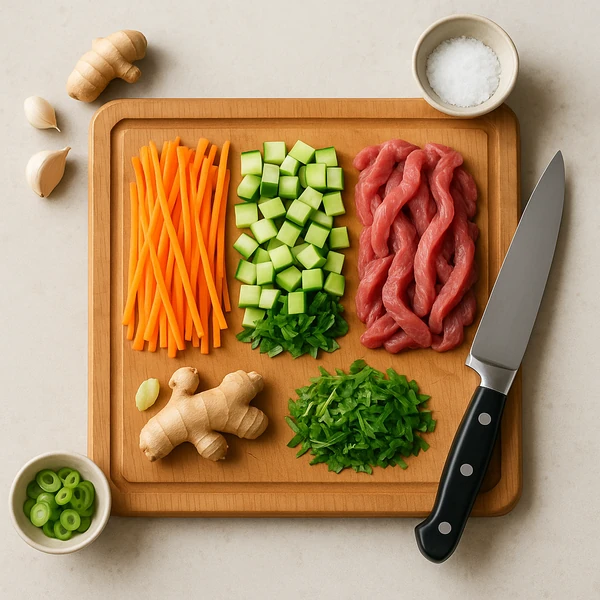
For many Asian dishes, the outcome is decided not on the pan but already on the cutting board. The size, thickness, and especially the uniformity of the cuts affect the cooking speed, texture, and whether different ingredients cook evenly. This guide summarizes practical rules and typical mistakes in cutting vegetables, meat, and herbs – so you cook more confidently and without unnecessary dead ends.
Why the decision in Asian cooking happens already on the cutting board
In many Asian kitchens, ingredient preparation (cutting, separating components, timing) is as important as the cooking itself. If the preparation is poor, not even a good sauce or a quality pan can save the dish: some ingredients overcook, some remain tough, some release water, and instead of a lively dish, you get a stewed mixture.
The reason is simple: many techniques are quick and work with a short timeframe. A typical example is the wok and stir-fry (fast frying while stirring). The “window” in which the dish has the right texture is often measured in minutes. The more uneven the cutting, the more you have to improvise during cooking – and the easier the rhythm falls apart.
What “well cut” means: size, thickness, and uniformity
Good cutting isn’t about fancy shapes. It’s mainly about control over how ingredients behave under heat and in sauce.
- Size: smaller pieces cook faster, larger ones require longer time (stewing, baking, grilling). Choosing the wrong size means either things won’t cook through or will overcook.
- Thickness: affects how quickly heat penetrates the ingredient’s center. For meat, in fast cooking methods, thinner slices are more important than thicker ones.
- Uniformity: key word. Even great ingredients only turn out average if some parts are in small pieces and others in large chunks. Uniformity makes cooking predictable.
Practically: for one dish, ensure that pieces of the same ingredient type behave similarly (vegetables of similar hardness have similar size; meat has similar thickness; herbs have similar “delicacy”).
Knife, cutting board, and working rhythm: minimal equipment that changes the result
A common mistake when equipping for “Asian cooking” is buying based on exotic impression. A more meaningful approach is to consider function: in cutting and preparation, the biggest differences are knife sharpness, stable cutting board and comfortable transferring of ingredients. These affect the result far more than a collection of specialties.
Sharp universal knife vs. wide “Chinese cleaver” (and why there is confusion around it)
For home Asian cooking, the practical minimum is:
- a sharp universal / chef’s knife,
- a larger stable cutting board,
- optionally a second smaller knife for more detailed work.
If you are tempted by the “Chinese cleaver,” it’s good to know one thing: many imagine it simply as a heavy tool for bones. In reality, Chinese-style cooking often uses lighter and more versatile wide knives, which are not primarily for bones but for cutting vegetables, meat, herbs, tofu – and also for transferring chopped ingredients from the cutting board to the pan. In other words, the “Chinese cleaver” is not necessarily just one category of use.
Cutting board, bowls, and transferring ingredients: mise en place the Asian way
For quick techniques, it pays to consider work organization. It helps to have:
- a larger cutting board, where your ingredients don’t pile up in a heap,
- several smaller bowls for separated components (or at least a “zone” on the board),
- a simple way to transfer to the pan (e.g. a wide blade to scoop up ingredients).
It’s not a formality: when you mix hard and soft components and deal with the sauce only during cooking, you usually end up with overcooked vegetables and undercooked pieces.
Cutting must match the technique: wok, soup, salad, grill, and fillings
This is a key rule: the same ingredient isn’t cut the same way for different cooking methods. You need a different cut for wok, another for soup, another for cold dishes, and another for fillings.
For wok and stir-fry: smaller and uniform cuts
- Choose rather smaller and uniform pieces.
- For meat in fast cooking, thinner sliceswork better.
- Consider vegetables according to hardness and cooking time: those that take longer should have cuts that allow this, and often a different order when adding to the pan.
- Avoid large piecesthat won’t cook through in the short time.
Practical test: if for the same dish you would have to remove some ingredients and finish others, the cut is probably too uneven.
For soups and broths: what goes into the base and what into the finished bowl
In soups and broths, it’s useful to distinguish two roles:
- the base – aromatics can be larger and more robust (the goal is to release flavor into the liquid),
- final toppings – can be more delicate, to be easy to eat and feel fresh.
If you cut everything finely and cook it from the start, you easily lose the freshness and texture you want in the finished bowl.
For salads and cold dishes: delicacy, tenderness, and dressing retention
For cold dishes and salads, important is ease of consumption and how the shape affects the dressing’s behavior. The cut’s shape can determine whether the dressing "coats" the ingredient and stays on it or runs off and the flavor becomes flat.
For grilling and baking: pieces must withstand longer cooking time
For longer techniques, the logic is opposite to wok: pieces must endure the time without drying out or falling apart. Also watch that thin parts don’t cook (or burn) before thick parts.
For dumplings, pancakes, and fillings: to hold together but not be mush
For fillings, the aim is for the mixture to hold together, but also have texture. The cut must not end in a uniform paste without character – and at the same time can’t be so coarse that the filling falls apart and is hard to shape.
🍜 Dryness, moisture, and surface of ingredients: why wet ingredients spoil the wok (and when it doesn't matter)
Cutting is only part of preparation. Equally important is the ingredient’s surface – especially its moisture.
When too much moisture is a problem:
- in wok and stir-fry,
- in tofu,
- in mushrooms,
- in meat that should brown,
- in vegetables that should stay crisp and not be stewed.
A typical beginner’s mistake is putting ingredients into the pan right after washing. In fast cooking, instead of frying, you often get a stewing effect.
When moisture is not a problem or is desired:
- in broth bases,
- in stewing,
- in steaming,
- in some fillings and doughs,
- in ingredients cooked in sauce.
Practical rule: always first clarify whether you want to fry, or cook/stew. Decide how much drying is needed accordingly.
👃 Herbs and aromatics: how to cut to keep aroma (and avoid unnecessary loss)
Asian cuisines often rely on aroma – herbs and fresh aromatics are not just decoration but part of the flavor. Therefore, it’s worth understanding that herbs are not used in one universal way: sometimes they form the base, elsewhere they are the final touch. This also affects how to handle them when cutting.
Coriander leaves: both leaves and stems matter
Coriander leaves are among the most important herbs in Asian cooking and are used across dishes (soups, salads, stir-fry, dips, sauces, final garnish). An important detail: stems often have even more flavor than leaves, so it makes sense to use both – keeping in mind that leaves are more delicate and stems more “carrying.”
Basils: sweet basil, Thai basil, and holy basil are not perfectly interchangeable
In Asian cooking, you often find several types under the name “basil”:
- sweet basil is more versatile and milder,
- Thai basil has an anise-like tone and retains flavor better when heated,
- holy basil tends to be peppery and sharper.
In practice, this means it’s not just about “cutting basil somehow,” but also about when and where you want it in the dish. Some basils are better for wok dishes and curries, others as a fresh final herb – and this affects whether you cook it longer or protect it as the last fresh touch.
Perilla and shiso: strong leaves that also serve as edible "wrappers"
Korean perilla and Japanese shiso are strongly aromatic leaves that can function as herb, spice, and edible wrapper. In Korea, perilla is used in wraps, soups, pickling, and stewed dishes; in Japan, shiso often provides a refreshing contrast to rice, fish, and fried dishes. This is a useful reminder even for cutting: sometimes the right choice is not to cut finely, but to work with the leaf so it serves as a separate layer in a bite.
The most common mistakes that spoil the result most (and how to fix them)
- Cutting "by eye" regardless of technique. Fix: first clarify whether you are cooking wok/stir-fry, soup, salad, stewing, grilling, or filling – and adjust cutting accordingly.
- Too large differences in size. Fix: cut in batches and consistently check if pieces are similar; for mixed vegetables, separate harder and softer components.
- Cutting only during cooking. Fix: prepare ingredients and workspace in advance. With fast techniques, it often makes the difference between "fresh and seared" vs. "rushed and stewed."
- Throwing wet ingredients into the pan. Fix: for wok/stir-fry, consider the surface and drying (especially for tofu, mushrooms, meat, and vegetables you want to sear rather than stew).
- Insufficient separation of hard and soft components. Fix: cut and set aside separately those that behave differently (e.g. aromatics vs. tender vegetables vs. protein).
- Mixing up cuts for salad with cuts for wok. Fix: for cold dishes, focus on fineness and dressing adherence; for wok, focus on speed and uniformity.
- Underestimating sauce and starch preparation. Fix: when you know the dish will be quick, prepare seasoning and thickening in advance so cooking doesn’t break down into improvisation.
- Working in a crowded and untidy place. Fix: clear a space and set up an ingredient storage system (bowls/zones) to avoid mixing different stages.
- Poor hygiene of knife and cutting board. Fix: monitor tool cleanliness and workflow logic (especially when switching between different ingredients and preparation stages).
What to take away from the article
- For many Asian dishes, the outcome is decided already on the cutting board: size, thickness, and especially cutting consistency directly affect texture and evenness.
- The most important rule is: cutting must match the technique (wok vs. soup vs. salad vs. grill vs. fillings).
- For fast techniques, surface moisture is equally important – wet ingredients often end up stewed instead of seared.
- With herbs and aromatics, it pays to know their role in the dish: sometimes they form the base, other times a final fresh touch – and adjust handling accordingly.
- The minimum that changes the outcome is not an exotic set: it is a sharp knife, a stable cutting board, and good work organization.
[The main article image will be added according to editorial workflow.]

Read next
If you want to explore this topic further, continue with these related blog guides and articles:
