

 Česky (CZK)
 Slovensky (EUR)
 Deutsch (EUR)
 Austria
 Belgium
 Bulgaria
 Croatia
 Denmark
 Estonia
 Finland
 France
 Germany
 Greece
 Hungary
 Italy
Italy Latvia
 Lithuania
 Luxembourg
 Netherlands
 Poland
 Portugal
 Romania
 Slovenia
 Spain
Spain Sweden










Coconut oil
🥥 Coconut oil: how to choose it and how to use it in Asian cooking
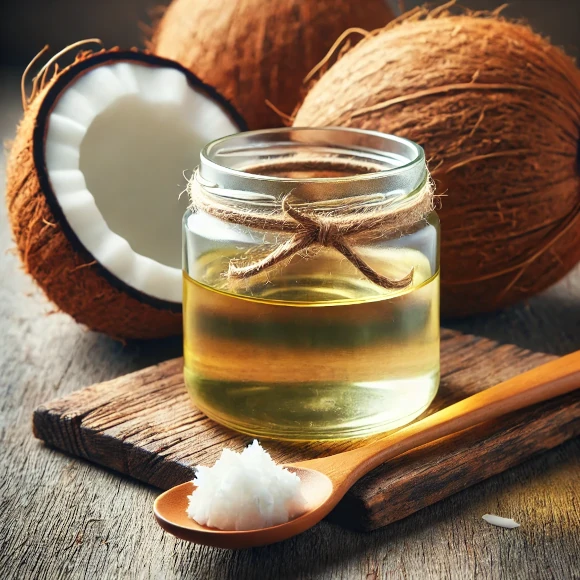
Coconut oil is a quiet MVP in Asian cooking: it can add a soft coconut aroma, handle bold spices, and work as a reliable fat for stir-fries, curries, and desserts. It’s not “magic in a jar” — it’s simply a useful cooking fat with a clear personality.
Shop Asian ingredients at Taste Of Asia.
💡 Tip: Want your curry or stir-fry to taste more “restaurant” with minimal effort? Start by blooming paste/spices in oil. The fat does most of the heavy lifting.
🕰️ Origin and background
Coconut palms are native across Southeast Asia and coastal regions, as well as parts of India and Sri Lanka. Wherever coconuts are common, coconut milk, coconut cream, and coconut oil naturally become everyday pantry staples — for frying, sautéing, and sweets.
A simple rule works well: if a cuisine cooks with coconut, coconut oil will usually make sense. Sometimes for flavor (virgin), sometimes for neutrality and versatility (refined).
🧪 Types and processing
You’ll usually see two main styles:
- Virgin — more coconut aroma and flavor. Great for desserts, porridge, coconut-forward curries, and anywhere you want those notes to show.
- Refined — more neutral. Ideal for everyday stir-frying, wok cooking, and recipes where you don’t want coconut to dominate.
It’s normal for coconut oil to solidify and melt depending on room temperature. That’s a feature, not a flaw.
Useful categories for coconut cooking: Oils and Coconut milk & cream.
👃 Flavor profile
- 🥥 Virgin: noticeable coconut aroma, gently sweet impression, pairs nicely with curry pastes, vanilla, chocolate, and rice.
- ⚪ Refined: cleaner, more neutral — great when you want the dish (not the oil) to lead.
- 🔥 Best results come from using it to bloom aromatics (pastes/spices) before adding liquids.
✅ Tip: With virgin coconut oil, a small amount goes a long way. It can easily overpower delicate ingredients.
🍳 Best uses in Asian cooking
🔥 Stir-fry and wok
For wok cooking, refined coconut oil is often the safest pick: stable, not too aromatic, and it keeps up with fast cooking.
🍛 Curries, soups, sauces
For curry, the “pro move” is simple: bloom the curry paste in coconut oil first, then add coconut milk. It tastes rounder and more fragrant. Check Curry pastes and coconut milk.
🍚 Rice and coconut vibe
A teaspoon stirred into hot rice can add a soft aroma and richer mouthfeel. Browse rice in Rice & rice products.
🍫 Baking and desserts
Virgin coconut oil shines in cookies, brownies, coconut balls, creams, and granola — it’s a fat that actually contributes flavor.
🥗 Cold uses
Because it solidifies, it’s less common in cold dressings. If you want it in a dip, treat it like butter: soften, whip, then combine.
🫶 Practical note
Coconut oil is still a fat. The best way to think about it is as a flavor and cooking tool. Often, less is more, especially with virgin coconut oil.
If you have specific dietary goals, always check labels and choose what fits your routine best.
✅ How to choose
- Want coconut flavor? Choose virgin.
- Want a neutral everyday cooking fat? Choose refined.
- Smell test: clean/coconut = good, stale/rancid = no.
- Storage: sealed, dry, away from sun/heat.
🛒 Our picks
- KTC 100% Coconut oil 500 ml — a versatile coconut oil for cooking, baking, and quick stir-fries.
- Chaokoh Coconut milk 18% 1 l — a classic for curries, soups, and sauces when you want creamy coconut body.
- Mae Ploy Red curry paste 400 g — the shortcut to Thai curry: oil + paste + coconut milk = done.
🍛 Recipe: Quick Thai red curry with coconut oil
This is exactly where coconut oil makes sense: bloom the paste in oil and your curry tastes deeper within minutes.
Ingredients (2 servings)
- coconut oil 1–2 tbsp
- red curry paste 1–2 tbsp
- coconut milk 400 ml
- chicken or tofu 250–300 g
- vegetables 1 cup
- fish sauce or soy sauce 1–2 tsp
- sugar pinch + lime
- jasmine rice to serve
Method
- Heat coconut oil and bloom curry paste for 20–30 seconds over medium heat.
- Add chicken/tofu, stir briefly.
- Pour in coconut milk, add vegetables.
- Simmer 8–10 minutes.
- Season and finish with lime.
- Serve with jasmine rice.
✅ Tip: Let it rest for 2 minutes before serving — aromas settle and flavors integrate.

Recommended products1
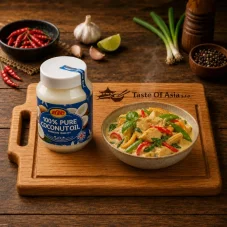
KTC 100% Coconut Oil 500 ml
Read next
If you want to continue with the same topic, here are more related articles to explore: