


 Česky (CZK)
 Slovensky (EUR)
 Deutsch (EUR)
 Austria
 Belgium
 Bulgaria
 Croatia
 Denmark
 Estonia
 Finland
 France
 Germany
 Greece
 Hungary
 Italy
Italy Latvia
 Lithuania
 Luxembourg
 Netherlands
 Poland
 Portugal
 Romania
 Slovenia
 Spain
Spain Sweden










Bowls, chopsticks, and Asian-style serving: what makes sense and why
Asian dining is not just about "pretty tableware." Bowls, chopsticks, and soup spoons change how the food is eaten, how it retains temperature, how sauce or broth is ladled – and often even how sharing at the table naturally works. In this guide, you will align the basic types of bowls and chopsticks, their practical differences, and a few simple rules that will make you feel confident at home (without the stress of excessive formality).
🍽️ Introduction: serving is not decoration, but part of flavor and comfort
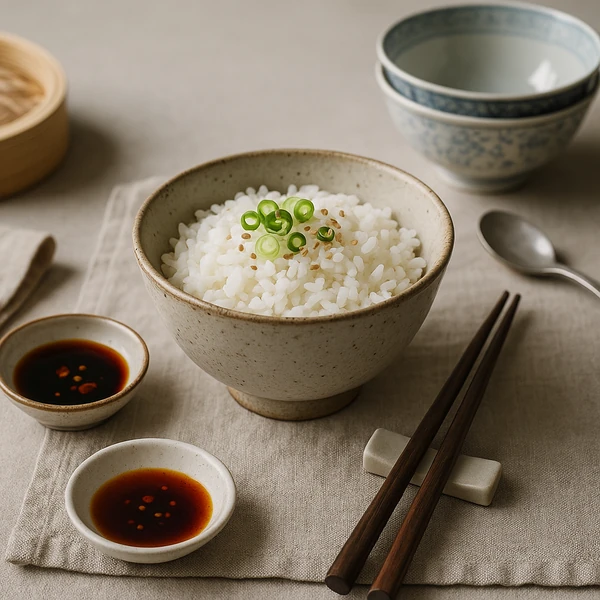
It is tempting to think of bowls and chopsticks as an "Asian accessory" meant to impress. In reality, the shape and serving method influence how the food is perceived and how well it is eaten. A bowl retains heat, allows comfortable combination of rice, sauce, broth, and side dishes, and naturally supports working with chopsticks and spoons. Similarly, chopsticks are not one universal thing – they vary in length, tip, material, and what they are suited for.
An important framework: it doesn't make sense to get a "complete Asian set" just because it looks exotic. It is practical to think by function – and serving is one of those functions that shows right away with the first meal.
🍽️ What exactly does "Asian-style serving" mean (and why sharing is so common)
In many parts of Asia, dining is not centered around one large personal plate per person. More common is the logic of multiple bowls and side dishes, shared serving dishes, and gradual tasting. It is not just about rules of polite behavior – food often functions as a shared experience, a space for hospitality, and a way to build relationships at the table.
This setup also reflects in the tableware: smaller bowls for individuals, larger bowls in the center of the table, tools for convenient serving, and habits that prevent chaos during shared meals (who takes when, how to serve yourself, how to be considerate).
Bowls: why they are so practical and which type to choose by dish
Many Asian dishes are eaten from bowls not because it is "traditional," but because it is functional. A bowl holds heat and allows several components of a dish to be combined in one space so they can be easily taken and mixed.
Bowls as the "frame" of a meal: rice is no longer just a side dish
In the European concept, rice is often just a side. In Asian logic, rice can be the very structure of the dish – for example, as a base of one bowl complemented by a topping (rice + something on top) or as a quick, filling bowl that stands on its own. It is especially clear with "urban rice bowls" (e.g., Taiwanese style rice with sauce or toppings) how a bowl can be a small, quick, but flavorfully intense main dish.
Bowls for broths and noodles: heat, liquid, and eating pace
For broths and noodle dishes, the bowl serves as a container for liquid, sides, and noodles. The result is a different way of eating: alternating bites from the solid part and sips of broth, easily "mixing" the ideal ratio.
Smaller bowls and side dishes: why they are useful at home too
Serving "in multiple bowls" is not just for big family dinners. It also makes sense at home to have smaller bowls for individual parts (rice, something juicy, something crispy, sauce) – this makes sharing easier and also facilitates eating with chopsticks, because smaller bites grip better in a bowl than on a flat plate.
🍳 Chopsticks are not all the same: length, shape, and practical use
Chopsticks differ by country and purpose. For home orientation, it is useful to distinguish mainly two situations: cooking chopsticks and eating chopsticks.
Cooking (longer) chopsticks: safer handling of hot food
Longer cooking chopsticks are practical for frying and handling hot food. They allow flipping, transferring, and "grabbing" individual pieces without having to reach close to the pan or oil. This is not about aesthetics but about control and safety.
Eating chopsticks: differ by region and ergonomics
Eating chopsticks may be shorter, longer, blunter, or sharper depending on the country. The material can also differ. Practical consequence: some chopsticks support more delicate work with smaller bites, others can handle a "robust" style. Therefore, it is good to choose ones that fit your hand and match the type of dishes you eat most often.
Japan and Korea as examples: same chopsticks? No
Japanese dining emphasizes delicacy and respect for the service: chopsticks should not be used roughly and food should be taken considering how it was served. Korea is specific in that besides chopsticks, a spoon plays a big role – and Korean metal chopsticks have different ergonomics than the wooden variants used elsewhere.
Soup spoon: an inconspicuous item that really helps with broths
For broths, noodle dishes, and some desserts, wide soup spoons have practical significance. They are not decoration: they allow scooping liquid and small pieces, speeding up eating without mess. Combined with chopsticks, a simple division of roles makes sense: chopsticks pick up solid parts, spoon works with broth and small bits.
How to serve and share food at home: simple rules that work
Etiquette in Asian cuisine is not mainly about "strict prohibitions." It is about making sharing at the table flow smoothly and considerately. At home, you can adopt a few principles that will immediately improve the atmosphere and practical aspect of dining.
1) With shared meals, first take a portion for yourself
From a shared bowl, it is common first to take some onto your own smaller plate or bowl. This helps hygiene and prevents confusion in the middle of the table. It is also more practical: then you take bites from your "own" bowl calmly and without competing.
2) Take calmly, not aggressively – and be aware of the "last piece"
In shared service, it is inappropriate to grab food aggressively, reach over others, or take without regard for the table's pace. The last piece or portion may be culturally sensitive – as a general principle, it works well to offer to others or ensure they have taken some already.
3) Use chopsticks precisely – and as a sign of respect
The most important chopstick rules are surprisingly practical: use chopsticks calmly and precisely, don't point with them, and respect that they are not just a tool but also a cultural signal. In many situations, this shows respect to the host, others at the table, and the food itself.
Most common mistakes and misunderstandings (and how to avoid them)
- I buy equipment based on the "exotic impression." The most common mistake is the feeling that "Asian cuisine" requires a complete set of tools. It is much more practical to address function: what improves my serving and dining for the meals I eat most often.
- I treat chopsticks as a universal item. They differ in length, tip, and whether they are meant for eating or cooking. If you choose a type that doesn't fit you, you'll feel like "chopsticks are difficult" – often it's just a bad choice.
- I use chopsticks in a way considered inappropriate. Key general prohibitions: do not point with chopsticks, do not stick them vertically into rice, do not use them as a knife or fork for "skewering," do not directly pass food from one chopstick to another, and do not move plates or bowls with chopsticks on the table. These actions are often linked to ritual associations, so they seem strongly inappropriate.
- With shared food, I eat "from platter to mouth." A safe rule is first to take a portion for yourself and only then eat.
- "Rice is just a side, so I'll put it aside on a plate." In many Asian styles, rice is the frame of the dish – and the bowl is a natural way to combine it with sauce, topping, or broth.
What to take away from the article
- Bowls, chopsticks, and spoons are not decorations – they change comfort, food temperature, and how flavors and textures combine.
- Chopsticks are not universal: there are cooking (longer) and eating chopsticks, and they vary regionally too (e.g., Japanese delicacy vs. Korean spoon role).
- Wide soup spoon makes immediate practical sense with broths and noodles.
- Shared serving works best when you first take for yourself, act considerately, and respect basic chopstick "taboos."
- Choose equipment based on what you really eat and cooknot on the impression that you need a complete Asian set.

Read next
If you want to explore this topic further, continue with these related blog guides and articles:
