


 Česky (CZK)
 Slovensky (EUR)
 Deutsch (EUR)
 Austria
 Belgium
 Bulgaria
 Croatia
 Denmark
 Estonia
 Finland
 France
 Germany
 Greece
 Hungary
 Italy
Italy Latvia
 Lithuania
 Luxembourg
 Netherlands
 Poland
 Portugal
 Romania
 Slovenia
 Spain
Spain Sweden










Wok hei and high temperature: why food from a wok tastes different (and what you can replicate at home)
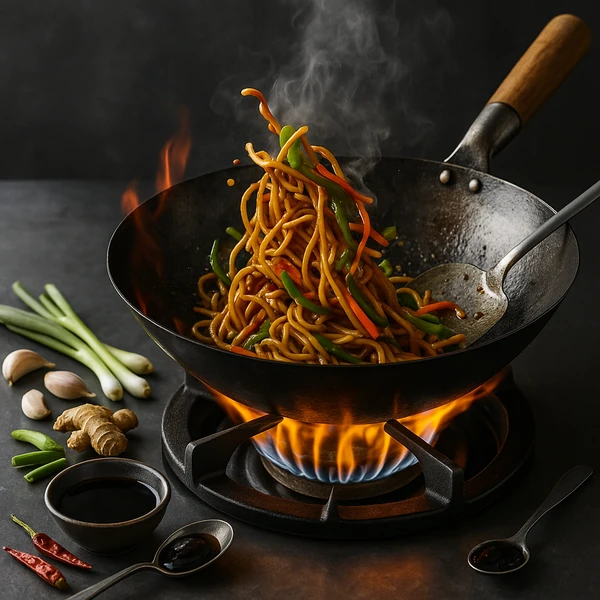
In Asian cooking, it's often not just the choice of ingredients that matters, but the way heat is managed. The wok and very high temperatures create a character that people describe as "wok hei" – the typical impression of quick, intense searing. In the article, we compare what this really means in practice, why the wok is different from a regular pan, how home and professional conditions differ, and how to get the most out of high heat even on a regular stove.
Why high temperature is so important in Asian cuisine
Asian cuisines are not defined only by sauces and ingredients. Equally important is the management of heat, steam, fat, broth, and texture. In practice, this means that the same ingredient can taste completely different depending on whether you:
- quickly and intensely sear it in a wok,
- slowly simmer it in broth,
- steam it,
- or fry it in oil.
High temperature is especially key for quick techniques like stir-fry (rapid frying with constant stirring). It’s not just about "speed." It’s about how the high heat helps create a typical texture (crispy on the outside, juicy inside), while keeping vegetables fresh and holding the sauce together without overcooking.
🌶️ What is wok hei (practically) and how it relates to wok design
The term wok hei is used to describe the character of the food created with really intense work on a hot wok. In a home context, it makes sense to understand it mainly as the result of proper work with high heat: quick searing in the center, controlled moving of ingredients to milder zones, and discipline in preparation.
Why is it related specifically to the wok? The wok’s shape is like a shallow bowl that concentrates the heat into the center and at the same time allows shifting food up the sides. This has several consequences:
- The center is extremely hot and is meant for quick searing.
- You can quickly sear food and at the same time push it aside to milder zones on the sides.
- One part of the pan can actively "cook," while the other can briefly wait without burning..
- With the right technique, you often manage with less fat, because the cooking is quick and purposeful.
There is also a practical historical aspect around the wok: it spread not only because of flavor, but also because it helped save fuel and shorten cooking time.
What are the "types" of high temperature: wok, stove type, and realistic alternatives
High temperature in a wok isn't just about turning the knob to the maximum. In home conditions, you need to be realistic: on weaker electric or induction cookers, a classic round wok may not work as people imagine it does in professional kitchens.
Wok: when it makes great sense and when it reaches limits
The wok is a very powerful tool when you want to cook in a style that uses temperature zones and quick movement of ingredients. However, if your heat source cannot maintain sufficient power, you might end up "steaming ingredients in their own juice" instead of searing.
Therefore, in home settings, the choice of design and appropriateness is often considered: it makes sense to think about the shape of the bottom and the material to match your stove. In typical home kitchens, a flat bottom (instead of round) and material that heats up quickly are often mentioned as practical choices.
Pan as an "honest" alternative when you want performance and predictability
If you don't have conditions at home where a wok really runs "at maximum," a quality wider pan can deliver more predictable performance: it has controlled contact with the heat source and can heat up better outside the center. This doesn’t mean you're cooking badly or "inauthentically." It means you understand the limits of your equipment and adjust accordingly:
- portion sizes,
- work pace,
- and order of steps.
How to get the most out of high heat at home (without a recipe, but concretely)
Stir-fry is a fast technique that requires discipline. If you want the food to really sear (and not cook in its own juice), it helps to follow a few practical rules:
1) Prepare everything in advance (mise en place)
At high temperatures, there is no time to look for sauce, cut more onion, or defrost meat when the wok is already hot. That’s why it makes sense in wok cooking to have:
- ingredients chopped,
- liquid components measured and ready,
- and a clear space at the stove to quickly add and move ingredients.
2) Cutting is not a detail: it’s a "time setting"
Asian techniques emphasize cutting before cooking. The reason is simple: at high heat, a few seconds make the difference. If you cut some ingredients too thick and others too thin, the result becomes uneven: some parts remain raw, others get over-dried, some release water before they can sear.
A practical tip: try to ensure pieces in one pan "wave" have similar thickness and searing time. If that’s not possible, divide the cooking into several short steps.
3) Work with temperature zones, not just a single surface
A strength of the wok is that the center is hottest while the sides are milder. In practice, you use this by:
- searing quickly in the center what requires fierce contact with heat,
- and pushing ingredients that are done to the sides so they don’t continue aggressive searing.
This way, part of the pan actively works, and part "waits." In a pan without marked zones, you achieve a similar effect by cooking in smaller batches and maintaining a stable temperature.
4) Watch the volume: an overcrowded vessel kills high temperature
One of the most common reasons for "lack of flavor and no searing" is putting too large a batch at once. Once you add too many ingredients to a hot vessel, the temperature drops and instead of searing, ingredients soften and release water. The practical solution: cook in smaller batches and combine parts only at the end.
A wok isn’t just for stir-fry: where high heat helps and where it harms
A common misunderstanding is that the wok is only for quick frying. In reality, it is more versatile: it can do stir-fry, boil, braise, poach, fry, and with a rack and lid, even steam.
It’s important to distinguish when high heat is truly an advantage and when another technique is better. For example, for broths and soups, gentle simmering instead of aggressive boiling often makes sense: it helps extract flavor, keep broth clear, and preserve ingredient structure. Typically this applies to dashi, phở, ramen bases, Korean tang and jjigae, as well as Chinese broth soups and braised dishes.
The point: high heat is a great tool but not a universal answer to everything. In Asian cooking, often the winner is the one who knows how to alternate intense techniques with slow and precise ones.
Most common mistakes and misunderstandings (and how to fix them quickly)
- "I get wok hei automatically just by having a wok." No. It depends on managing heat, temperature zones, and discipline. If your heat source can’t keep up, adjust portions and pace or use a quality pan.
- "A round wok is always the best." Not necessarily. On some home stoves, a shape that better fits the cooking surface and transfers heat effectively might make more sense.
- "If it doesn’t burn and sizzle, it’s not right." Intensity is not a goal in itself. The goal is quick searing without unnecessary steaming or burning.
- "Wok is only for stir-fry." The wok is a versatile vessel and often helps with boiling, braising, or steaming. If high heat doesn’t work well for you, it doesn’t mean the wok "makes no sense."
- "Asian cooking is mainly about ingredients." Ingredients are important, but the technique often determines whether the food feels "right." This is especially evident with a wok.
What to take from the article
- High temperature is a tool in Asian cooking, which significantly changes texture and flavor impressions, but it must be used purposefully.
- The wok works differently than a pan, because it concentrates heat in the center and allows work with temperature zones.
- "Wok hei" in home practice is mainly based on discipline: preparation, cutting, small batches, and working with zones.
- Home conditions have limitations – sometimes a quality pan is better than a wok that doesn’t get hot enough outside the center.
- The wok is not just for stir-fry: it’s equally important to know when it’s better to choose a slower technique (e.g. gentle simmering of broth).

Read next
If you want to explore this topic further, continue with these related blog guides and articles:
