


 Česky (CZK)
 Slovensky (EUR)
 Deutsch (EUR)
 Austria
 Belgium
 Bulgaria
 Croatia
 Denmark
 Estonia
 Finland
 France
 Germany
 Greece
 Hungary
 Italy
Italy Latvia
 Lithuania
 Luxembourg
 Netherlands
 Poland
 Portugal
 Romania
 Slovenia
 Spain
Spain Sweden










The most common mistakes when cooking with a wok (and how to quickly fix them at home)
A wok can give food speed, aroma, and a pleasant "seared" quality – but only when its logic is respected. At home, the most frequent mistakes are: not enough heat, overcrowded pan, wrong order of ingredients, or too much sauce. In this article, you'll find a practical guide on how to recognize these problems and what to do to make stir-fry work reliably even without a professional burner.
Why mistakes with the wok are so common: technique in Asian cuisine is not a detail
In Asian cooking, it often doesn’t only matter what you cook, but mainly how you work with it: with heat, steam, fat, broth, and texture. This is especially apparent in the wok – the difference between "quickly seared" and "braised" happens in a few minutes and is usually not about the recipe but about discipline in the process.
The wok makes sense mainly where you want short and intense heat treatment (typically stir-fry). But if you apply the same approach to food that requires a different logic (for example, longer, gentle simmering), the result will seem flat or "broken" – even if you use great ingredients.
🌶️ What’s different about the wok: temperature zones, movement, and realistic expectations at home
The wok is iconic precisely because it concentrates the heat in the center, allows quick movement of ingredients, and naturally creates different temperature zones. This is a big advantage: some ingredients can be seared quickly and intensely, while others just "finish" on the side without completely stopping the cooking pace.
At the same time, it’s useful to be realistic: in homes with a regular stove, the classic wok may not perform the same as in a professional kitchen. In such situations, it often makes more sense to adapt to conditions – for example, by choosing the appropriate wok shape and material, or even using a wider pan for a more predictable contact with the heat source.
Pan as a full alternative (not a "defeat")
On a weaker stove, a well-heated wider pan can deliver more predictable performance than a wok that doesn’t get hot outside the center. The result is often paradoxically more "wok-like" (quick stir-frying, better searing) because you’re not cooking in the steam of your own juices.
It is important to understand the equipment limits and adapt portion sizes and working style. This is often the fastest way to fix recurring mistakes without needing to change the entire kitchen.
Stir-fry at home: a simple workflow that prevents most problems
Stir-fry is a quick technique but not "random." Most mistakes happen even before you turn on the stove: in preparation, cutting, and trying to improvise at the moment when the wok demands pace.
1) Prepare everything in advance (mise en place)
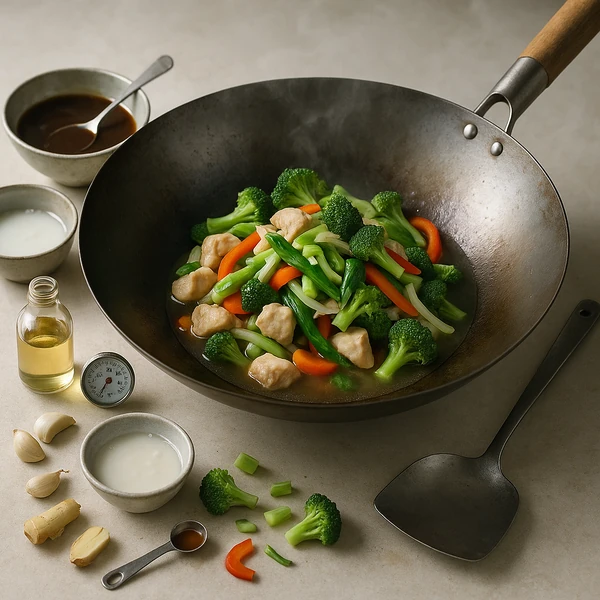
In quick stir-frying, individual steps happen in short intervals. Therefore, prepare ingredients beforehand so that during cooking you only add, stir, and check the status. In practice, it helps to divide things into several piles or bowls depending on when you want to add them.
- things that need more time
- things that are cooked briefly
- delicate ingredients that must not overcook
- sauce (if used) separately
2) Cutting is not cosmetic – it determines time and texture
Asian cooking techniques put great emphasis on cutting in advance because with short and intense procedures, the cooking "doesn’t forgive." If the pieces vary in size, some will overcook and others will remain hard – even if everything else is done correctly.
Practical rule: cut so that ingredients that should be done at the same time have similar "cook times." It’s not about one universal thickness but consistency within the particular pan.
3) Derive the order of ingredients from their fragility
One of the most common mistakes is the wrong ingredient order. A safe way at home is to follow this simple logic: what needs more time and heat goes earlier; what easily breaks down or overcooks goes later and only briefly.
This rule is also useful with tofu: different textures behave completely differently. For example, silken (very soft) tofu is fragile and not suitable where you’ll stir aggressively or flip it – while firmer tofu handles the pan much better.
The most common mistakes in cooking with a wok (and what to do differently)
The mistakes below repeat across Asian techniques but are most visible with the wok. Each includes a practical "fix" that works in home conditions.
1) Overcrowded wok or pan
How to recognize it: instead of stir-frying, the ingredients steam, release water, soften before they can sear, and the whole dish tastes more "boiled" than "seared."
How to fix it: cook in smaller batches. If you cook for several people, it’s often better to make two quick batches than one large one that drops the temperature and breaks the texture. On a home stove, this is one of the biggest differences between average and good results.
2) Insufficiently heated wok
How to recognize it: ingredients "start slowly," lie in the pan without reaction, and you tend to add time – losing freshness and crunch.
How to fix it: start only when the wok is really ready for quick work. Stir-fry depends on short time and higher intensity – if you start with a lukewarm wok, the entire process shifts to braising mode.
3) Wrong order of ingredients
How to recognize it: some pieces are overcooked and others undercooked, delicate things fall apart, aromatic components either aren’t noticeable or easily "get lost" in too long a process.
How to fix it: follow their "fragility" and cook time. If unsure, split the process: quickly sear part of the ingredients, remove, do the next batch, then quickly combine at the end. This is common practice with the wok to keep texture control.
4) Cooking delicate things too long
How to recognize it: herbs and delicate green parts lose character, fragile ingredients break or become "rubbery," and the dish seems tired.
How to fix it: add delicate ingredients later and give them only a short heat contact. If working with fragile textures (typically very soft tofu), expect that aggressive stirring will break them – and adjust both cutting and movement intensity in the pan accordingly.
5) Too much sauce in stir-fry
How to recognize it: instead of quick coating, a "soup" forms in the pan, ingredients soften and lose seared notes. The dish is tastewise strong but texturally uniform.
How to fix it: treat the sauce as seasoning and binding, not as the main volume. Add it gradually and stop when ingredients are just lightly coated and the wok doesn’t turn into braising. If you want more "juice," it's often better to handle it outside the wok (e.g., separately prepare a base) than pour a large amount of liquid into the stir-fry.
6) Underestimating preparation and cutting beforehand
How to recognize it: in stress you catch up cutting during cooking, the wok meanwhile burns some ingredients or cools down, and the process falls into improvisation.
How to fix it: regard preparation as part of the technique. In quick processes, "preparation in advance" is what makes the dish clean, fresh, and technically confident. If you feel overwhelmed, the problem is not the wok – the problem is the plan.
7) Wrong oil temperature when frying in the wok (when using the wok like a deep fryer)
How to recognize it: the result is unnecessarily greasy or, on the contrary, burnt on the outside and underdone inside.
How to fix it: if you fry in the wok, ensure it’s a stable and controlled technique – frying is a different discipline than stir-fry. If you lack conditions for sure temperature control, it’s usually better to choose another procedure than "something in between."
8) Trying to apply one technique to food that needs a different logic
How to recognize it: trying to "make ramen in a wok" or accelerate soup stock with a rapid boil – and the result lacks depth, clarity, and proper structure.
How to fix it: accept that Asian cuisine isn’t just fast wok. Besides stir-fry, there is a strong world of broths and slow simmering, suitable for dishes like dashi and Japanese soups, phở and other Vietnamese broths, ramen bases, Korean tang and jjigae, or Chinese broth soups and braised dishes. Choosing the right technique for the right dish removes half of "wok problems."
What to take away from the article
- The wok is not just a vessel – it’s a technique of working with temperature, time, and texture. In Asian dishes, it often decides whether the result feels "right."
- The most common mistakes are practical: overcrowded pan, insufficiently heated wok, wrong ingredient order, overcooked delicate things, and too much sauce.
- At home, realism is important: sometimes a well-heated wide pan does a better job than a wok that doesn't heat evenly outside the center.
- Stir-fry requires discipline in preparation: prepare everything in advance, cut considering cook times, and plan order by ingredient fragility.
- Don’t try to "solve everything with the wok": some dishes rely on gentle simmering and long broths, not on quick stir-frying.

Read next
If you want to explore this topic further, continue with these related blog guides and articles:
