


 Česky (CZK)
 Slovensky (EUR)
 Deutsch (EUR)
 Austria
 Belgium
 Bulgaria
 Croatia
 Denmark
 Estonia
 Finland
 France
 Germany
 Greece
 Hungary
 Italy
Italy Latvia
 Lithuania
 Luxembourg
 Netherlands
 Poland
 Portugal
 Romania
 Slovenia
 Spain
Spain Sweden










Order of ingredients in a wok: simple logic that determines both flavor and texture
Cooking in a wok (stir-fry) is a fast technique at high temperature. That's exactly why the 'throw everything in at once and stir' approach doesn’t work: some ingredients would burn, others would remain raw, and often instead of sautéing, the food would start to steam. In this article, you'll find practical logic for sorting ingredients ahead of time and putting them into the wok in the right order to achieve a clean flavor and good texture.
Why the order of ingredients matters more in a wok than in regular cooking
In many Asian cuisines, technique is not just a “kitchen detail” – it often determines whether a dish feels precise and authentic or flat and unclear. Wok and stir-fry are typical for working quickly, at a high temperature and with precise timing. This has a direct consequence: when the rhythm is lost (you chop on the fly, don’t measure the sauce, ingredients are piled together), the wok will “punish” you faster than slower methods.
Wrong order or poor preparation usually leads to:
- aromatics (e.g., garlic, ginger) burning before the rest cooks,
- parts of the dish being raw while others are overcooked,
- ingredients releasing water and steaming instead of sautéing,
- the sauce not coating the dish evenly and the result looks “messy”.
What exactly stir-fry means and what makes a wok “different”
Stir-fry (quick sautéing with constant movement) is a technique that needs discipline: everything prepared, the pan/wok heated, and the portion adjusted to the cooker's power. It's not just about speed. It's about the fact that in such a short time you cannot "make up" for mistakes – the order of ingredients is part of the technique itself.
Wok has the advantage of concentrating heat in the center while also creating different temperature zones. Because of this, you can intensely sauté some ingredients and temporarily push others to cooler spots. At home, however, it's useful to be realistic: if the wok outside the center doesn’t get hot enough, you need to adjust portion sizes and the tempo of adding ingredients.
Two key “variants” that change the order: type of vessel and swapping stir-fry with sauté
Wok vs. wide pan: when the order behaves differently
At home, a good wide pan can be a very realistic alternative. On a weaker stove, it can provide more predictable performance than a wok that doesn’t heat well outside its center. The practical effect on ingredient order is simple: in a pan, you can often maintain a more stable temperature over a larger contact area, while in a wok you need to watch more carefully, how much you put in at once and how quickly you work with it.
Stir-fry vs. sauté: similar in appearance, different in practice
In European cooking, stir-fry is sometimes confused with sauté, but stir-fry typically works with higher temperature, faster work and often with a different volume of food. For ingredient order, this means: in stir-fry, the "right minute" is really short. What you can still forgive in sauté (late added aromatics, irregular vegetable pieces) can easily result in burning or unnecessary steaming in the wok.
🍜 Practical logic of order: how to divide ingredients and when to add them to the wok
The most reliable way not to get lost in the wok is to divide ingredients according to how fast they cook through and how easily they burn. This is not a “universal recipe” – it’s an order that gives you control.
1) Start with a plan (not a knife): mise en place that makes sense
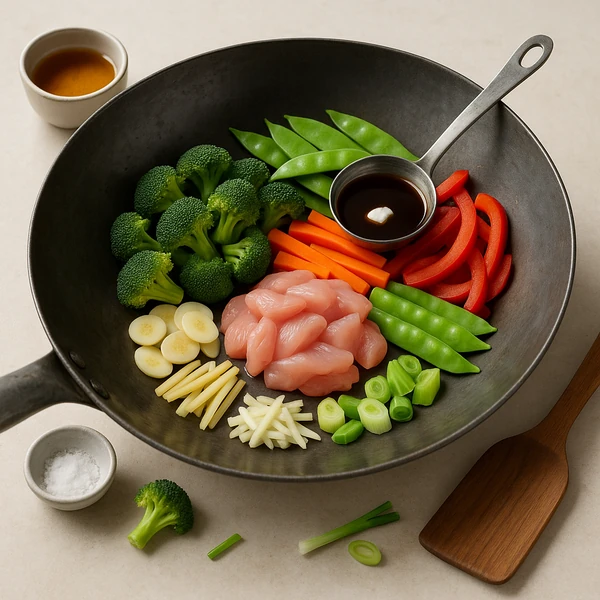
With fast techniques, there’s no time to look for more ingredients or mix starch. Prepare ingredients so you can add them in clear groups. Practically, it works to separate:
- aromatics (things that give the base aroma and burn easily),
- protein component (meat, tofu, etc.),
- hard vegetables,
- softer vegetables,
- leafy and delicate components,
- finishing elements (what should stay fresh or only briefly pass through heat),
- sauce and starch (prepared separately).
This division matters mainly because each group needs different time. When everything is mixed up, typically you end up with aromatics overcooked/burnt and the rest underdone.
2) Cutting must match the wok: same pieces, fast heat
In a wok, the outcome is often decided on the cutting board. Shape and size change cooking time and texture – for stir-fry it’s crucial to cut so ingredients cook within the same "window."
- Uniform small pieces help ensure nothing burns or stays raw.
- Large pieces require a longer time – then it’s often better to cut them smaller or cook in smaller batches by groups.
- Irregular cuts can work, but you must realize thinner parts will be done sooner (and can easily overcook in the wok).
3) Actual order in the wok: from the most sensitive bases to quick finishing
Specific dishes vary, but for home stir-fry it’s practical to follow this framework (adjusting to your ingredient and stove power):
- Aromatics go first, but only for a short contact with heat. The goal is to perfume, not to brown to bitterness. If you know you’ll have many more steps in the wok, it’s better to keep aromatics really short and move on quickly.
- Protein component typically needs continuous time on heat. A practical trick is to watch volume: if you put too much in the wok at once, it loses heat and starts “cooking in its own juice” instead of sautéing.
- Hard vegetables (those that need longer to soften) take priority over soft ones. In fast cooking, it’s common that harder components get a little extra time, while delicate ones are added at the end.
- Softer vegetables come later because they should be done quickly and not fall apart.
- Leafy and delicate components belong at the finish – often a quick wilt is enough.
- Sauce and starch should be prepared separately and added when the main ingredients are almost done. It is practical to have starch mixed in advance (usually mixed separately) so lumps don’t form in the wok and everything combines quickly.
- Finishing elements come last – their purpose is contrast and freshness. This logic fits with a general rule about ingredient choice: some distinct oils make the most sense when finishing a dish, not as a universal frying oil.
If you cook on lower heat, it helps to work in smaller batches: briefly sauté part of the ingredients, temporarily remove them, and combine at the end. This is not “cheating,” but adjusting the technique to real home conditions.
💡 What to watch out for: the most common mistakes that break order and result
"I’ll just put everything in and it will cook itself"
In the wok, this usually means only one thing: different cooking times merge into a compromise that is no good for anything. The result feels like a mixture without clear texture: some parts are too soft, some undercooked, and aromatics are burnt or on the contrary lack flavor.
Unprepared mise en place (cutting, starch, sauce) = lost rhythm
In stir-fry it’s common that the dish is done in several short steps. When you are looking for ingredients, cutting, or mixing starch during cooking, often something in the wok overcooks. Here the saying is literal: preparation doesn’t start with a knife, but with a plan.
Too large portion and “steaming” instead of sautéing
Once there is too much ingredient, the wok/pan loses heat and excess moisture has nowhere to escape quickly. The result is a softer, less distinct dish tasting differently than expected from stir-fry. The solution is usually simple: reduce the portion or cook by groups.
Wrong sauce choice: not knowing if you buy a “base” or already seasoned product
With Asian ingredients, there is often confusion that the same category exists as a basic building block and as a pre-prepared (seasoned) product. This matters for wok: the base gives you more control over flavor and timing, the seasoned product can be practical, but you need to know what to expect from it.
A simple rule helps: read the label and look at the first ingredients listed (they are in descending order by weight). From the label, you often see whether the product is based on fermented ingredients or mostly water and flavorings. This helps you better predict how the sauce will behave in the wok and what role it should play in the dish.
What to take away from the article
- The order of ingredients in the wok is not a formality: it’s part of the technique based on high heat, speed, and precise timing.
- The biggest difference is made by mise en place: separate aromatics, protein, hard and soft vegetables, delicate components, finishing elements, and have sauce and starch prepared separately.
- Cut so ingredients cook within the same short window – in the wok, mistakes on the cutting board cannot be "made up."
- Take home conditions realistically: if power is insufficient, smaller portions or cooking by groups help; a good pan can be better than a wok that doesn’t heat outside the center.
- For sauces, it’s worth knowing whether you’re working with a base or a seasoned product – and read the label, because the ingredient order hints at what to expect from the flavor.

Read next
If you want to explore this topic further, continue with these related blog guides and articles:
